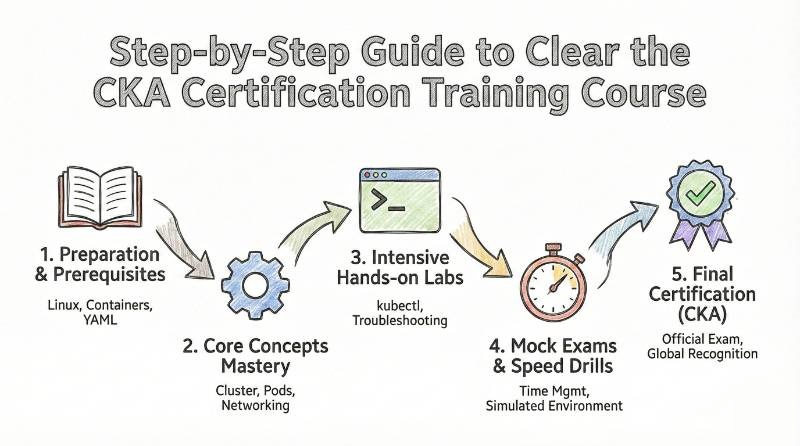
In the modern world of software delivery, managing containerized applications has shifted from being a niche skill to an absolute necessity. Having watched the industry move from physical data centers to virtualized clouds, and now to distributed ecosystems, it is clear that Kubernetes is the engine driving this change.
The Certified Kubernetes Administrator (CKA) program is more than just a certificate. It is proof that you can handle the complexities of a production-grade cluster. This guide is designed to help engineers and managers in India and across the globe understand how to master this platform and advance their careers.
Global Certification Master Table
Before diving into the specifics of Kubernetes, here is an overview of the professional tracks available to help you map out your long-term career growth.
| Track | Level | Who it’s For | Prerequisites | Skills Covered | Recommended Order |
| Kubernetes | Administrator | DevOps/Cloud Engineers | Linux & Docker Basics | Cluster Setup, Networking, Storage | 1st (Core) |
| DevOps | Professional | Software Engineers | Coding, Git | CI/CD, IaC, Pipelines | 2nd |
| DevSecOps | Specialist | Security Engineers | DevOps Basics | Auditing, Compliance, Security | 3rd |
| SRE | Reliability | Ops Leads | DevOps Professional | SLOs/SLIs, Monitoring | 4th |
| AIOps | Advanced | Data & Ops Leads | Python | AI/ML in Operations | 5th |
| FinOps | Management | Managers & Leads | Cloud Basics | Cost Optimization, Budgeting | 6th |
The Complete Guide: Certified Kubernetes Administrator (CKA)
What it is
The CKA is a performance-based exam that tests your ability to install, configure, and manage production-ready Kubernetes clusters. It is not a multiple-choice test; you are given a command-line interface and real problems to solve within a set time limit.
Who should take it
- System Administrators looking to transition into the cloud-native space.
- Software Engineers who want to understand how their code runs in production.
- DevOps Professionals who need to automate infrastructure management.
- IT Managers who lead teams working with containerized stacks.
Skills you’ll gain
- Cluster Configuration: Bootstrapping clusters using tools like
kubeadm. - Workload Management: Deploying applications and managing their lifecycle.
- Network Policies: Setting up secure communication between services.
- Storage Solutions: Configuring persistent volumes for data-driven apps.
- Advanced Troubleshooting: Identifying and fixing node and pod failures.
Real-world projects you should be able to do after it
- Design and build a multi-node Kubernetes cluster from scratch.
- Secure a cluster using Role-Based Access Control (RBAC).
- Automate the scaling of applications based on real-time traffic.
- Perform live cluster upgrades with zero downtime for the users.
Preparation Plan
7–14 Days (Intensive Review)
- First 4 Days: Master the “Core Concepts.” Focus heavily on the API primitives and the control plane.
- Next 5 Days: Practice imperative commands using
kubectl. Speed is vital in the exam. - Final 5 Days: Run through mock exams. Focus on the areas where you lose the most time.
30 Days (Balanced Pace)
- Week 1: Focus on Linux fundamentals and understanding container runtimes.
- Week 2: Installation and Configuration. Build a cluster multiple times.
- Week 3: Deep dive into Networking and Storage.
- Week 4: Troubleshooting labs and fine-tuning your time management skills.
60 Days (Comprehensive Mastery)
- Month 1: Focus on the theory. Read the official documentation and build small local labs.
- Month 2: Practice advanced scenarios. Build clusters “the hard way” to understand the networking layer deeply. Focus on mock exams in the final two weeks.
Common Mistakes
- Typing Errors: Small typos in YAML files can waste 15 minutes of exam time.
- Ignoring Documentation: Not knowing exactly where to find example YAML files in the official K8s docs.
- Context Confusion: Forgetting to switch to the correct cluster context before running a command.
- Over-Engineering: Trying to write complex YAML when a simple imperative command would work.
Best next certification after this
Once you have mastered the administration side, the Certified Kubernetes Security Specialist (CKS) is the best next step to focus on hardening your clusters.
Choose Your Path: 6 Strategic Learning Tracks
To stay ahead in the industry, you should align your Kubernetes knowledge with a specific career path:
- DevOps Path: Focus on integrating K8s with CI/CD tools to speed up software delivery.
- DevSecOps Path: Prioritize security by learning how to scan images and secure the supply chain.
- SRE Path: Focus on keeping systems stable, managing error budgets, and improving observability.
- AIOps/MLOps Path: Learn how to deploy machine learning models at scale using Kubernetes clusters.
- DataOps Path: Focus on the infrastructure needed to support large-scale data pipelines and databases.
- FinOps Path: Focus on managing the costs of running Kubernetes in the cloud and optimizing resource usage.
Role → Recommended Certifications Mapping
- DevOps Engineer: CKA + Certified DevOps Professional.
- SRE: CKA + SRE Certified Professional.
- Platform Engineer: CKA + Certified DevOps Architect.
- Cloud Engineer: CKA + Master in Cloud (AWS/Azure) DevOps.
- Security Engineer: CKA + DevSecOps Certified Professional.
- Data Engineer: CKA + DataOps Certified Professional.
- FinOps Practitioner: CKA + FinOps Certified Professional.
- Engineering Manager: CKA + Certified DevOps Manager.
Top Institutions for CKA Training
These organizations provide the structured learning and lab environments necessary to succeed.
DevOpsSchool
As a premier institution in the DevOps and Cloud ecosystem, DevOpsSchool is widely recognized for its high-intensity, mentor-led programs. They prioritize a “learn-by-doing” methodology, dedicating over 70% of the course to hands-on labs. This focus on practical troubleshooting and real-world project scenarios ensures that students are not just exam-ready, but industry-ready. Their lifetime learning management system (LMS) access and strong alumni support network make them a top choice for serious career growth.
Cotocus
Cotocus specializes in bridge-the-gap training that connects individual technical skills with enterprise-level architecture. They are an excellent option for senior engineers and managers who need to understand how Kubernetes integrates into complex, multi-cloud environments. Their curriculum often includes advanced sessions on scalability and governance that go beyond the standard CKA syllabus.
Scmgalaxy
Known primarily as a community-centric hub, Scmgalaxy offers an incredible repository of technical tutorials and troubleshooting guides. Their training approach is deeply rooted in solving real-world challenges, making it perfect for engineers who want to understand the “under the hood” mechanics of Kubernetes. It is a fantastic place for continuous learners who value deep technical documentation and peer support.
BestDevOps
BestDevOps is highly recommended for busy working professionals. They offer streamlined, efficient learning paths that focus on the core competencies required to master the CKA exam quickly. Their training is designed to be concise and effective, cutting through the noise to deliver the essential knowledge needed for day-to-day Kubernetes operations.
devsecopsschool
For those looking to specialize in security, devsecopsschool is the gold standard. They integrate security-first principles into every module of their Kubernetes training. You’ll learn how to harden clusters, manage secrets, and ensure compliance—skills that are increasingly mandatory in the modern DevSecOps landscape.
sreschool
If your goal is to transition into a Site Reliability Engineering role, sreschool provides the specialized focus you need. Their CKA training emphasizes observability, high availability, and incident response, teaching you how to maintain the long-term health and performance of distributed systems.
aiopsschool
Aiopsschool is the leader for forward-thinking professionals interested in the intersection of AI and operations. Their curriculum includes insights into how AI-driven automation can be applied to Kubernetes management, preparing you for the next generation of intelligent infrastructure.
dataopsschool
Managing data-intensive workloads on Kubernetes requires a specific set of skills. Dataopsschool focuses on the intricacies of stateful applications, persistent storage, and data pipeline orchestration, making it the top choice for Data Engineers and Architects.
finopsschool
As cloud costs become a primary concern for leadership, finopsschool teaches you the financial side of Kubernetes. Their training focuses on cost optimization, resource allocation, and budget accountability, enabling you to drive both technical and financial efficiency in your organization.
Next Certifications to Take
After you clear your CKA, consider these three directions:
- Same Track: Certified Kubernetes Security Specialist (CKS) to become a security expert.
- Cross-Track: Terraform Associate to master Infrastructure as Code (IaC).
- Leadership: Certified DevOps Manager (CDM) to move into a strategic leadership role.
Career Outcome & Strategy FAQs
- Is the CKA exam very difficult? It is challenging because it is hands-on. If you practice your commands, it is very manageable.
- How long should I study? For most people, 4 to 8 weeks of consistent study is enough.
- What are the prerequisites? You should have a basic understanding of Linux and how containers work.
- Should I take CKA or CKAD? CKA is better for those who want to manage infrastructure. CKAD is better for developers.
- Is this certification valuable today? Yes, Kubernetes is the standard for cloud-native applications globally.
- How long does the certificate last? It is valid for 2 years before you need to renew it.
- Can I use help during the exam? You can access the official Kubernetes documentation during the test.
- What happens if I fail? Most vouchers include one free retake, so you can try again if you don’t pass the first time.
- Will this help me get a raise? Most certified professionals report a significant increase in salary and job offers.
- Do I need to know coding? You don’t need to be a software developer, but being comfortable with YAML and basic scripts helps.
- Is CKA enough to get a job? It is a great start, but combining it with other tools like Terraform or Jenkins makes you much more hireable.
- Can managers benefit from this? Absolutely. Understanding how the platform works helps you make better decisions for your team.
CKA Training FAQs
- What makes the DevOpsSchool training different? The focus is on practical, mentor-led labs rather than just watching videos.
- Will I get to work on real projects? Yes, the training includes scenarios that mimic real-world production issues.
- Is the training available online? Yes, we offer flexible online batches for professionals in India and globally.
- Do you provide mock exams? We provide simulated environments that look and feel just like the actual CKA exam.
- What tools will I learn besides Kubernetes? You will also get comfortable with Linux, Docker, and various networking tools.
- Is there any support after the course? Yes, we have a community of alumni and experts who help each other with technical questions.
- Can I ask questions during the training? Yes, our sessions are interactive, allowing you to get immediate help from instructors.
- Is the course recognized by companies? Yes, our training is respected across the industry for producing high-quality engineers.
Conclusion
The journey to becoming a Certified Kubernetes Administrator is a defining step in a modern technical career. In my years of experience, I have found that the most successful engineers are those who don’t just chase a certificate, but seek out deep, hands-on knowledge.
By choosing an institution that aligns with your specific career path—whether that is Security, SRE, or Financial Management—you are doing more than just preparing for an exam; you are future-proofing your career. Kubernetes is the foundation of the modern cloud, and mastering it today ensures you will be the one leading the transformations of tomorrow.