Introduction
Every enterprise today relies heavily on data to shape commercial strategy, fuel customer-facing software, and train predictive machine-learning models. However, as organizations race to adopt cloud architectures, streaming platforms, and sprawling analytics ecosystems, keeping those pipelines healthy has become an uphill battle. Legacy data management techniques frequently buckle under pressure, triggering fragile pipelines, undetected quality flaws, tedious manual deployment cycles, and communication silos across departments.
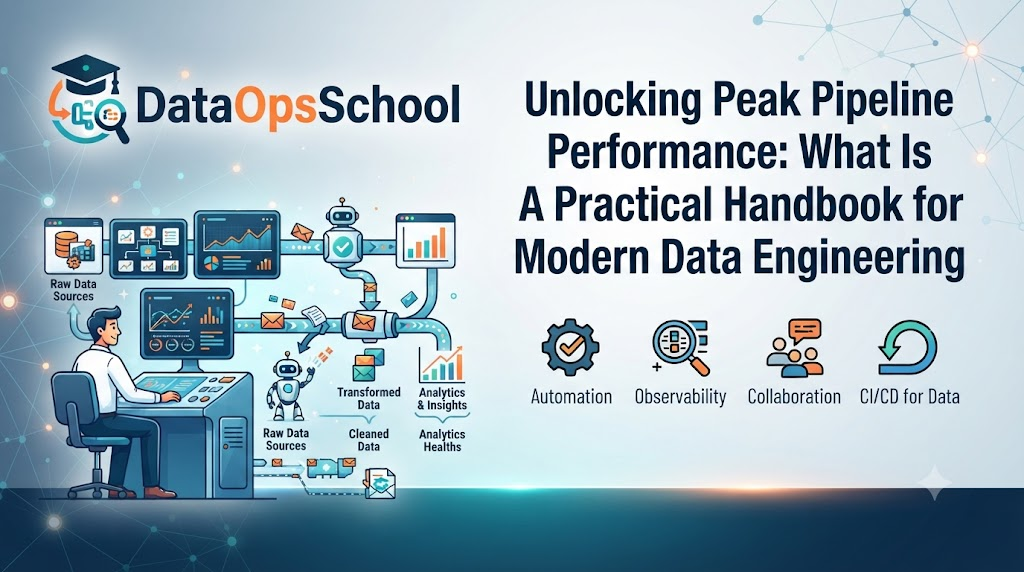
When data breaks silently, downstream executive dashboards display faulty metrics, machine-learning models ingest corrupt training features, and stakeholders rapidly lose confidence in analytics. Fixing these recurring breakdowns demands a fundamental overhaul of operational culture and engineering standards. This precise challenge brings What is DataOps to the forefront of modern data strategy. DataOps unites cross-team collaboration, automation, rigorous testing, governance, and continuous delivery to streamline how information moves from raw ingestion points to real business value.
What Is DataOps?
What is DataOps? Fundamentally, DataOps represents a fusion of cultural mindsets, technical practices, and automated workflows designed to bridge data engineering, integration, quality assurance, security, and operations. It borrows heavily from Agile software development and DevOps principles, reshaping them to fit the unique life cycle of data assets.
Managing data is vastly different from writing standard software code. While traditional software development focuses primarily on static application logic, data pipelines must constantly adapt to shifting volumes, unpredictable upstream schema drift, fluctuating third-party sources, and intricate state dependencies. DataOps addresses these realities through continuous integration, automated delivery, robust version control, deep observability, governance frameworks, and tight feedback loops. By treating data pipelines with the same operational rigor applied to core software products, engineering teams guarantee dependable, friction-free data delivery.
Why DataOps Matters for Modern Data Teams
Today’s data professionals face a daily barrage of operational bottlenecks. They juggle complex multi-cloud data flows, unannounced schema updates from upstream systems, and chronic data quality failures. Many organizations still rely heavily on manual deployment steps, which triggers sluggish release cycles, frequent pipeline outages, and immense stress during production incidents.
Adding to the complexity, regulatory mandates are stricter than ever, while communication gaps frequently isolate data engineers, analysts, and business leaders. Without proper operational discipline, maintaining dependable data products becomes an uphill battle. DataOps practices replace reactive firefighting with structured automation, reliable testing suites, and crystal-clear ownership lines, helping teams catch issues before they impact downstream users.
Core Principles of DataOps
An effective DataOps operating model rests on several fundamental principles designed to introduce speed, predictability, and trust into data workflows.
- Collaboration: Breaking down organizational walls so data engineers, software developers, data scientists, and business analysts share joint ownership of data reliability.
- Automation: Eliminating manual intervention across ingestion, transformation, testing, and deployment to minimize human error and accelerate delivery cycles.
- Continuous Improvement: Leveraging retrospective analyses, feedback mechanisms, and performance metrics to constantly refine pipelines.
- Data Quality: Embedding continuous validation rules throughout every stage of the pipeline to flag anomalies, missing values, and schema mismatches early.
- Version Control: Storing all pipeline code, configuration files, and transformation scripts in version-controlled repositories with comprehensive history tracking.
- Testing: Applying automated unit, integration, and regression testing specifically tailored to data assets, mirroring standard software development practices.
- Observability: Moving beyond basic uptime monitoring to track data freshness, volume trends, lineage paths, and pipeline health in real time.
- Reproducibility: Designing workflows so that data transformations and model training routines can be consistently re-executed across different environments.
- Governance: Weaving security, access controls, and data lineage tracking directly into the pipeline lifecycle without slowing down deployment velocity.
- Faster and Reliable Delivery: Streamlining the journey of data products from initial development to production with minimal friction and maximum confidence.
What Does DataOps Training Teach?
Transitioning toward an operationalized data culture requires intentional skill development. A comprehensive DataOps Training program helps professionals master the intersection of software automation, data engineering, and operational excellence.
Learners dive into pipeline architectures, the complete data lifecycle, CI/CD mechanisms tailored for data assets, automated testing frameworks, and advanced data quality management. Training also covers workflow orchestration, monitoring, observability, compliance enforcement, and troubleshooting methodologies. Crucially, effective programs blend conceptual theory with hands-on practice, equipping engineers and architects to build resilient systems that foster seamless cross-team collaboration.
How to Choose a DataOps Course
Selecting the right learning pathway is a vital milestone for career progression. When evaluating a DataOps Course, professionals should carefully examine curriculum depth, the availability of hands-on labs, and the real-world experience level of the instructors.
An ideal course covers contemporary toolchains, navigates common production friction points, and includes practical assessments to verify knowledge retention. Learners should also consider whether the pacing fits their schedule, whether the content targets beginner or advanced tiers, and how well the material aligns with corporate training standards or professional growth objectives.
Creating a Practical DataOps Tutorial
A valuable DataOps Tutorial provides clear, step-by-step guidance through a simplified end-to-end workflow, helping practitioners visualize how various technical components interact in practice.
A practical tutorial typically walks through sample data ingestion, basic transformation logic, version control management, automated validation checks, and pipeline execution monitoring. By illustrating how automated testing and deployment procedures handle simulated pipeline failures, tutorials give practitioners a risk-free environment to master incident recovery and operational troubleshooting.
DataOps Tools and the Modern Data Toolchain
Tools act as the backbone of any successful DataOps strategy, enabling teams to automate repetitive tasks and maintain deep visibility across complex architectures. However, tool selection must always follow organizational needs rather than industry fads.
The modern data toolchain encompasses version control systems, CI/CD runners, integration tools, orchestration engines, transformation frameworks, cloud databases, streaming services, container platforms, and underlying infrastructure. Additional specialized tools focus heavily on monitoring, observability, data quality enforcement, and governance. A cohesive toolchain supports an integrated operating model rather than creating fragmented technical islands.
How to Build an Effective DataOps Toolchain
Assembling a high-performing toolchain requires a careful audit of existing infrastructure, data throughput, pipeline complexity, and the core skill sets of the team. Organizations need to evaluate their cloud strategy, security protocols, governance constraints, and system integration requirements prior to adopting new software.
Maintenance overhead and scalability are crucial considerations; introducing an excessive number of niche tools often leads to integration bloat and tool fatigue. The ultimate goal is to choose technologies that mesh seamlessly, deliver robust observability, and empower teams to distribute trusted data efficiently.
DataOps Certification and Professional Development
As enterprises mature their data engineering operations, professionals increasingly look for credible ways to validate their expertise. Earning a DataOps Certification demonstrates a practitioner’s deep grasp of operational principles, workflow automation, quality assurance, and governance frameworks.
Certification should always complement practical, hands-on field experience rather than act as a substitute for it. It signals to peers and employers that an individual understands how to apply engineering rigor to data workflows, maintain high operational awareness, and design scalable architectures.
The Role of a Certified DataOps Engineer
A Certified DataOps Engineer concentrates heavily on the day-to-day execution, automation, and stability of data pipelines. Their daily responsibilities include constructing robust workflows, authoring automated test suites, configuring CI/CD pipelines, and establishing real-time monitoring alerts.
Certified engineers troubleshoot pipeline breakdowns, enforce strict data quality standards, and integrate diverse technologies across the data stack. They act as critical operational bridges, collaborating closely with data creators, analytics professionals, and machine-learning teams to safeguard overall pipeline reliability.
The Role of a Certified DataOps Architect
While engineers focus primarily on pipeline execution and tool management, a Certified DataOps Architect maps out the overarching data platform vision. Their responsibilities center on enterprise-wide platform architecture, scalability patterns, security frameworks, and major infrastructure decisions.
Architects define foundational platform standards, establish enterprise operating models, enforce comprehensive governance, and balance cost against operational performance. They maintain a holistic view of the organization to design resilient foundations capable of supporting secure, observable, and dependable data operations at scale.
DataOps Consulting for Organizations
Many enterprises hit performance bottlenecks when trying to scale their data operations independently. Organizations frequently turn to DataOps Consulting when confronting recurring pipeline failures, poor data quality, sluggish manual deployments, or a complete absence of observability.
Consultants help resolve governance complexities, simplify convoluted toolchains, steer cloud migrations, and bridge internal skill gaps. Effective consulting engagements always start with an exhaustive assessment of business requirements and current operational habits before recommending technical adjustments or tool replacements.
Understanding DataOps Services
Professional DataOps Services assist organizations in designing, building, and refining their operational ecosystems. These professional offerings typically span data platform evaluations, custom pipeline development, CI/CD automation rollouts, data quality enhancement frameworks, and observability integrations.
Additional service offerings often encompass governance alignment, platform optimization, operational support, team enablement, and managed support arrangements. These services allow businesses to fast-track their operational maturity while ensuring internal teams acquire the knowledge necessary for long-term self-sufficiency.
DataOps vs DevOps
Although DataOps shares a common lineage with DevOps, they govern entirely distinct domains. DevOps focuses primarily on software code bases, infrastructure provisioning, and application deployment lifecycles. DataOps adapts these core philosophies—such as automation, cross-functional collaboration, continuous delivery, testing, and continuous feedback—specifically for data-centric workflows.
DataOps accounts for the unique realities of data environments, including stateful dependencies, schema drift, strict freshness constraints, and analytical validation. It is not merely a rebranding of DevOps, but a specialized discipline tailored precisely to modern data engineering challenges.
DataOps and Data Quality
Data quality serves as the lifeblood of any data-driven operation. Ingesting massive volumes of data at high speeds provides little benefit if the underlying information contains errors, missing attributes, inconsistencies, or delays.
DataOps embeds automated data quality checks directly into the pipeline execution path. By validating data types, enforcing constraints, tracking value distributions, and mapping data lineage, teams can spot anomalies instantly. Catching these issues early prevents corrupted data from contaminating downstream business reports and machine-learning models, protecting executive decision-making.
DataOps and Observability
Traditional monitoring alerts a team when a scheduled pipeline job succeeds or fails, but it rarely explains why downstream dashboards display incorrect insights. Data observability goes much deeper, tracking pipeline health, data freshness, schema adjustments, execution latency, and granular data quality signals in real time.
Comprehensive observability empowers data teams to investigate root causes rapidly, trace data lineage across intricate transformations, and dispatch targeted alerts long before business stakeholders notice discrepancies in their reporting.
DataOps for Governance and Security
Security and governance can never be treated as afterthoughts within modern data environments. DataOps practices harmonize with governance frameworks by baking access controls, clear data ownership definitions, and auditability directly into the deployment pipeline.
Automated data lineage tracking, strict environment isolation, secure secrets management, and uniform policy enforcement help organizations satisfy compliance requirements without sacrificing agility. Treating governance as an intrinsic component of pipeline development ensures security without creating bureaucratic speed bumps.
How to Build a DataOps Learning Path
Embarking on a career in data operations demands a structured, step-by-step approach to skill acquisition. A successful educational journey typically follows a clear progression beginning with fundamentals and advancing toward enterprise architecture.
- Data Fundamentals: Gaining a solid grasp of core database structures, SQL query optimization, cloud storage fundamentals, and basic data engineering concepts.
- DataOps Concepts: Understanding the cultural mindset and operational philosophies that bridge agile delivery principles with data pipelines.
- Pipeline Development: Learning how to ingest, transform, and orchestrate data flows using industry-standard frameworks.
- Automation: Mastering scripting languages, workflow schedulers, and infrastructure-as-code foundations.
- Testing: Writing effective unit and integration test suites for data transformations and schema validations.
- CI/CD: Building continuous integration and deployment pipelines specifically designed for data code and configuration files.
- Observability: Setting up monitoring dashboards, logging systems, lineage trackers, and notification alerting mechanisms.
- Governance: Integrating security protocols, access permissions, and compliance guardrails into day-to-day workflows.
- Advanced Architecture: Designing scalable, enterprise-grade data platforms and sustainable operating models.
Blending theoretical instruction with hands-on lab exercises and real-world troubleshooting guarantees that learners develop practical, job-ready capabilities.
Common Mistakes Organizations Make When Adopting DataOps
Organizations diving into operational transformations frequently fall into predictable traps. One major mistake is treating DataOps as a pure software procurement exercise rather than a cultural and procedural evolution. Automating broken or inefficient processes only leads to faster, more catastrophic failures.
Other frequent pitfalls include overlooking data quality validation, skipping automated testing routines, ignoring pipeline observability, and failing to establish clear data ownership. Many teams buy popular tools before understanding their actual operational requirements, or they neglect to train their staff properly, expecting an overnight transformation. Avoiding these missteps requires prioritizing people and processes first, backed by thoughtful technology choices.
How DataOpsSchool Can Help
Organizations and practitioners seeking to sharpen their expertise can explore specialized platforms dedicated to advancing data operations. DataOpsSchool.com offers a robust set of resources focused on DataOps training, certifications, consulting, and professional services tailored for modern data teams.
The platform structures its offerings around practical, hands-on labs, role-based learning paths, data quality frameworks, governance models, CI/CD pipelines, automated testing, observability, and modern data architectures. With role-based certification options including Certified DataOps Engineer and Certified DataOps Architect, professionals can validate their practical competencies using real-world playbooks, templates, and labs designed for modern data stacks.
The Future of DataOps
The data operations landscape continues to evolve at a rapid pace. Horizon developments highlight an increasing reliance on AI-assisted data operations, automated data quality remediation, advanced observability tooling, and cloud-native data platforms.
Platform engineering for data is gaining significant momentum, encouraging teams to treat internal data platforms as true product offerings. As real-time data streaming expands and machine-learning operations converge with traditional data engineering, DataOps will remain the vital discipline enabling organizations to deliver reliable, trusted data at scale.
Conclusion
As companies become increasingly reliant on data to steer corporate strategy and power user experiences, the demand for strong operational discipline has never been higher. Successful DataOps relies on a careful equilibrium among people, processes, and technology, demonstrating that tools alone cannot solve organizational challenges.
By embracing cross-functional collaboration, automation, rigorous testing, governance, and continuous improvement, engineering teams can construct resilient pipelines that deliver high-quality data reliably. Professionals and organizations exploring these practices can look to resources like DataOpsSchool.com to guide their ongoing journey through DataOps training, certification, consulting, and professional services.



Leave a Reply
You must be logged in to post a comment.