Introduction
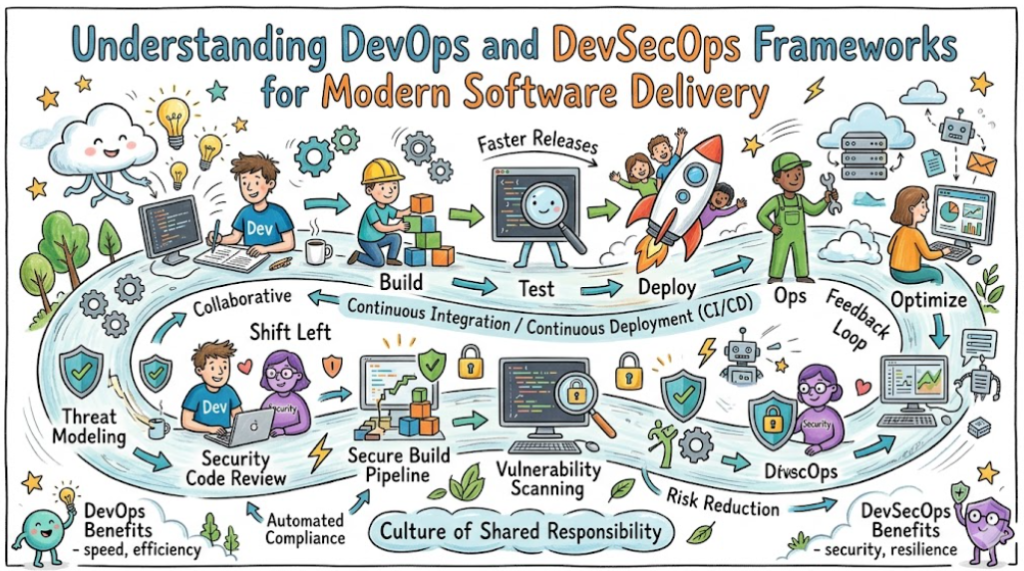
The landscape of software delivery has shifted dramatically over the last decade. Gone are the days of long development cycles punctuated by infrequent, manual deployments. Modern enterprises now demand rapid, iterative updates to remain competitive. This shift gave rise to DevOps, a cultural and technical methodology that broke down the silos between software developers and IT operations.
However, as organizations accelerated their release velocity, a critical challenge emerged: security often lagged behind. Traditional security models, which relied on end-of-lifecycle testing, became a bottleneck in high-speed CI/CD environments. This tension between speed and security necessitated a new approach, leading to the rise of DevSecOps—the integration of security practices directly into the development and operations lifecycle.
Whether you are a student, a developer, or an engineering manager, understanding the nuances between these two paradigms is vital. For those looking to master these methodologies, platforms like DevOpsSchool provide structured learning paths to navigate the complexities of cloud-native infrastructure and security. By integrating security as a core component of the pipeline, organizations can ensure that their velocity does not come at the cost of stability or vulnerability.
What Is DevOps?
DevOps is more than just a set of tools; it is a philosophy that emphasizes collaboration, communication, and automation. At its core, DevOps aims to shorten the systems development life cycle and provide continuous delivery with high software quality.
In a traditional setup, developers wrote code and threw it over the wall to operations teams, who were then responsible for deployment and maintenance. This often led to friction, finger-pointing, and slow release cycles. DevOps bridges this divide by aligning the goals of both teams.
Core Philosophy
- Culture: Moving away from silos toward shared responsibility.
- Automation: Replacing manual processes with scripts and CI/CD tools.
- Continuous Improvement: Using data and monitoring to refine the process.
For example, a major e-commerce platform using DevOps practices can push hundreds of code updates daily without manual intervention, thanks to automated build and deployment pipelines.
What Is DevSecOps?
DevSecOps stands for Development, Security, and Operations. It is the practice of integrating security testing and compliance into every phase of the software development lifecycle, rather than treating it as an afterthought.
The philosophy of DevSecOps is often summarized as Shift-Left Security. Instead of waiting for a security team to audit an application right before production, developers and engineers incorporate security checks, such as static analysis and dependency scanning, from the very first commit.
Security Integration
- Automated Security: Security tools run automatically within the CI/CD pipeline.
- Proactive Threat Modeling: Identifying potential risks during the planning phase.
- Shared Responsibility: Every team member is accountable for the security posture of the software.
Why DevSecOps Emerged
The necessity for DevSecOps arose from the inherent limitations of standard DevOps in a high-threat environment. As organizations adopted cloud-native architectures and microservices, the attack surface grew exponentially.
- Speed vs. Security: DevOps optimized for speed, but security audits were manual and slow, creating massive project delays.
- Complexity: With hundreds of containers and microservices, manual security reviews became impossible.
- Compliance: Regulatory bodies demand continuous compliance, which cannot be achieved with traditional point-in-time audits.
- Cyber Threats: Automated attacks on infrastructure require automated defense mechanisms.
DevOps vs DevSecOps: Core Differences
| Feature | DevOps | DevSecOps |
| Primary Focus | Speed and collaboration | Speed, security, and compliance |
| Security Ownership | Often handled by a separate team | Shared by everyone (Dev, Ops, Sec) |
| Pipeline Integration | Focuses on CI/CD automation | Focuses on Secure CI/CD |
| Automation Goals | Deployment speed | Security testing and compliance |
| Risk Management | Reactive (post-incident) | Proactive (pre-incident) |
| Tool Ecosystem | CI/CD and monitoring tools | CI/CD, SAST, DAST, SCA tools |
| Monitoring | Performance and uptime | Security threat detection |
DevOps Lifecycle Explained
The DevOps lifecycle is an iterative process designed to deliver value quickly.
- Planning: Defining the requirements and features.
- Development: Writing and version-controlling code.
- Build: Compiling and packaging the application.
- Testing: Executing automated unit and integration tests.
- Release: Preparing the artifact for production.
- Deployment: Pushing code to the server or cloud environment.
- Monitoring: Tracking performance and availability.
- Feedback: Using metrics to improve the next cycle.
DevSecOps Lifecycle Explained
DevSecOps treats security as a quality metric at every step.
- Secure Planning: Including security requirements in the user stories.
- Secure Coding: Implementing IDE plugins to catch vulnerabilities while typing.
- SAST (Static Analysis): Automatically scanning source code for flaws.
- Dependency Scanning: Ensuring third-party libraries have no known CVEs.
- Container/Infra Security: Scanning Docker images and Kubernetes manifests for misconfigurations.
- Runtime Monitoring: Continuous threat detection in the production environment.
Popular DevOps Tools
| Tool | Purpose | Enterprise Usage | Difficulty |
| Jenkins | CI/CD Automation | High | Medium |
| Docker | Containerization | High | Low/Medium |
| Kubernetes | Orchestration | High | High |
| Terraform | IaC | High | Medium/High |
| Prometheus | Monitoring | High | Medium |
Popular DevSecOps Tools
| Tool | Purpose | Enterprise Usage | Difficulty |
| SonarQube | SAST | High | Medium |
| Snyk | Dependency Scanning | High | Low |
| Aqua Security | Container Security | High | Medium |
| HashiCorp Vault | Secrets Management | High | High |
| OWASP ZAP | DAST | High | Medium |
DevOps vs DevSecOps Career Paths
The demand for these roles is surging globally.
- DevOps Engineer: Focuses on pipeline stability, cloud infrastructure, and automation. Essential skills include Linux, CI/CD tools, and cloud platforms like AWS or Azure.
- DevSecOps Engineer: Bridges the gap between security teams and engineering. Requires deep knowledge of application security, compliance frameworks, and automated defense tools.
- Cloud Security Engineer: Specializes in securing cloud environments, IAM, and network policies.
- SRE (Site Reliability Engineer): Focuses on the intersection of operations and development to ensure scale and reliability.
DevOps and DevSecOps Certifications
Certifications validate your skills and help you stand out to recruiters. While practical experience is king, structured programs at DevOpsSchool offer the necessary foundation to pass industry-standard exams.
| Certification | Level | Focus Area | Best For |
| AWS DevOps Engineer | Advanced | Cloud Deployment | DevOps Pros |
| CKA (Kubernetes Admin) | Advanced | Orchestration | Platform Eng |
| Certified DevSecOps Prof. | Professional | Security Integration | Security/DevOps |
| Terraform Associate | Intermediate | Infrastructure as Code | Cloud Engineers |
Common Beginner Mistakes
- Ignoring Security: Trying to fix security issues only after the product is live.
- Tooling First: Learning tools before understanding the underlying operational concepts.
- Weak Linux Fundamentals: DevOps relies heavily on Linux; skipping this will hinder progress.
- Manual Processes: Failing to automate testing, leading to human error.
- Ignoring Compliance: Overlooking regulations like GDPR or HIPAA until it is too late.
Future of DevSecOps
The future lies in Security-as-Code. As AI advances, we will see automated threat remediation where the system detects a vulnerability and patches it without human intervention. Zero-trust architecture will become the standard, and security will be so deeply embedded that it becomes invisible to the developer, allowing for high speed without compromising on safety.
FAQs
- What is the difference between DevOps and DevSecOps?
DevOps focuses on the velocity of delivery through collaboration. DevSecOps incorporates security checks throughout that cycle to protect the delivery. - Is DevSecOps harder than DevOps?
It requires a broader skillset as it involves both infrastructure and security principles. - Does DevSecOps require coding?
Yes, you need to script automation and interact with APIs of security tools. - Which tools are used in DevSecOps?
Snyk, SonarQube, and HashiCorp Vault are primary examples. - Is Kubernetes important for DevSecOps?
Yes, securing clusters is a major part of modern DevSecOps. - Can DevOps engineers move into DevSecOps?
Yes, it is the natural career progression. - Is cybersecurity knowledge necessary?
It is essential for a DevSecOps role. - Which career has better future growth?
Both are high-growth, but DevSecOps offers more specialization. - Do I need a security degree?
Not necessarily, certifications and practical skills are more valued. - How long does it take to learn?
Depending on your background, 6 to 12 months for a solid transition. - Is it only for cloud apps?
It is most effective for cloud, but applicable everywhere. - What is Shift-Left?
Integrating testing early in the development cycle. - Is manual testing dead?
No, but it should be for edge cases, not baseline security. - How do I start?
Build a simple CI/CD pipeline and integrate a security scanner. - Does it cost more?
It might increase initial overhead but saves significantly on breach costs.
Final Thoughts
Transitioning toward a DevSecOps mindset is not just a technical upgrade; it is a cultural necessity. Balancing the need for speed with the absolute requirement for security is the hallmark of a mature engineering organization. Do not get caught up in the hype of new tools; focus on the underlying principles of automation, visibility, and continuous improvement. Your goal is to make security an enabler of speed, not a blocker.








Leave a Reply
You must be logged in to post a comment.