Introduction
In the current landscape of rapid software deployment, the speed at which organizations push code to production is breathtaking. However, this velocity often exposes critical vulnerabilities if security remains an afterthought. As cloud-native applications become the standard, the traditional “gatekeeper” model of security is no longer sustainable. Organizations now face sophisticated cybersecurity threats that can cripple operations in minutes.
This shift toward rapid, automated delivery necessitates a paradigm change: security must be embedded directly into the software development lifecycle. This is where DevSecOps becomes not just a preference, but a requirement for survival. By fostering a culture of shared responsibility, teams can ensure that secure software delivery is a continuous process rather than a final checklist. For those looking to master these concepts, DevOpsSchool provides comprehensive resources to navigate the complexities of secure CI/CD pipelines and modern platform engineering.
What Is DevSecOps?
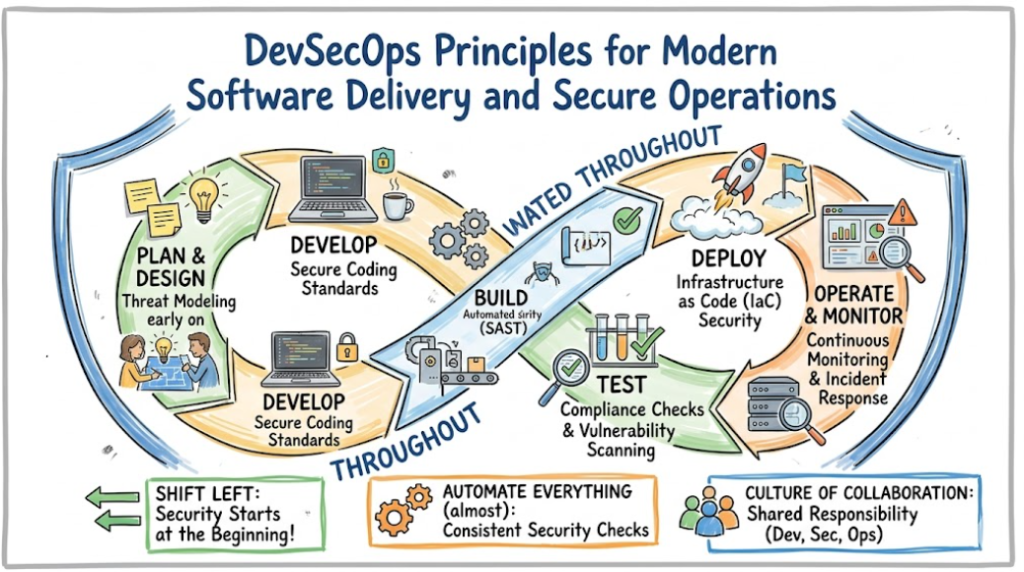
DevSecOps is the philosophy of integrating security practices within the DevOps process. Instead of waiting for a project to be completed before handing it off to a security team, security becomes an integral part of every stage of the software delivery lifecycle.
It is built on a shared responsibility model where developers, operations engineers, and security professionals collaborate to design, build, and deploy secure infrastructure. The core philosophy is security automation. By automating security checks, organizations can detect flaws early, reduce human error, and maintain high delivery speeds without compromising system integrity. The “Shift-Left” approach—moving security testing as far left (early) in the development process as possible—is the cornerstone of this methodology.
Why DevSecOps Matters in Modern Software Delivery
Modern software delivery relies on complex, distributed architectures. As applications are broken down into microservices and deployed across multi-cloud environments, the attack surface grows exponentially.
- Faster Releases: Without DevSecOps, security testing acts as a bottleneck at the end of the pipeline. Automation removes this friction.
- Growing Threats: Automated exploits target vulnerabilities in open-source libraries and misconfigured cloud settings daily.
- Compliance: Regulations like GDPR and SOC 2 require continuous visibility into the security posture of an environment, which manual audits cannot provide.
- Cloud-Native Resilience: Modern infrastructures require automated protection that can adapt to ephemeral container lifecycles.
Evolution from DevOps to DevSecOps
In traditional IT environments, security was treated as a separate silo. Developers wrote code, operations deployed it, and security teams audited it post-facto. This created a “us vs. them” culture where security was viewed as a hindrance to speed.
As CI/CD automation matured, it became clear that waiting for an end-of-cycle security scan was unsustainable. If a vulnerability was discovered, the entire release cycle would stall, costing organizations time and money. DevSecOps evolved to bridge this gap, integrating security tools directly into the automated pipeline, allowing for real-time feedback loops.
DevOps vs DevSecOps
| Feature | DevOps | DevSecOps |
| Primary Focus | Speed and Efficiency | Speed, Security, and Compliance |
| Security Ownership | Security Team | Shared Responsibility |
| CI/CD Integration | Deployment Focus | Integrated Security Scanning |
| Compliance | Periodic Audits | Continuous Compliance |
| Vulnerability Scanning | Manual/Intermittent | Automated/Continuous |
| Monitoring | Operational Health | Threat/Anomaly Detection |
| Automation Scope | Build/Deploy | Build/Deploy/Protect |
| Team Collaboration | Dev + Ops | Dev + Ops + Security |
Core Principles of DevSecOps
- Shift-Left Security: Testing code for vulnerabilities while it is being written.
- Security Automation: Replacing manual processes with automated scans and policy checks.
- Continuous Monitoring: Real-time visibility into the security status of production environments.
- Infrastructure Security: Treating infrastructure as code (IaC) and securing it at the provisioning stage.
- Compliance Automation: Using code to enforce regulatory standards.
- Shared Responsibility: Moving from a blame culture to a collaborative security culture.
- Secure CI/CD Pipelines: Ensuring that every step of the build pipeline is verified.
- Continuous Improvement: Iterating on security policies based on threat intelligence.
Shift-Left Security Explained
Shift-left security means testing for security early. By the time code reaches the build stage, the developer should have already run static analysis tools. This reduces the cost and effort of remediation, as developers can fix issues while the code is fresh in their minds, rather than days or weeks later during a penetration test.
Security in CI/CD Pipelines
A secure pipeline automates several layers of defense:
- SAST (Static Application Security Testing): Analyzes source code for known vulnerabilities.
- DAST (Dynamic Application Security Testing): Tests the running application to find runtime issues.
- Dependency Scanning: Checks open-source libraries for known security vulnerabilities.
- Container Scanning: Ensures the base images used for deployment are free of vulnerabilities.
Role of Automation in DevSecOps
Automation is the engine of DevSecOps. It enables:
- Secret Management: Automatically injecting environment variables rather than hardcoding sensitive keys.
- Policy Enforcement: Automatically rejecting deployments that do not meet security baseline configurations.
- Automated Compliance: Scanning cloud resources to ensure they meet standards like CIS Benchmarks.
DevSecOps in Cloud-Native Environments
Cloud-native environments are dynamic. Servers are replaced by containers, and static IPs are replaced by service meshes. Securing this requires:
- Kubernetes Security: Securing the cluster, the control plane, and the applications running inside pods.
- Microservices Security: Using mutual TLS (mTLS) to encrypt traffic between services.
- Least Privilege: Ensuring every container has only the permissions it needs to function.
Infrastructure as Code (IaC) Security
Tools like Terraform, Ansible, Checkov, and tfsec allow teams to define infrastructure programmatically. The security advantage here is that infrastructure configurations can be scanned for misconfigurations before they are deployed. If a security group is configured to be too open, the CI/CD pipeline can flag it and fail the build.
Container Security in DevSecOps
Containers must be treated as immutable. Once an image is built, it should not be modified. Security involves scanning for vulnerabilities in the OS libraries, using minimal base images (like Alpine or Distroless), and implementing container runtime protection to monitor for suspicious process execution.
Kubernetes Security Best Practices
- RBAC (Role-Based Access Control): Restrict access to the Kubernetes API.
- Network Policies: Control traffic flow between pods.
- Pod Security Standards: Prevent pods from running as root.
- Secret Management: Use tools like HashiCorp Vault instead of base64-encoded Kubernetes secrets.
- Admission Controllers: Validate or mutate requests before they are persisted in etcd.
Monitoring and Observability in DevSecOps
Security monitoring is about detecting anomalies. Tools like Prometheus and Grafana provide operational metrics, while tools like Falco provide deep-dive security monitoring for container runtimes, detecting suspicious system calls in real-time. The ELK Stack or Datadog are essential for aggregating logs to perform forensic analysis.
Popular DevSecOps Tools
| Tool | Purpose | Security Area | Difficulty |
| SonarQube | Code Analysis | SAST | Low |
| OWASP ZAP | Dynamic Scanning | DAST | Medium |
| Trivy | Container Scanning | Vulnerability Management | Low |
| HashiCorp Vault | Secrets Management | Access Control | High |
| Falco | Runtime Security | Threat Detection | High |
| Checkov | IaC Scanning | Compliance | Low |
Real-World DevSecOps Workflow Example
- Commit: A developer pushes code to a Git repository.
- CI Trigger: The CI tool (like Jenkins or GitLab CI) triggers a build.
- SAST Scan: The pipeline runs a SAST tool; if a critical flaw is found, the build fails.
- Dependency Check: A scanner verifies if any third-party libraries have known CVEs.
- Container Build: A Docker image is built and scanned for vulnerabilities.
- CD Deployment: The image is deployed to Kubernetes if all checks pass.
- Runtime Protection: Once live, Falco monitors the pod for unexpected shell access.
Benefits of DevSecOps
- Faster Vulnerability Detection: Issues are found during the build, not in production.
- Reduced Risk: Automated guardrails prevent misconfigurations.
- Better Collaboration: Teams work toward a unified security goal.
- Scalability: Automation allows a small security team to manage thousands of deployments.
Challenges in DevSecOps Adoption
- Cultural Resistance: Moving away from “siloed” workflows requires executive buy-in.
- Tool Fatigue: Implementing too many security tools can overwhelm developers.
- Skill Gaps: DevOps engineers need security knowledge, and security pros need coding skills.
- Alert Fatigue: Too many false positives from security scans can lead to teams ignoring alerts.
Common Security Risks in Modern Software Delivery
- Misconfigured Cloud Resources: S3 buckets left public, open ports.
- Vulnerable Dependencies: Using outdated libraries with known exploits.
- Secret Exposure: API keys committed to source code repositories.
- Insecure Containers: Using large, unpatched base images.
Best Practices for Successful DevSecOps Adoption
- Start Small: Automate one or two critical checks first.
- Integrate Early: Make security a part of the IDE for developers.
- Educate: Run “Security Champions” programs within development teams.
- Prioritize: Don’t try to fix everything at once; focus on high-risk vulnerabilities first.
DevSecOps Team Structure
A healthy DevSecOps culture involves:
- DevSecOps Engineer: Bridges the gap between infrastructure and security.
- Security Engineer: Focuses on tool integration and vulnerability management.
- SRE with Security Focus: Ensures production availability while enforcing security policy.
DevSecOps and Compliance
Compliance is often a manual, painful process. With DevSecOps, you move to Compliance-as-Code. By automating your security policies, you can generate compliance reports for SOC 2 or HIPAA on demand, as the logs and scan reports provide a continuous paper trail of your security posture.
Career Opportunities in DevSecOps
The demand for professionals who understand both software delivery and security is higher than ever. Roles like DevSecOps Engineer, Cloud Security Architect, and Security Automation Engineer are among the most highly compensated in the IT industry. Mastering these skills opens doors to senior engineering and leadership positions.
Certifications & Learning Paths
Hands-on experience is critical. While certifications provide a roadmap, real-world project work is the ultimate validator of skill.
| Certification | Best For | Skill Level | Focus Area |
| CKA/CKS | Kubernetes Security | Intermediate/Advanced | Cloud-Native |
| AWS Security Specialty | Cloud Security | Intermediate | AWS Ecosystem |
| OSCP | Penetration Testing | Advanced | Security Mindset |
| DevOpsSchool Courses | All-round DevSecOps | Beginner to Expert | Practical Delivery |
Common Beginner Mistakes
- Trying to automate everything at once: Focus on the most critical paths.
- Treating security as a tool rather than a culture: Tools don’t fix people-centric problems.
- Neglecting documentation: Automated security is only useful if the team understands the alerts.
- Ignoring fundamental networking: Understanding how traffic flows is essential for cloud security.
Future of DevSecOps
The future lies in AI-assisted security. Tools that can automatically suggest code fixes or detect sophisticated patterns of lateral movement in a network are becoming more common. Furthermore, as Zero Trust becomes the standard for networking, DevSecOps will evolve to manage identity and fine-grained access policies at the application level.
FAQs
- What is DevSecOps in simple terms? It is the practice of integrating security testing into every step of the software development process.
- Why is DevSecOps important? It prevents security from being a bottleneck and reduces the risk of breaches in fast-paced release cycles.
- How is DevSecOps different from DevOps? DevSecOps adds a proactive layer of security, compliance, and automated threat monitoring to the DevOps workflow.
- What is shift-left security? Testing for vulnerabilities as early as possible, usually in the development phase.
- Is Kubernetes security part of DevSecOps? Yes, it is a critical component given the prevalence of containerization in modern delivery.
- What tools are used in DevSecOps? Common tools include SonarQube, Trivy, Falco, Terraform, and various CI/CD integrations.
- Does DevSecOps require coding? Yes, automation is the core of DevSecOps; knowing a language like Python, Go, or shell scripting is essential.
- Is DevSecOps a good career choice? It is one of the most high-growth and high-paying areas in technology due to the massive global demand for secure cloud solutions.
- How do I start with DevSecOps? Learn basic DevOps, then introduce security scanning tools into your existing pipelines.
- Can I use DevSecOps for legacy systems? Yes, though it requires a different approach focused on perimeter security and hardening existing services.
- What is compliance as code? Using automated scripts to verify that infrastructure meets regulatory requirements.
- Is DevSecOps only for large enterprises? No, startups can benefit from automated security to prevent early-stage breaches.
- What is the biggest challenge in DevSecOps? Changing the team culture is typically more difficult than selecting tools.
- Does DevSecOps eliminate the need for penetration tests? No, but it significantly reduces the number of low-hanging vulnerabilities before a test begins.
- How does DevSecOps handle secret management? It uses secure vaults to inject keys at runtime instead of hardcoding them in the application.
Final Thoughts
DevSecOps is not a product you can buy; it is a discipline you build. By integrating security into the CI/CD pipeline, you are protecting your organization from preventable threats while simultaneously enabling your team to move faster and with more confidence. Start by automating one security check, then iterate. The value lies in consistency, visibility, and a culture that values security as a core feature of your software delivery.








Leave a Reply
You must be logged in to post a comment.