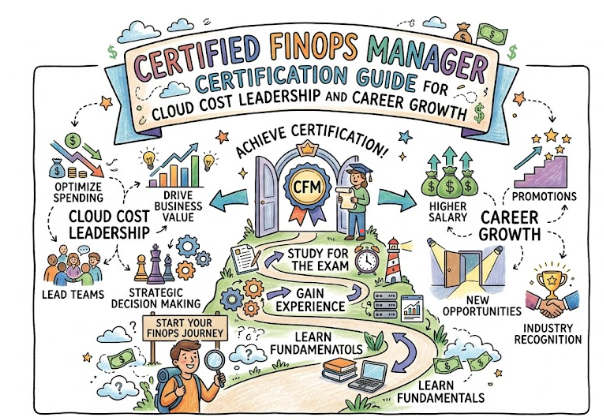
Introduction
The modern cloud ecosystem demands a shift from traditional procurement to a dynamic, real-world financial management model. The Certified FinOps Manager is a professional designation designed for those who need to bridge the gap between engineering, finance, and business leadership. This guide is tailored for professionals looking to master the intersection of cloud architecture and fiscal responsibility within the DevOps, cloud-native, and platform engineering spheres. By understanding these principles, engineers and managers can make better career decisions that align with the shifting priorities of global enterprises. Whether you are navigating complex multi-cloud environments or optimizing a single provider, finopsschool provides the structured path necessary to achieve operational excellence and financial accountability.
What is the Certified FinOps Manager?
The Certified FinOps Manager represents the evolution of IT management where financial accountability is integrated into the software development lifecycle. It exists because cloud spending has become a primary variable cost that can easily spiral out of control without dedicated oversight and cultural change. This program emphasizes real-world, production-focused learning over abstract theory, ensuring that practitioners understand how to implement “Inform, Optimize, and Operate” phases effectively. It aligns with modern engineering workflows by treating cost as a primary metric, similar to performance or security, within enterprise practices.
Who Should Pursue Certified FinOps Manager?
This certification is highly beneficial for cloud architects, systems engineers, and SREs who are responsible for resource provisioning and efficiency. Engineering managers and technical leaders will find value in the strategic elements of the curriculum, helping them justify cloud budgets to executive stakeholders. It is equally relevant for finance professionals and data analysts who need to understand the technical nuances of cloud billing and usage patterns. Both beginners in the cloud space and experienced professionals in India and across the global market can use this track to distinguish themselves in a competitive job landscape.
Why Certified FinOps Manager is Valuable Now and Beyond
As enterprise adoption of cloud services continues to grow, the demand for professionals who can manage these costs will remain high for the foreseeable future. This certification helps professionals stay relevant despite frequent changes in cloud provider tools by focusing on the underlying principles of unit economics and cultural alignment. Longevity in the tech industry often depends on being able to solve the most painful problems for a business, and uncontrolled cloud spending is a top-tier concern. The return on time and career investment is significant, as it positions individuals at the critical junction of technology and business strategy.
Certified FinOps Manager Certification Overview
The Certified FinOps Manager program is delivered via the Certified FinOps Manager official course and hosted on finopsschool.com. The certification is designed to help professionals understand cloud cost governance, FinOps lifecycle, budgeting, optimization, and collaboration models.
The program can be understood as a practical certification path for professionals who want to manage cloud financial operations at team, department, or enterprise level. It is not limited to one cloud provider, so learners can apply the concepts across multi-cloud and hybrid cloud environments.
The assessment approach generally focuses on practical understanding, role-based responsibilities, cloud cost concepts, and decision-making scenarios. Candidates should be prepared to explain how cloud cost data is collected, analyzed, optimized, and communicated across stakeholders.
Certified FinOps Manager Certification Tracks & Levels
The certification journey begins at the foundational level, where core terminology and the FinOps lifecycle are established for all participants. As practitioners advance to the professional level, the focus shifts toward advanced data analysis, automation of cost-saving measures, and complex architectural optimizations. The advanced tracks are designed for those aiming for leadership roles, focusing on governance, policy creation, and driving cultural change across diverse business units. These levels align with career progression, allowing a junior engineer to eventually transition into a dedicated cloud economist or FinOps director role.
Complete Certified FinOps Manager Certification Table
| Track | Level | Who it’s for | Prerequisites | Skills Covered | Recommended Order |
|---|---|---|---|---|---|
| FinOps Foundation | Foundation | Beginners, cloud learners, junior engineers | Basic cloud and billing awareness | Cloud cost basics, tagging, billing models, ownership | Start here |
| FinOps Practitioner | Professional | DevOps, cloud, SRE, finance, and platform teams | Cloud operations experience | Cost visibility, budgeting, forecasting, optimization | After foundation |
| Certified FinOps Manager | Professional | Team leads, managers, senior engineers | Cloud cost and operations understanding | Governance, reporting, accountability, stakeholder alignment | Main certification |
| FinOps Leadership | Advanced | Engineering managers, architects, technical leaders | Experience managing cloud teams or budgets | Strategy, policy, maturity model, executive reporting | After manager level |
| FinOps Automation | Advanced | Platform engineers, DevOps engineers, SREs | Automation and cloud platform knowledge | Cost automation, alerts, policy checks, dashboards | Parallel advanced path |
| FinOps Governance | Advanced | Cloud governance, security, compliance, finance teams | Understanding of enterprise controls | Chargeback, showback, policy, audit readiness | After practitioner level |
Detailed Guide for Each Certified FinOps Manager Certification
Certified FinOps Manager – FinOps Foundation
What it is
The FinOps Foundation level validates basic understanding of cloud cost, billing models, tagging, and cost visibility. It helps learners understand why cloud financial management is important in modern engineering teams.
Who should take it
This level is suitable for beginners, junior cloud engineers, DevOps learners, finance professionals entering cloud, and managers who need basic FinOps awareness. It is also useful for professionals shifting from traditional IT operations to cloud operations.
Skills you’ll gain
- Understand cloud billing and pricing basics.
- Learn cost ownership and tagging practices.
- Read cloud cost reports with better clarity.
- Understand budget alerts and cost visibility.
- Build awareness of cloud waste and unused resources.
Real-world projects you should be able to do
- Create a basic cloud cost report.
- Identify unused cloud resources.
- Prepare a simple tagging structure.
- Set up basic budget tracking.
- Explain cloud cost drivers to a small team.
Preparation plan
For 7–14 days, focus on cloud billing basics, tagging, and common cost problems. For 30 days, study cost reports, budgets, and real cloud usage examples. For 60 days, practice with dashboards, team-based cost ownership, and simple optimization exercises.
Common mistakes
- Studying only definitions without practical examples.
- Ignoring tagging and ownership.
- Treating cost as only a finance team responsibility.
- Not understanding cloud pricing models.
- Skipping budget and forecasting basics.
Best next certification after this
Same-track option: Certified FinOps Manager
Cross-track option: Cloud Cost Optimization certification
Leadership option: FinOps Leadership certification
Certified FinOps Manager – FinOps Practitioner
What it is
The FinOps Practitioner level validates practical cloud cost management knowledge. It focuses on daily FinOps work such as analyzing spend, improving utilization, supporting budgets, and helping teams reduce cloud waste.
Who should take it
This level is suitable for DevOps engineers, cloud engineers, SREs, platform engineers, finance analysts, and technical leads. It is best for professionals who already work with cloud systems and want to take ownership of cost optimization.
Skills you’ll gain
- Analyze cloud cost trends.
- Improve resource utilization.
- Support budgeting and forecasting.
- Apply showback and chargeback concepts.
- Work with engineering and finance teams.
- Create cost optimization recommendations.
Real-world projects you should be able to do
- Build a cloud cost dashboard.
- Identify high-cost services and workloads.
- Recommend rightsizing actions.
- Prepare team-level cost reports.
- Create monthly cloud spend summaries.
Preparation plan
For 7–14 days, revise cloud billing, cost allocation, and optimization basics. For 30 days, practice cost analysis using sample workloads and dashboards. For 60 days, work on cost governance, stakeholder reporting, budgeting, and optimization case studies.
Common mistakes
- Focusing only on cost cutting.
- Ignoring application performance and reliability.
- Not involving engineering teams.
- Using reports without explaining business impact.
- Missing reserved capacity, storage, and data transfer costs.
Best next certification after this
Same-track option: Certified FinOps Manager
Cross-track option: SRE or Cloud Architecture certification
Leadership option: FinOps Leadership certification
Certified FinOps Manager – Manager Level
What it is
Certified FinOps Manager validates the ability to manage FinOps practices across teams. It focuses on governance, reporting, accountability, collaboration, budget discipline, and cost-aware engineering culture.
Who should take it
This certification is suitable for engineering managers, cloud managers, DevOps leads, platform leads, FinOps practitioners, and senior engineers. It is also valuable for finance professionals who work closely with cloud and engineering teams.
Skills you’ll gain
- Manage cloud cost governance.
- Build team accountability models.
- Plan budgets and forecasts.
- Lead optimization programs.
- Align engineering, finance, and business teams.
- Create executive-level cloud cost reports.
Real-world projects you should be able to do
- Build a FinOps operating model.
- Create cloud budget ownership by team.
- Design showback or chargeback reports.
- Lead cost optimization reviews.
- Prepare cloud cost governance policies.
Preparation plan
For 7–14 days, revise FinOps principles, budgeting, and cost allocation. For 30 days, study governance models, reporting formats, and stakeholder communication. For 60 days, practice leadership scenarios, executive reporting, and enterprise-level cloud cost planning.
Common mistakes
- Treating FinOps as only a reporting task.
- Ignoring culture and accountability.
- Not connecting cost with business value.
- Over-optimizing without understanding workload needs.
- Not creating clear ownership rules.
Best next certification after this
Same-track option: FinOps Governance certification
Cross-track option: Platform Engineering or SRE certification
Leadership option: Cloud Leadership or Engineering Management certification
Certified FinOps Manager – FinOps Leadership
What it is
FinOps Leadership focuses on strategic cost governance, organizational maturity, decision-making, policy creation, and leadership communication. It prepares professionals to guide FinOps adoption at department or enterprise level.
Who should take it
This level is best for senior managers, cloud architects, enterprise architects, platform leaders, finance leaders, and technical directors. It is suitable for professionals who influence cloud strategy and business decisions.
Skills you’ll gain
- Design FinOps maturity roadmap.
- Build cloud governance policies.
- Communicate cost value to executives.
- Lead cross-functional FinOps programs.
- Connect cloud spend with business outcomes.
- Manage cloud cost risk and accountability.
Real-world projects you should be able to do
- Create enterprise FinOps strategy.
- Build cost governance framework.
- Define team-level cloud ownership.
- Design executive cloud cost reports.
- Lead multi-team optimization programs.
Preparation plan
For 7–14 days, review FinOps roles, reporting, and cloud cost principles. For 30 days, study governance, stakeholder alignment, and leadership communication. For 60 days, prepare enterprise case studies, maturity planning, and executive reporting scenarios.
Common mistakes
- Focusing only on tools instead of process.
- Ignoring team behavior and accountability.
- Not linking cost to product value.
- Creating policies without engineering input.
- Using complex reports that leaders cannot act on.
Best next certification after this
Same-track option: FinOps Governance certification
Cross-track option: Cloud Strategy certification
Leadership option: Engineering Leadership certification
Choose Your Learning Path
DevOps Path
DevOps professionals should use Certified FinOps Manager to understand how CI/CD, infrastructure automation, containers, and cloud environments affect cost. This path helps DevOps engineers make better decisions while provisioning infrastructure, managing environments, and automating deployment pipelines.
A DevOps engineer with FinOps knowledge can reduce waste in test environments, improve resource scheduling, and support better budget control. This path is useful for engineers who want to move from delivery automation toward platform ownership and cloud accountability.
DevSecOps Path
DevSecOps professionals can use Certified FinOps Manager to understand how security controls, compliance tools, scanning workloads, and monitoring systems affect cloud spend. Security is important, but it must also be designed with cost awareness.
This path helps security engineers balance protection, compliance, and financial efficiency. It also supports better conversations between security, platform, finance, and engineering teams when security workloads create high cloud usage.
SRE Path
SRE professionals should consider Certified FinOps Manager because reliability and cost are closely connected. High availability, redundancy, observability, autoscaling, and disaster recovery all affect cloud bills.
This path helps SREs understand how to maintain reliability without unnecessary waste. It also helps them make better trade-offs between uptime, performance, capacity planning, and cost control in production systems.
AIOps Path
AIOps professionals can benefit from Certified FinOps Manager because AI-driven operations often depend on observability data, automation platforms, event pipelines, and cloud infrastructure. These systems can become expensive if not governed properly.
This path helps AIOps professionals understand the cost impact of telemetry, automation, analytics, and intelligent operations. It also supports better cost-aware design for monitoring and incident management platforms.
MLOps Path
MLOps professionals should learn FinOps because machine learning workloads can create high cloud costs through compute, storage, GPUs, data pipelines, and model training environments. Without proper governance, ML experimentation can become expensive.
Certified FinOps Manager helps MLOps teams manage cost visibility, resource scheduling, workload optimization, and budget ownership. It is useful for teams running training, inference, and data processing workloads at scale.
DataOps Path
DataOps professionals can use Certified FinOps Manager to manage the cost impact of pipelines, storage, data lakes, warehouses, streaming systems, and analytics platforms. Data workloads often grow silently and create large cloud bills.
This path helps DataOps teams design cost-aware pipelines, improve storage lifecycle policies, and connect data usage with business value. It also supports better governance between data, finance, and engineering teams.
FinOps Path
The FinOps path is the most direct route for professionals who want to specialize in cloud financial management. It covers cost visibility, ownership, optimization, budgeting, forecasting, governance, and leadership reporting.
Certified FinOps Manager is highly suitable for professionals who want to become FinOps leads, cloud cost managers, cloud governance specialists, or engineering leaders. It helps them build a strong bridge between technology and business accountability.
Role → Recommended Certified FinOps Manager Certifications
| Role | Recommended Certifications |
|---|---|
| DevOps Engineer | FinOps Foundation, FinOps Practitioner, Certified FinOps Manager |
| SRE | FinOps Practitioner, Certified FinOps Manager, FinOps Governance |
| Platform Engineer | FinOps Practitioner, Certified FinOps Manager, FinOps Automation |
| Cloud Engineer | FinOps Foundation, FinOps Practitioner, Certified FinOps Manager |
| Security Engineer | FinOps Foundation, FinOps Governance, Certified FinOps Manager |
| Data Engineer | FinOps Foundation, FinOps Practitioner, DataOps with FinOps focus |
| FinOps Practitioner | Certified FinOps Manager, FinOps Leadership, FinOps Governance |
| Engineering Manager | Certified FinOps Manager, FinOps Leadership, Cloud Leadership |
Next Certifications to Take After Certified FinOps Manager
Same Track Progression
After Certified FinOps Manager, professionals can move deeper into FinOps governance, cloud cost optimization, cloud budgeting, and financial accountability. This helps them become stronger in enterprise cloud cost strategy.
Deep specialization is useful for professionals who want to lead FinOps programs, manage cloud budgets, improve forecasting, and create cost-aware engineering processes across multiple teams.
Cross-Track Expansion
Cross-track expansion helps professionals connect FinOps with DevOps, SRE, DevSecOps, DataOps, AIOps, MLOps, and cloud architecture. This is important because cloud cost is affected by many technical decisions.
For example, an SRE can use FinOps knowledge to improve capacity planning, while a DataOps engineer can use it to control storage and pipeline costs. This makes the professional more complete and business-aware.
Leadership & Management Track
The leadership path is useful for professionals who want to move into engineering management, cloud governance, platform leadership, or technical program management. Certified FinOps Manager gives a strong base for this transition.
Managers with FinOps knowledge can guide teams with better budget discipline, cost ownership, and cloud strategy. They can also communicate more clearly with finance, product, and executive stakeholders.
Training & Certification Support Providers for Certified FinOps Manager
DevOpsSchool
DevOpsSchool supports professionals who want to build practical skills across DevOps, cloud, automation, SRE, DevSecOps, and related engineering areas. For Certified FinOps Manager learners, DevOpsSchool can help create a stronger foundation in cloud operations, infrastructure automation, CI/CD, monitoring, and production engineering practices. This matters because FinOps is not only a finance topic; it is also connected with how engineers design, deploy, scale, and operate cloud systems. Learners who already understand DevOps practices can apply FinOps more effectively in real projects. DevOpsSchool is useful for professionals who want structured learning, practical examples, and career-focused mentoring.
Cotocus
Cotocus is known for technology consulting, DevOps implementation, cloud solutions, and enterprise engineering support. For Certified FinOps Manager learners, Cotocus can provide useful exposure to real-world cloud operations, automation, infrastructure planning, and enterprise delivery practices. This type of learning support is helpful because FinOps professionals must understand how cloud resources are actually used inside production environments. Cotocus can be valuable for teams that want practical guidance around cloud maturity, platform modernization, and operational efficiency. Learners can benefit by connecting FinOps concepts with actual engineering workflows, business goals, and cost-control practices.
Scmgalaxy
Scmgalaxy focuses on software configuration management, DevOps, build and release engineering, automation, and cloud-related learning. For Certified FinOps Manager learners, this background is useful because many cloud cost issues begin from poor release processes, unmanaged environments, and weak infrastructure discipline. Scmgalaxy can help learners understand how software delivery, version control, automation, and release governance connect with cloud cost management. Professionals who understand these areas can better identify waste, improve deployment practices, and support cost-aware engineering. It is a helpful learning source for people who want to connect FinOps with practical software delivery processes.
BestDevOps
BestDevOps supports learning around DevOps practices, tools, cloud platforms, automation, and engineering workflows. For Certified FinOps Manager learners, BestDevOps can help build the technical base required to understand how infrastructure decisions affect cloud bills. FinOps managers often need to work with DevOps teams, platform teams, and cloud engineers, so understanding these practical workflows is important. BestDevOps can help learners connect cost optimization with CI/CD pipelines, environment management, infrastructure provisioning, and monitoring practices. This makes it useful for professionals who want to become more confident in technical discussions around cloud cost and operations.
devsecopsschool.com
devsecopsschool.com focuses on security-driven DevOps practices, secure automation, compliance, and governance in modern engineering environments. For Certified FinOps Manager learners, this is important because security tooling, compliance scanning, logging, monitoring, and policy controls can increase cloud cost if not managed carefully. Learning through a DevSecOps lens helps professionals understand how to balance security, compliance, and cost efficiency. FinOps managers often need to work with security teams to ensure that cost optimization does not weaken protection. This provider is useful for learners who want to understand secure and financially responsible cloud operations.
sreschool.com
sreschool.com focuses on site reliability engineering, production reliability, observability, incident response, service-level objectives, and operational excellence. For Certified FinOps Manager learners, SRE knowledge is very valuable because reliability choices often have direct cost impact. Redundancy, scaling, monitoring, backup, failover, and capacity planning can all increase cloud spend. A professional who understands both SRE and FinOps can make better decisions about performance, uptime, and budget. sreschool.com is useful for learners who want to connect cloud cost management with production reliability, operational maturity, and real engineering trade-offs.
aiopsschool.com
aiopsschool.com focuses on AIOps, intelligent operations, automation, observability analytics, and AI-driven IT operations. For Certified FinOps Manager learners, this is helpful because AIOps systems can generate large data volumes through logs, metrics, traces, events, and automation workflows. These systems must be governed carefully to avoid unnecessary cost. Learners can understand how intelligent operations platforms support incident detection, performance analysis, and automation while still needing financial discipline. aiopsschool.com is useful for professionals who want to combine FinOps with modern operational intelligence, cost-aware observability, and automated cloud operations.
dataopsschool.com
dataopsschool.com focuses on DataOps, data pipelines, analytics workflows, automation, governance, and data platform practices. For Certified FinOps Manager learners, DataOps knowledge is important because data workloads often create major cloud costs through storage, compute, transfer, and analytics usage. FinOps professionals need to understand how data pipelines are designed, scheduled, monitored, and optimized. dataopsschool.com can help learners connect FinOps with data engineering realities, including lifecycle policies, workload planning, and cost-aware pipeline design. This is useful for professionals working in data-heavy organizations where cloud cost control depends strongly on data operations.
finopsschool.com
finopsschool.com is directly aligned with Certified FinOps Manager learning because it focuses on cloud financial operations, cost governance, optimization, budgeting, forecasting, and FinOps career development. It is suitable for engineers, managers, cloud professionals, finance teams, and leaders who want structured learning around FinOps practices. The platform helps learners understand both technical and business sides of cloud cost management. It can support professionals who want to build practical confidence in cost visibility, accountability, reporting, chargeback, showback, and optimization. For Certified FinOps Manager preparation, finopsschool.com is the most directly relevant provider in this list.
Frequently Asked Questions
1. Is Certified FinOps Manager difficult?
Certified FinOps Manager is moderately difficult for professionals who are new to cloud cost management. It becomes easier if you already understand cloud platforms, billing basics, infrastructure, and team operations. The challenge is not only remembering definitions but also understanding real business situations. You need to know how cloud cost is created, how teams use resources, and how managers make cost decisions. With structured preparation and practical examples, most working professionals can prepare effectively.
2. Do I need cloud experience before taking Certified FinOps Manager?
Cloud experience is helpful but not always mandatory. If you are a beginner, you should first understand cloud services, billing models, compute, storage, networking, and common deployment patterns. Professionals from finance or management backgrounds can also pursue it if they are willing to learn technical basics. The certification is best understood when you can connect cost reports with real cloud workloads.
3. How much time is needed to prepare?
Preparation time depends on your background. If you already work in cloud, DevOps, SRE, or platform engineering, a focused 30-day plan may be enough. Beginners may need 60 days to build confidence. Managers and finance professionals may need extra time to understand technical cloud usage. The best approach is to combine reading, examples, reports, and practical case studies.
4. Is Certified FinOps Manager useful for DevOps engineers?
Yes, it is useful for DevOps engineers because DevOps teams often create and manage cloud environments. CI/CD pipelines, test systems, containers, infrastructure automation, and monitoring tools can all affect cloud cost. A DevOps engineer with FinOps knowledge can reduce waste, improve environment governance, and support better cost visibility. This can help them grow into platform or cloud leadership roles.
5. Is this certification useful for managers?
Yes, Certified FinOps Manager is especially useful for managers who handle cloud teams, budgets, delivery planning, or platform strategy. It helps managers understand cloud cost reports, ask better questions, create ownership models, and support cost-aware decisions. It also helps them communicate more effectively with finance, engineering, and business stakeholders.
6. Can finance professionals pursue Certified FinOps Manager?
Yes, finance professionals can pursue this certification if they work with cloud budgets, billing, forecasting, or technology teams. They may need to learn cloud fundamentals first. The certification helps finance teams understand why cloud costs change and how engineering decisions affect spending. It also improves collaboration between finance and technical teams.
7. Does Certified FinOps Manager help in career growth?
Yes, it can help career growth because cloud cost management is now important for many organizations. Professionals who understand cloud technology and financial accountability can support better business decisions. This certification can help engineers move toward cloud governance, platform leadership, FinOps roles, or management responsibilities.
8. Is FinOps only about reducing cloud cost?
No, FinOps is not only about cost cutting. It is about getting better value from cloud usage. Sometimes spending more is acceptable if it supports performance, reliability, security, or business growth. A good FinOps manager helps teams understand trade-offs and make informed decisions rather than simply reducing every expense.
9. Which roles benefit most from this certification?
The roles that benefit most include cloud engineers, DevOps engineers, SREs, platform engineers, FinOps practitioners, engineering managers, finance analysts, and cloud governance professionals. It is also useful for technical leaders who need to manage cloud strategy and budget ownership across teams.
10. Can beginners take this certification?
Beginners can take it, but they should first learn cloud basics. Understanding compute, storage, networking, billing, and monitoring will make the certification easier. Beginners should start with foundation concepts before moving into budgeting, forecasting, chargeback, showback, and governance.
11. What is the ROI of Certified FinOps Manager?
The return on investment comes from better career positioning, improved cloud cost decision-making, and stronger communication with leadership teams. For organizations, the value comes from reduced waste, better forecasting, and improved accountability. For professionals, the value comes from gaining a skill that connects engineering with business outcomes.
12. What should I learn before this certification?
Before starting, learn cloud fundamentals, billing basics, infrastructure concepts, tagging, monitoring, budgeting, and basic reporting. You should also understand how teams use cloud resources in development, testing, staging, and production environments. This foundation will help you understand FinOps concepts more clearly.
FAQs on Certified FinOps Manager
1. What does Certified FinOps Manager mainly validate?
Certified FinOps Manager validates your ability to manage cloud cost, governance, budgeting, forecasting, reporting, and stakeholder collaboration. It shows that you can work with engineering, finance, and business teams to improve cloud accountability.
2. Is it more technical or managerial?
It is both technical and managerial. You need technical understanding of cloud usage, but you also need management skills for reporting, budgeting, ownership, and decision-making.
3. Is it suitable for cloud engineers?
Yes, cloud engineers can benefit strongly because they already understand infrastructure. The certification helps them add cost governance and business value thinking to their technical skills.
4. Is it useful for Indian professionals?
Yes, it is useful for Indian professionals working in cloud, DevOps, SRE, platform engineering, finance operations, and global delivery teams. Many organizations need cost-aware cloud professionals.
5. Does it require coding?
Heavy coding is usually not required. However, understanding automation, cloud services, infrastructure scripts, and dashboards can be helpful.
6. Can it help me move into leadership?
Yes, it can support leadership growth because FinOps requires communication, ownership, governance, and business alignment. These are important skills for managers and technical leads.
7. What is the best preparation method?
The best preparation method is to study FinOps concepts, review cloud billing examples, practice cost reporting, understand optimization cases, and learn how to explain cost data to different stakeholders.
8. Should I take it after DevOps or cloud certification?
Yes, it is a strong next step after DevOps or cloud certification. It adds business and cost management depth to your existing technical knowledge.
Final Thoughts: Is Certified FinOps Manager Worth It?
In the current landscape of cloud computing, being “good with technology” is no longer enough; you must also be “good with the business of technology.” The Certified FinOps Manager designation is a powerful signal to employers that you understand the fiscal impact of technical decisions. It moves you away from being a cost center and into a role where you are a value-driver for the organization. For any professional who wants to lead at the intersection of engineering and finance, this path is not just worth it—it is essential. The investment you make in these skills today will pay dividends as companies continue to prioritize efficiency and accountability in the cloud.