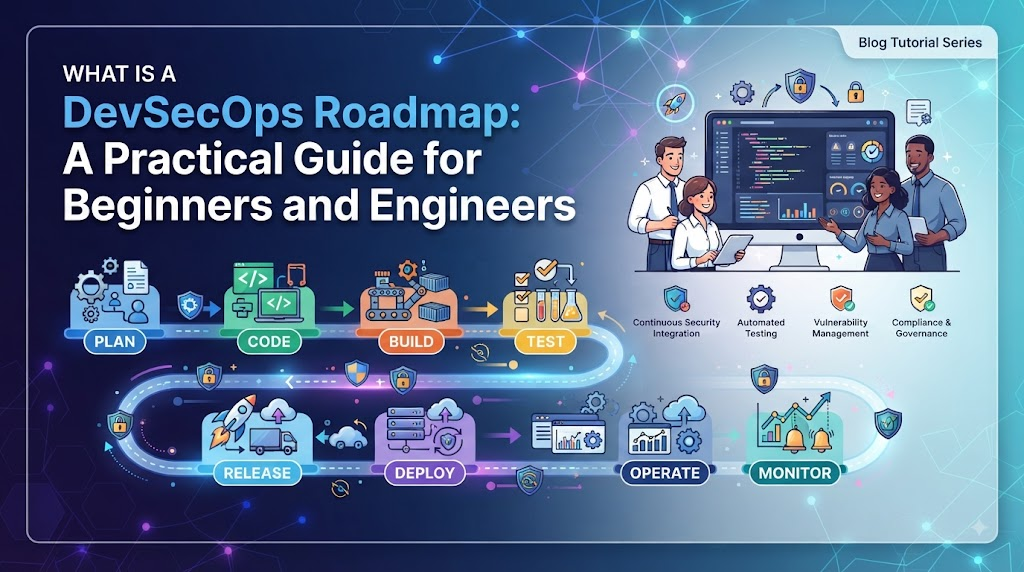
Introduction
Modern software delivery requires organizations to release applications faster without compromising security, reliability, or compliance. Traditionally, security was treated as a final gate review before production, which often created bottlenecks, delayed deployments, and created friction between development and security teams. The need to balance speed and safety has driven the adoption of DevSecOps across modern engineering organizations.
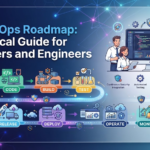
The DevSecOps roadmap serves as a structured learning and implementation path that connects development, operations, security, cloud, automation, CI/CD, infrastructure, and monitoring. Beginners often struggle because they try to learn complex security tools before understanding software delivery and DevOps fundamentals. Building a strong foundation in core engineering principles is necessary before attempting to secure complex distributed systems.
To gain structured guidance and professional training in this domain, learners often turn to comprehensive programs offered by DevOpsSchool, where foundational practices and advanced workflows are taught systematically. Understanding the complete lifecycle ensures that security becomes an embedded engineering practice rather than a reactive afterthought.
What Is a DevSecOps Roadmap?
A DevSecOps roadmap is a structured educational and implementation sequence designed to help engineers understand how to integrate security controls into every stage of the software delivery lifecycle. It provides a logical progression from basic operating system navigation to advanced cloud security automation.
A comprehensive roadmap covers several core domains:
- Learning sequence
- Security integration
- Software lifecycle
- Automation
- Infrastructure
- Cloud
- CI/CD
- Monitoring
- Risk management
- Continuous improvement
A roadmap is not a rigid list of tools and should be adapted to the learner’s role, background, and organizational environment. Technology stacks change frequently, but the core engineering and security principles remain consistent across different platforms.
Why Do You Need a DevSecOps Roadmap?
Attempting to learn DevSecOps randomly often creates knowledge gaps, leaving engineers overwhelmed by the sheer volume of available security tools and frameworks. A structured approach ensures that learners build competencies in the correct sequence.
Key benefits of following a roadmap include:
- Structured learning progression from basics to advanced topics
- Reduced confusion when faced with numerous modern security tools
- Better skill progression with measurable milestones
- Enhanced security awareness across development and operations teams
- Practical experience through applied workflows and project implementation
- Clear career planning for professionals transitioning into security roles
- Enterprise readiness for secure cloud-native environments
Having a clear path prevents learners from jumping straight into vulnerability scanners without understanding how code is compiled, tested, and deployed in production.
DevSecOps Roadmap at a Glance
The following progression outlines the logical path from foundational computing to advanced DevSecOps engineering:
Linux & Networking
↓
Git & Version Control
↓
DevOps Fundamentals
↓
CI/CD
↓
Cloud Fundamentals
↓
Containers
↓
Infrastructure as Code
↓
Security Fundamentals
↓
Security Automation
↓
DevSecOps Pipeline Security
↓
Cloud & Infrastructure Security
↓
Monitoring & Observability
↓
Compliance & Governance
↓
Incident Response
↓
Real-World DevSecOps Projects
↓
Continuous Improvement
Each stage builds upon the previous one, ensuring that engineers understand the underlying technology before attempting to secure it.
DevOps Fundamentals Before DevSecOps
DevOps fundamentals must be mastered before attempting to secure modern delivery pipelines. Security cannot be effectively automated or integrated if an engineer does not understand how software moves from a developer’s local machine to a production environment.
Essential foundational areas include:
- Software Development Life Cycle (SDLC) models and Agile methodologies
- Cross-functional collaboration between development, operations, and security
- Continuous integration and continuous delivery pipeline concepts
- Infrastructure automation and configuration management principles
- Cloud computing models and shared responsibility frameworks
- Monitoring, logging, and feedback loops for operational health
Security professionals moving into DevSecOps must understand the software delivery pipeline so they can implement security controls that support developer productivity rather than obstructing it.
Linux and Networking Fundamentals
Operating system and networking concepts form the bedrock of all infrastructure and cloud security. Without knowing how operating systems manage processes and how packets traverse networks, securing modern applications is impossible.
Key topics to master include:
- Essential Linux shell commands and file system navigation
- Managing file permissions, ownership, and access control lists
- Managing system processes, daemons, and system services
- Secure Shell (SSH) configuration, key pairs, and remote access
- Shell scripting for automation and task execution
- Core networking concepts including DNS, HTTP, HTTPS, and TCP/IP
- Managing network ports, routing, and firewall rules
- Basic network troubleshooting using standard diagnostic utilities
Security issues often require understanding the underlying operating system and network architecture to identify unauthorized access, misconfigurations, or network anomalies.
Git and Version Control
Version control systems are essential for tracking changes across source code, infrastructure definitions, configuration files, and security policies. Git is the industry standard for managing collaborative engineering workflows.
Core concepts to understand include:
- Repository initialization, cloning, and local tracking
- Making commits, tracking history, and writing descriptive messages
- Working with branches, merging changes, and resolving conflicts
- Creating pull requests and participating in code reviews
- Using tags to mark specific software release versions
- Implementing branch protection rules to prevent unauthorized direct pushes
Git becomes critical for secure software delivery because source code, infrastructure configurations, and security policies can all be managed, audited, and reviewed through version control.
CI/CD Fundamentals
Continuous Integration and Continuous Delivery (CI/CD) pipelines automate the process of building, testing, and deploying software. Understanding how a pipeline operates is essential before embedding security checks into it.
Core pipeline stages include:
- Continuous Integration for frequent code merging and automated testing
- Continuous Delivery for ensuring code is always in a releasable state
- Continuous Deployment for automating production releases
- Pipeline stages including build, test, package, and deployment
A standard delivery pipeline follows this progression:
Code
↓
Build
↓
Test
↓
Security Checks
↓
Package
↓
Deploy
↓
Monitor
Understanding how code flows through these automated gates is essential before adding specialized security tools to the pipeline.
Cloud Fundamentals
Modern infrastructure runs almost exclusively in cloud environments. DevSecOps engineers must understand how cloud resources are provisioned, networked, and secured.
Essential cloud concepts include:
- Compute instances, serverless functions, and managed container services
- Object storage, block storage, and file storage architectures
- Virtual private clouds, subnets, and routing tables
- Identity and Access Management (IAM) principles and user policies
- Security groups and network access control lists
- Load balancing and high-availability architecture
- Managed database services and encryption mechanisms
- Cloud-native logging, auditing, and monitoring services
The shared-responsibility model dictates that cloud providers secure the underlying infrastructure, while organizations are responsible for securing their own data, applications, configurations, and identity controls.
Container Security Fundamentals
Containers package applications and their dependencies together, ensuring consistent execution across different environments. Securing containers requires attention to image composition, runtime behavior, and registry management.
Key areas of container security include:
- Writing efficient Dockerfiles with minimal base images
- Understanding image layers and minimizing unnecessary dependencies
- Storing images in secure, private container registries
- Scanning container images for known vulnerabilities before deployment
- Managing sensitive data and avoiding hardcoded secrets in images
- Securing container runtimes and limiting container privileges
Securing a container begins long before deployment, starting with the selection of base images and the elimination of unnecessary software packages.
Infrastructure as Code Security
Infrastructure as Code (IaC) allows engineers to define cloud resources using human-readable configuration files. Managing infrastructure programmatically introduces the need to secure configuration code just like application source code.
Important IaC security practices include:
- Ensuring secure default configurations for cloud resources
- Enforcing least privilege access in IAM and security group definitions
- Implementing secure network policies and storage encryption
- Preventing the inclusion of plaintext secrets in template files
- Scanning IaC templates for misconfigurations before deployment
- Enforcing organizational compliance policies through automated checks
- Detecting and remediating infrastructure drift over time
Tools such as Terraform or equivalent declarative frameworks allow security policies to be evaluated before infrastructure is provisioned in the cloud.
Security Fundamentals for DevSecOps
DevSecOps engineers need a solid grasp of core security principles to identify, evaluate, and mitigate risks across software and infrastructure components.
Fundamental security concepts include:
- Confidentiality, integrity, and availability (CIA triad)
- Authentication mechanisms and multi-factor verification
- Authorization models and role-based access control
- Data encryption in transit and at rest
- Secure management of cryptographic keys, tokens, and secrets
- Identifying software vulnerabilities, common threats, and attack vectors
- Assessing risk impact and implementing effective security controls
Having this baseline knowledge enables engineers to communicate effectively with dedicated security teams and make informed architectural decisions.
Application Security in DevSecOps
Application security focuses on finding and fixing software flaws early in the development cycle. Integrating security checks directly into developer workflows reduces the cost and complexity of remediation.
Core application security practices include:
- Writing secure code and following established secure coding guidelines
- Managing third-party dependencies and tracking open-source vulnerabilities
- Performing Static Application Security Testing (SAST) on source code
- Conducting Dynamic Application Security Testing (DAST) on running apps
- Using Software Composition Analysis (SCA) for dependency checks
- Detecting hardcoded secrets, API keys, and credentials in code repositories
- Securing application programming interfaces (APIs) against common attacks
Integrating these tests into daily development workflows ensures vulnerabilities are addressed before code reaches production environments.
Security Automation
Security automation eliminates manual security reviews by embedding automated checks directly into engineering pipelines. This ensures consistent enforcement of security standards without creating unnecessary delays.
Key areas of security automation include:
- Automating vulnerability scanning across source code repositories
- Running automated dependency checks during build phases
- Scanning container images for vulnerabilities prior to release
- Evaluating Infrastructure as Code templates for misconfigurations
- Scanning for exposed secrets, passwords, and tokens before commit stages
- Executing policy and compliance checks automatically
Automating a security check provides rapid feedback to developers, whereas automatically blocking builds must be configured carefully to avoid disrupting valid release cycles.
DevSecOps CI/CD Pipeline
A mature DevSecOps pipeline integrates multiple security gates throughout the build and deployment process. Each stage evaluates a specific aspect of software or infrastructure risk.
Developer Commit
↓
Source Code Analysis
↓
Build
↓
Unit Tests
↓
Dependency Scan
↓
SAST
↓
Container Build
↓
Container Scan
↓
IaC Scan
↓
Deploy to Test
↓
DAST
↓
Security Validation
↓
Production Deployment
↓
Monitoring
Exact pipeline stages vary depending on application architecture, risk tolerance, regulatory requirements, and organizational maturity.
Shift-Left Security
Shift-left security means moving security tasks earlier in the software development lifecycle rather than waiting until testing or deployment phases. Addressing flaws early significantly reduces remediation costs and security risk.
Important aspects of shift-left security include:
- Finding architectural and code issues during the design and coding phases
- Providing rapid, actionable feedback directly to developers
- Promoting secure coding habits through automated linting and guidance
- Conducting automated dependency and infrastructure checks before code merge
- Educating engineering teams on common vulnerability patterns
Shift-left does not mean shifting all security responsibilities entirely onto developers; rather, it provides developers with the tools and guidance needed to write secure code from the start.
DevSecOps and Secrets Management
Secrets such as API keys, database passwords, tokens, and cryptographic certificates must be handled with extreme care. Hardcoding secrets in source code repositories or container images is a major security risk.
Key management principles include:
- Avoiding hardcoded credentials in application source code or configuration files
- Using centralized secrets management systems with encryption at rest
- Enforcing the principle of least privilege for secret access
- Implementing short-lived, dynamically generated credentials where possible
- Rotating secrets regularly and revoking compromised credentials immediately
- Auditing secret access logs to detect unauthorized retrieval attempts
Centralized secret stores ensure that applications fetch required credentials securely at runtime without exposing them in static configuration files.
DevSecOps and Identity and Access Management
Identity and Access Management (IAM) is one of the most critical security pillars in modern cloud environments. Every human user and automated service account must be strictly authenticated and authorized.
Core IAM practices include:
- Enforcing strong multi-factor authentication for all human users
- Implementing role-based and attribute-based access controls
- Applying the principle of least privilege to all permissions
- Using dedicated service accounts with minimal required privileges
- Utilizing temporary, role-based credentials for cloud deployments
- Conducting regular access reviews to remove orphaned or unused accounts
Proper IAM configuration prevents unauthorized access and limits the blast radius if an individual credential is compromised.
DevSecOps and Monitoring
Monitoring and observability provide the visibility needed to detect security incidents, analyze system behavior, and maintain operational stability across distributed environments.
Key monitoring domains include:
- Collecting and analyzing security audit logs from cloud and operating systems
- Monitoring application logs for suspicious activity, errors, or anomalies
- Reviewing infrastructure metrics and resource utilization patterns
- Maintaining centralized audit trails for compliance verification
- Configuring automated alerts for abnormal security events
- Tracking performance traces and network flows for threat detection
Robust monitoring allows security teams to identify indicators of compromise quickly and respond before minor issues escalate into major incidents.
DevSecOps and Compliance
Compliance ensures that organizational systems adhere to internal security policies and external regulatory frameworks. Integrating compliance into engineering workflows makes audits continuous rather than disruptive manual events.
Important compliance practices include:
- Defining clear security policies and baseline configuration standards
- Automating compliance checks as part of infrastructure deployments
- Gathering audit evidence programmatically from cloud and pipeline tools
- Implementing Policy as Code to enforce guardrails continuously
- Maintaining strict access controls and immutable logging practices
- Reviewing security posture regularly against industry frameworks
Treating compliance as code allows organizations to verify adherence automatically during every build and deployment cycle.
DevSecOps and Incident Response
Incident response involves preparing for, detecting, containing, and recovering from security breaches. A structured response lifecycle minimizes damage and provides valuable lessons for future prevention.
Detect
↓
Investigate
↓
Contain
↓
Eradicate
↓
Recover
↓
Learn
DevSecOps teams use automation, telemetry, and observability data to accelerate incident detection, streamline containment procedures, and improve post-incident learning.
DevSecOps Tools by Category
While concepts and workflows matter more than specific products, engineers frequently work with standard industry tools across different security categories.
| Category | Example Tools | Purpose |
| Version Control | Git | Source code management and change tracking |
| CI/CD | Jenkins / GitLab CI / GitHub Actions | Pipeline automation and orchestration |
| SAST | SonarQube / equivalent | Static code analysis for security flaws |
| Dependency Scanning | OWASP Dependency-Check / equivalent | Identifying vulnerable open-source packages |
| Container Security | Trivy / equivalent | Scanning container images and filesystems |
| IaC Security | Checkov / equivalent | Analyzing infrastructure configuration templates |
| Secrets Detection | Gitleaks / equivalent | Finding accidental secret exposure in code |
| Cloud Security | Cloud-native security tools | Monitoring cloud posture and resource security |
| Monitoring | Prometheus / Grafana / equivalent | Infrastructure and application observability |
| SIEM | Security monitoring platforms | Aggregating logs and detecting security events |
Tools are interchangeable; mastering the underlying security principles allows engineers to adapt to any tool stack in an enterprise environment.
Real-World DevSecOps Workflow Example
Consider a realistic enterprise scenario where a developer creates a new feature for a cloud-native web application:
- Step 1: Code: The developer writes new application code in a local development environment.
- Step 2: Commit: The developer pushes the code to a Git repository using descriptive commit messages.
- Step 3: Code Review: A pull request is opened, triggering automated peer reviews and automated branch protection checks.
- Step 4: Automated Build: The CI/CD pipeline compiles the application and executes automated unit tests.
- Step 5: Security Testing: Automated SAST and dependency scanners analyze the codebase for security flaws and vulnerable libraries.
- Step 6: Container Security: The application is packaged into a container image, and a container scanner verifies image integrity.
- Step 7: Infrastructure Validation: Infrastructure as Code templates are scanned for security misconfigurations before deployment.
- Step 8: Deployment: The application is deployed to a staging environment where DAST tools perform runtime security checks.
- Step 9: Monitoring: Application performance, logs, and security telemetry are continuously monitored in real time.
- Step 10: Incident Response: If an anomaly occurs, automated alerts notify the engineering and security teams for rapid investigation.
Security is continuously integrated throughout this lifecycle, ensuring that risks are mitigated without slowing down delivery velocity.
DevSecOps Roadmap for Beginners
Beginners should follow a structured progression to build competency without becoming overwhelmed by advanced topics prematurely:
- Stage 1: Linux & Networking: Master command-line navigation, file permissions, and TCP/IP networking basics.
- Stage 2: Git: Learn version control workflows, branching strategies, and pull requests.
- Stage 3: DevOps Fundamentals: Understand SDLC models, Agile practices, and software delivery pipelines.
- Stage 4: CI/CD: Build and automate basic build, test, and deployment pipelines.
- Stage 5: Cloud: Learn cloud computing fundamentals and the shared responsibility model.
- Stage 6: Docker: Understand containerization, Dockerfiles, and image management.
- Stage 7: Terraform / IaC: Learn infrastructure provisioning and declarative configuration.
- Stage 8: Security Fundamentals: Study core security concepts including CIA triad, IAM, and encryption.
- Stage 9: Security Automation: Integrate basic scanning tools into CI/CD pipelines.
- Stage 10: DevSecOps Projects: Build end-to-end secure deployment projects to solidify practical skills.
Following this sequence ensures that learners acquire the necessary foundational skills before tackling complex security toolsets.
DevSecOps Roadmap for DevOps Engineers
Existing DevOps professionals already understand infrastructure, cloud platforms, and CI/CD pipelines. Their transition focuses on embedding security practices into existing workflows:
- Mastering application security testing tools and integration techniques
- Implementing automated vulnerability scanning across pipelines and containers
- Strengthening cloud Identity and Access Management and least privilege policies
- Establishing centralized secrets management systems
- Securing Infrastructure as Code templates against misconfigurations
- Integrating compliance checks and Policy as Code into deployments
- Participating in incident response planning and operational monitoring
Existing DevOps skills in automation, scripting, and cloud infrastructure transfer directly into DevSecOps roles.
DevSecOps Roadmap for Security Professionals
Traditional security professionals often have deep knowledge of vulnerabilities, risk management, and compliance, but may be unfamiliar with modern software delivery pipelines:
- Learning Linux operating system administration and shell scripting
- Mastering Git version control and collaborative developer workflows
- Understanding CI/CD pipeline architecture and automation concepts
- Gaining hands-on experience with cloud platforms and containerization
- Learning Infrastructure as Code principles and deployment models
- Understanding developer tools and how to provide actionable security feedback
Understanding developer workflows allows security professionals to collaborate effectively with engineering teams and implement scalable security guardrails.
DevSecOps Roadmap for Developers
Developers write application code daily. Building DevSecOps skills helps them write secure code and participate actively in software security:
- Learning secure coding practices and common vulnerability mitigation
- Utilizing Git branching and participating in secure code reviews
- Understanding CI/CD pipeline triggers and build stages
- Managing third-party dependencies and reviewing SCA reports
- Using SAST tools locally to catch issues before committing code
- Managing API security and input validation properly
- Understanding container basics and cloud security fundamentals
Developers can become active participants in security without needing to become full-time security engineers.
DevSecOps Projects to Build
Practical project experience is essential for validating skills and building confidence. The following projects provide hands-on practice:
Project 1: Secure CI Pipeline
- Objective: Build an automated CI pipeline that includes linting, unit testing, and static code analysis.
- Skills: CI/CD configuration, Git workflows, SAST tools.
- Expected outcome: A functional pipeline that blocks builds containing critical code vulnerabilities.
Project 2: Container Security Pipeline
- Objective: Create a Dockerized application and implement automated container image scanning in a pipeline.
- Skills: Dockerfile optimization, container registries, vulnerability scanners.
- Expected outcome: A workflow that detects and reports vulnerable base images before deployment.
Project 3: Secure Infrastructure as Code
- Objective: Provision cloud infrastructure using Terraform and scan the templates for security misconfigurations.
- Skills: Terraform, IaC security scanning, cloud networking.
- Expected outcome: An automated check that prevents insecure cloud storage or security group settings.
Project 4: Secrets Management Workflow
- Objective: Configure a centralized secrets manager to supply database credentials to an application securely at runtime.
- Skills: Secrets management, environment configuration, least privilege access.
- Expected outcome: An application running successfully without any hardcoded credentials in source code.
Project 5: DevSecOps Kubernetes Deployment
- Objective: Deploy a secure multi-container application on Kubernetes with network policies and resource limits.
- Skills: Kubernetes, pod security standards, network segmentation.
- Expected outcome: A hardened cluster deployment that restricts unauthorized inter-pod communication.
Project 6: Continuous Security Monitoring
- Objective: Set up log aggregation and automated alerting for unauthorized access attempts or system anomalies.
- Skills: Monitoring tools, log analysis, alert configuration.
- Expected outcome: A dashboard displaying real-time security telemetry and automated alert notifications.
Common DevSecOps Learning Mistakes
Avoid these common pitfalls when learning and implementing DevSecOps:
- Learning tools without security concepts: Memorizing tool commands without understanding the underlying vulnerability leads to brittle implementations. Always learn the principle first.
- Skipping DevOps fundamentals: Trying to secure pipelines before understanding how CI/CD and cloud infrastructure work creates massive knowledge gaps.
- Trying too many tools: Installing dozens of scanning tools at once causes alert fatigue. Start with one tool per category and expand gradually.
- Ignoring application security: Focusing solely on infrastructure while neglecting code quality and dependency management leaves applications vulnerable.
- Ignoring IAM: Weak identity controls undermine all other security measures. Prioritize least privilege access early.
- Hardcoding secrets: Storing passwords or API keys in source code files introduces immediate security risks. Use dedicated secret stores.
- Skipping hands-on labs: Reading theory alone is insufficient. Practical implementation solidifies engineering skills.
- Ignoring troubleshooting: Learning how to debug failed security scans and pipeline errors is just as important as running them.
- Focusing only on scanning: Scanners generate data; interpreting that data, prioritizing risks, and fixing root causes is what matters.
- Treating DevSecOps as a security team’s responsibility: DevSecOps requires shared ownership across development, operations, and security.
Being aware of these mistakes helps learners maintain a practical, engineering-focused mindset.
DevSecOps Skills Checklist
Use this checklist to track your learning progress across core domains:
- Linux administration and shell commands
- TCP/IP networking and firewall management
- Git version control and branching workflows
- Shell scripting and task automation
- CI/CD pipeline configuration and management
- Cloud computing fundamentals and shared responsibility
- Docker containerization and image management
- Kubernetes basics and cluster concepts
- Infrastructure as Code (IaC) with Terraform or equivalent
- Core security principles (CIA, encryption, risk)
- Static Application Security Testing (SAST)
- Dynamic Application Security Testing (DAST)
- Dependency scanning and SCA
- Container vulnerability scanning
- Infrastructure security scanning
- Secrets management and rotation
- Identity and Access Management (IAM)
- Monitoring, logging, and observability
- Incident response workflows
- Compliance and Policy as Code
- Security automation best practices
- Troubleshooting pipeline and security failures
DevSecOps Career Roles
Different engineering roles incorporate DevSecOps responsibilities to varying degrees across organizations:
| Role | Important DevSecOps Skills |
| DevSecOps Engineer | CI/CD security, automation, vulnerability management, pipeline hardening |
| Cloud Security Engineer | Cloud IAM, network security, posture management, compliance |
| Application Security Engineer | SAST, DAST, secure coding, dependency analysis, threat modeling |
| DevOps Engineer | Pipeline automation, containerization, IaC, cloud deployment |
| Security Engineer | Threat analysis, incident response, security controls, risk assessment |
| SRE | Reliability, monitoring, incident management, observability |
| Platform Engineer | Internal developer platforms, guardrails, infrastructure orchestration |
| DevOps Consultant | Architecture design, cultural transformation, toolchain integration |
Responsibilities vary by organization, but all roles benefit from a strong understanding of secure software delivery workflows.
DevSecOps Learning Roadmap: Beginner to Advanced
Beginner
↓
Linux + Git + DevOps Fundamentals
↓
Intermediate
↓
CI/CD + Cloud + Containers + IaC
↓
Security Layer
↓
SAST + DAST + SCA + Secrets + Container Security
↓
Advanced
↓
Cloud Security + Kubernetes Security + Policy as Code + Compliance
↓
Expert
↓
Architecture + Threat Modeling + Governance + Incident Response + Security Automation
Learners should progress based on their current role and practical experience rather than trying to master every domain simultaneously.
Frequently Asked Questions
What is a DevSecOps roadmap?
A DevSecOps roadmap is a structured learning and implementation guide that outlines the logical sequence of skills, tools, and practices needed to integrate security into software delivery pipelines.
What should I learn before DevSecOps?
Before tackling DevSecOps, learners should master Linux administration, computer networking basics, Git version control, core DevOps pipeline concepts, and cloud computing fundamentals.
Is DevOps knowledge required for DevSecOps?
Yes. Understanding how software is built, tested, packaged, and deployed through CI/CD pipelines is essential before attempting to secure those workflows.
What security skills are needed for DevSecOps?
Key security skills include understanding authentication, authorization, least privilege IAM, vulnerability management, secure coding principles, and container security.
Is coding required for DevSecOps?
While heavy software development is not always required, basic scripting skills in languages like Python or Bash, along with understanding configuration code, are very important.
Which tools should I learn for DevSecOps?
Focus on industry standards for version control, CI/CD automation, containerization, IaC, and basic security scanners such as SonarQube, Trivy, or Checkov.
How important is CI/CD in DevSecOps?
Extremely important. CI/CD is the primary mechanism through which security tests and compliance checks are automated across software delivery stages.
Should I learn cloud security?
Yes. Because most modern applications run in cloud environments, understanding cloud IAM, networking, and storage security is a core requirement.
Is Kubernetes security necessary?
Kubernetes security becomes essential if your organization uses container orchestration for microservices architectures in production.
What projects should a DevSecOps beginner build?
Beginners should build secure CI pipelines, container scanning workflows, secure IaC templates, and secrets management integrations to gain hands-on experience.
How long does it take to learn DevSecOps?
The timeline varies based on prior experience, but building practical competency typically takes several months of dedicated study and hands-on lab practice.
What is the difference between DevOps and DevSecOps?
DevOps focuses on collaboration, automation, and speed in software delivery, while DevSecOps explicitly integrates security controls and risk management into every stage of that delivery lifecycle.
Final Thoughts
A DevSecOps roadmap should be treated as a practical progression rather than a checklist of security tools. Mastery comes from understanding software delivery, automation, infrastructure, cloud, application security, identity, monitoring, compliance, and incident response in a unified manner. Strong DevSecOps professionals understand how to integrate security into engineering workflows without unnecessarily slowing delivery, balancing organizational velocity with robust risk management.


Leave a Reply
You must be logged in to post a comment.