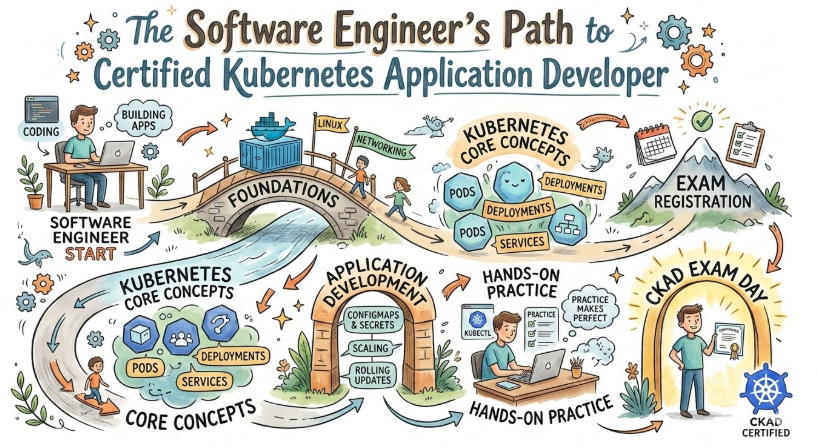
The bridge between writing code and running it has never been shorter. In the past, a software engineer could stop thinking once their feature was merged. Those days are gone. Today, the most successful engineers are the ones who understand the platform where their applications live. Kubernetes has become the universal language for that platform.
When I mentor engineers or advise managers on team growth, the conversation always leads to the Certified Kubernetes Application Developer (CKAD) program. This isn’t just another certificate to hang on a wall. It is a rigorous, practical challenge that proves you can actually build and manage applications in a live, distributed environment.
This guide is for the working professional who wants to cut through the noise and understand how to master Kubernetes application development. We will explore what the CKAD offers, how to prepare for it, and why it is a strategic move for your career.
The Big Picture: Mapping the Certification Landscape
Understanding where the CKAD fits in the wider world of tech is the first step toward building a solid career roadmap.
| Track | Level | Who it’s for | Prerequisites | Skills Covered | Recommended Order |
| Cloud Basics | Entry | Beginners / Leads | General Tech | Cloud & Container Concepts | 1 |
| Kubernetes Dev | Professional | Software Engineers | Container Basics | Pods, Networking, Scaling | 2 |
| Kubernetes Admin | Professional | SREs / Ops | Linux Skills | Cluster Setup & Maintenance | 3 |
| Security | Specialist | Security Engineers | CKA Cert | Hardening & Protection | 4 |
| Automation | Associate | DevOps Engineers | Basic Cloud | Infrastructure as Code | 5 |
| Management | Foundation | Leads / Directors | Leadership | DevOps Culture & Delivery | 6 |
The Deep Dive: Certified Kubernetes Application Developer (CKAD)
The CKAD is unique because it forces you to think like an architect while acting like a developer. It focuses on the everyday tasks required to keep applications healthy and scalable.
What it is
The Certified Kubernetes Application Developer (CKAD) is a performance-based exam from the Cloud Native Computing Foundation (CNCF). You don’t answer multiple-choice questions here. Instead, you are given a live terminal and two hours to solve complex engineering problems. It validates your ability to design, build, and troubleshoot applications directly on a Kubernetes cluster.
Who should take it
This is for any Software Engineer or Application Developer who works with containerized code. If you want to move beyond “just coding” and into “system ownership,” this is for you. Engineering Managers should also consider it. Understanding the technical reality of Kubernetes allows you to lead teams with more confidence and make better decisions regarding timelines and architecture.
Skills you’ll gain
Preparing for the CKAD changes the way you look at software. You stop viewing an application as a single file and start seeing it as a part of a larger, self-healing system.
- Design and Build: You will master Pod creation and learn how to use multi-container patterns to make your apps more modular.
- Deployment Management: You will learn how to update software with zero downtime and how to use Helm to manage complex installations.
- System Observability: You will learn to use health probes and logging to ensure your system is performing as expected.
- Environment Configuration: You will gain the skills to manage application settings and sensitive secrets safely outside of your code.
- Networking: You will learn how to connect services together and how to use Network Policies to keep that traffic secure.
Real-world projects you should be able to do after it
The goal of this program is to give you the skills to solve real production issues on Monday morning.
- Building Resilient Microservices: You can create applications that automatically restart if they crash and scale up when users flood your site.
- Secure Data Management: You will know how to mount secrets and config files into your containers without risking data leaks.
- Continuous Updates: You will be able to perform rolling updates, ensuring that users never see a “site down” page during a new release.
- Traffic Control: You will be able to route traffic to specific versions of your app and block unauthorized network access between services.
- Resource Optimization: You will be able to set CPU and memory limits, ensuring that one “noisy neighbor” app doesn’t take down the entire cluster.
Preparation plan (7–14 days / 30 days / 60 days)
The time you need to invest depends on your current comfort level with the command line.
The 14-Day “Quick Start” (For Current Practitioners)
This is for those who are already using kubectl at work.
- Week 1: Review the official exam domains. Identify and study the tools you don’t use daily, such as Network Policies or Jobs.
- Week 2: Practice speed. The CKAD is a race. Take mock exams and focus on solving problems using short, imperative commands.
The 30-Day “Standard” (For Working Engineers)
This is the most effective path for someone who knows Docker but is new to Kubernetes.
- Days 1-10: Master the core objects—Pods, Services, and Deployments. Learn how they interact.
- Days 11-20: Focus on networking, storage, and security. Learn how to configure Ingress and Persistent Volumes.
- Days 21-30: Practice and Mock Exams. Learn the shortcuts for
kubectland get used to looking up syntax in the official documentation.
The 60-Day “Foundational” (For Beginners)
If you are new to containers and the cloud, take your time to learn the “Why” before the “How.”
- Month 1: Focus on Linux basics and Docker. You must be comfortable with the terminal and container images before moving to Kubernetes.
- Month 2: Follow the 30-day plan. Spend extra time on hands-on labs to build muscle memory.
Common mistakes
I have seen many great engineers fail this exam simply because they didn’t respect the clock.
- Writing YAML from scratch: This is the biggest time-waster. Use
kubectlflags to generate your YAML files for you. - Ignoring the Namespace: If you create a perfect Pod but put it in the wrong namespace, you get zero marks. Always check the context.
- Over-thinking one task: If a question is hard, move on. You need a 66% to pass, not a 100%. Don’t let one hard task ruin your whole exam.
- Typing errors: A single typo in a YAML file can be hard to find under pressure. Always use the
--dry-runflag to test your commands before applying them.
Choose Your Path: 6 Directions for Growth
Kubernetes is the foundation for almost every modern engineering role. Once you have the CKAD, you can specialize in one of these six areas.
1. DevOps
This path is about the flow of work. You focus on automating the path from a developer’s machine to the production cluster, ensuring every step is fast and reliable.
2. DevSecOps
Security is the priority here. You learn how to scan images, secure the supply chain, and ensure that your Kubernetes clusters are locked down from the start.
3. SRE (Site Reliability Engineering)
SREs are the guardians of uptime. You focus on making sure systems are reliable, scalable, and easy to monitor, using code to fix operational problems.
4. AIOps/MLOps
This is where data science meets infrastructure. You focus on running and scaling AI models on Kubernetes, managing the heavy workloads they require.
5. DataOps
Data is complex. In this path, you focus on automating the pipelines that move data around, ensuring that your databases and data tools run smoothly on the cluster.
6. FinOps
This is about value. You focus on the cost of the cloud, making sure that your Kubernetes resources are used efficiently so the company doesn’t waste money.
Role → Recommended Certifications: A Career Map
If you are planning your next promotion or job change, here is how to align your certifications.
| Your Role | Core Certification | Recommended Next Step |
| Software Engineer | CKAD | Cloud Associate |
| DevOps Engineer | CKA | Terraform Associate |
| SRE | CKA | CKAD |
| Platform Engineer | CKA | CKS |
| Security Engineer | CKS | DevSecOps Foundation |
| Data Engineer | DataOps Foundation | CKAD |
| FinOps Professional | FinOps Practitioner | Cloud Basics |
| Engineering Manager | Cloud Basics | CKAD |
What’s Next? Expanding Your Skills
Passing the CKAD is a major win, but the learning doesn’t stop. You have three main directions you can go.
- Go Deeper (Same Track): Take the CKA (Administrator) exam. This will show you how to manage the cluster itself, not just the apps inside it.
- Go Wider (Cross-Track): Learn Terraform. This allows you to manage the actual servers and networks where Kubernetes lives.
- Go Higher (Leadership Track): Look into the DevOps Foundation. This focuses on the culture and strategies needed to lead modern engineering teams.
Top Training Institutions for CKAD Success
Choosing the right training partner can make the difference between passing and failing. These institutions are known for their hands-on approach and experienced teachers.
- DevOpsSchool: A leading provider that offers deep-dive, practical training. They focus on turning you into an expert who can solve real problems, not just someone who can pass a test.
- Cotocus: They specialize in technical workshops and corporate training. Their programs are great for teams that want to standardize their Kubernetes knowledge together.
- Scmgalaxy: A very well-known name in the community, they focus on the practical side of configuration and source code management.
- BestDevOps: They provide result-oriented training designed to help you build the speed and accuracy you need for the CKAD exam environment.
- devsecopsschool: If you want to learn how to build secure applications on Kubernetes from day one, this is the perfect place to start.
- sreschool: Their training is focused on reliability and monitoring, making it a great choice for engineers who want to specialize in keeping systems up.
- aiopsschool: For those moving into the AI world, they teach you how to manage the heavy data and processing needs of machine learning on Kubernetes.
- dataopsschool: They focus on the specific challenges of running data pipelines and distributed databases in a containerized world.
- finopsschool: A great resource for learning how to manage cloud costs, which is a vital skill for senior engineers and managers today.
Strategic FAQs: Insights for Leaders and Senior Engineers
1. Why is a performance-based exam better than a written one?
A written exam tests what you can remember. A performance-based exam tests what you can do. In a crisis, I would always trust an engineer who has proven they can work in a live terminal.
2. How long should an engineer study for the CKAD?
For most working software engineers, 30 days of focused study is enough to build the skills and the speed needed to pass.
3. Do we need a specific cloud provider for this?
No. The CKAD is vendor-neutral. The skills you learn will work exactly the same on AWS, Azure, Google Cloud, or your own local hardware.
4. How does the CKAD compare to the CKA?
The CKAD is for people who use the cluster (Developers). The CKA is for people who manage the cluster (Admins). Both are valuable for a complete understanding of the system.
5. Is this certification recognized globally?
Yes, it is the global standard. Major tech companies around the world look for this certification when hiring senior engineers and DevOps specialists.
6. Can my team learn this through self-study?
It is possible, but it takes much longer. Guided training usually cuts the learning time in half because it focuses on the topics that actually appear in the exam.
7. How often does the certification need to be renewed?
It is valid for two years. Because Kubernetes changes so fast, this ensures that engineers are always up to date with the latest features.
8. Does the exam allow the use of documentation?
Yes, you can access official documentation during the test. This makes it more like a real workday, where knowing how to find the answer is just as important as knowing it.
9. What is the most common reason people fail?
Usually, it is running out of time. Candidates often know the answers but are too slow at typing or spend too long on a single difficult question.
10. Should managers take the CKAD?
Yes. A manager who understands the platform their team uses can set more realistic goals and build a much better relationship with their engineers.
11. What is the value of the free retake?
It takes away the “fear of failure.” Knowing you have a second chance allows engineers to take the first attempt as a learning experience.
12. Is Kubernetes too complex for every company?
It can be, but the CKAD teaches you the standard way to do things. Following these standards prevents messy “custom” solutions that are hard to fix later.
Practical FAQs: Everything You Need to Know About the Test
1. What is the official link and who provides the training?
The official site is here: CKAD Official URL. The training is often facilitated by DevOpsSchool.
2. How long do I have for the exam?
The exam is a strict two hours long. You will be given a set of tasks to complete in that time.
3. What score is needed to pass?
You need a score of 66% to earn your certification.
4. Can I take the exam from home?
Yes, it is a remote-proctored exam. You just need a webcam, a stable internet connection, and a quiet room.
5. When will I get my results?
Results are typically emailed to you within 24 to 48 hours after the exam is finished.
6. Does this certification require an Administrator certification first?
No, the CKAD is a standalone certification. You do not need the CKA or any other certificate to take it.
7. Can I use my own laptop for the exam?
Yes, as long as your computer meets the technical requirements for the proctoring software and has a working webcam.
8. How can I save time during the exam?
The best way is to set up a few basic aliases, like alias k=kubectl, as soon as you start the terminal.
Conclusion
The move to cloud-native technology is not just a trend—it is a fundamental change in how software is created. Mastering Kubernetes is no longer an optional skill for those who want to reach the highest levels of software engineering. The Certified Kubernetes Application Developer (CKAD) program provides the most practical and respected way to prove you have those skills. It is a challenging journey, but it builds the technical muscle memory and confidence needed to handle complex production environments. Whether you are an individual engineer looking to advance your career or a leader looking to build a high-performing team, the CKAD is a strategic investment that pays off in more reliable software and faster delivery. Start your journey today, find a solid training partner, and become a master of the modern cloud.





Leave a Reply
You must be logged in to post a comment.