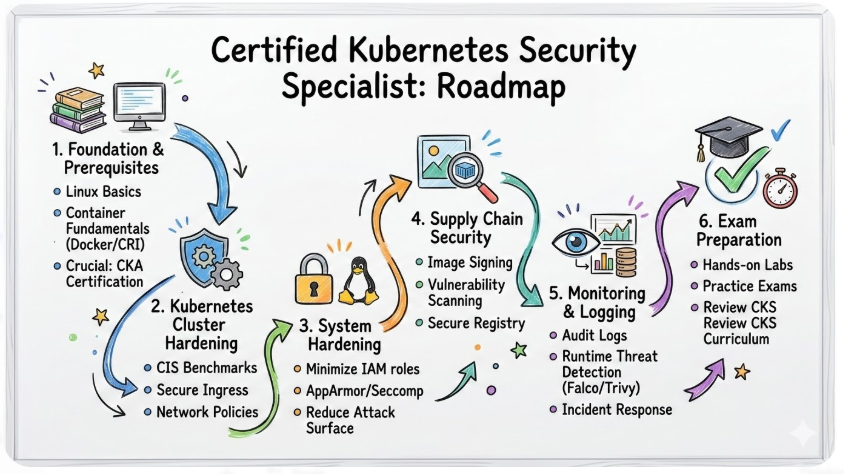
Over the years, I’ve seen many engineers focus entirely on getting their applications to “just run.” While keeping things alive is important, the real challenge is keeping them safe. We used to worry about physical locks and server room keys. Now, we worry about container vulnerabilities, misconfigured API servers, and “leaky” pod communications.
The Certified Kubernetes Security Specialist (CKS) is where you stop being a generalist and start being a defender. It is a core part of the Master in Observability Engineering Certifications Program, because you cannot truly observe what you haven’t secured. Whether you are managing a team in India or working as a software engineer in a global firm, this guide is your roadmap to mastering the hardest level of Kubernetes.
The Professional Certification Landscape
Before you jump into the security deep end, you need to see how the pieces fit together. Think of your career like building a house; you don’t start with the roof. You build the foundation first, and security is the structural reinforcement that keeps the house standing.
| Track | Level | Who it’s for | Prerequisites | Skills Covered | Recommended Order |
| DevOps | Foundation | All Engineers | Linux Basics | Automation, CI/CD | 1 |
| SRE | Specialist | Reliability Leads | CKA | SLOs, Monitoring | 2 |
| Kubernetes | Professional | Admins, SREs | Linux Skills | Cluster Management | 3 |
| Security | Expert | Security Leads | CKA | CKS, Hardening | 4 |
| DevSecOps | Expert | Architects | CKS, CKA | Lifecycle Defense | 5 |
| Observability | Master | Technical Leads | SRE, CKS | Full System Viz | 6 |
Certified Kubernetes Security Specialist (CKS)
The CKS is a performance-based exam. You don’t just sit there and click boxes. You are dropped into a broken, insecure cluster and told to fix it. It’s the ultimate test of your skills under pressure.
What it is
The CKS is the highest-level security certification offered by the CNCF. It validates your ability to protect the entire lifecycle of an application running on Kubernetes. This isn’t just about setting a password; it’s about auditing every line of configuration, scanning every image, and monitoring every system call. It is the bridge that turns a standard administrator into a security expert.
Who should take it
This is for the engineer who is already comfortable managing a cluster but wants to be the one who ensures it can’t be hacked. It is perfect for Software Engineers, SREs, and Platform Engineers. For Engineering Managers, having a CKS-certified team means you can sleep better at night knowing your global infrastructure is following the best security practices in the industry.
Skills you’ll gain
Preparing for this certification forces you to dig into parts of the system that most people never see. You move from “knowing about” security to “implementing” security.
- Cluster Hardening: You will learn how to lock down the Kubernetes API server, use CIS Benchmarks to find vulnerabilities, and restrict administrative access using the most strict RBAC (Role-Based Access Control) policies possible.
- Host and Node Security: You’ll gain the ability to protect the underlying Linux nodes. This includes using AppArmor to restrict application behavior and Seccomp to limit the system calls a container can make.
- Supply Chain Integrity: You will master the process of ensuring that only trusted code enters your cluster. You’ll learn to scan images for known flaws, sign images so they can’t be swapped out, and use Admission Controllers to block anything that isn’t safe.
- Runtime Defense: You’ll learn how to watch the cluster while it’s running. Using tools like Falco, you will be able to detect if a pod is being tampered with or if a sensitive file is being accessed by the wrong process.
Real-world projects you should be able to do after it
Once you pass the CKS, your value to a company skyrockets because you can solve problems that others can’t even see yet.
- Building a Defensive CI/CD Pipeline: You can build a system where code is automatically checked for security risks before it ever touches a server. If a developer tries to use an old, insecure image, your pipeline will stop them.
- Setting up an Automated Response System: You will be able to configure monitoring that doesn’t just send an alert when something is wrong, but can actually kill a pod or isolate a node automatically if it detects a security breach.
- Implementing Zero-Trust Networking: You can design a network where no pod can talk to another pod unless you have explicitly given it permission. This stops a hacker from moving through your system if they manage to get into one pod.
Preparation Plan
7–14 Days (The Expert Sprint):
For those who are already doing security work every day.
- Phase 1: Focus on the niche security tools like Falco and Trivy. Learn the command syntax so you don’t have to look it up.
- Phase 2: Practice manual edits to the Kubernetes API server and Kubelet flags.
- Phase 3: Run through the “Killer.sh” simulator to get used to the time pressure.
30 Days (The Standard Path):
- Weeks 1-2: Master RBAC, Network Policies, and the core Kubernetes security features. These are the “easy” points on the exam.
- Week 3: Deep dive into host-level security (Linux kernel hardening) and image scanning.
- Week 4: Spend your time in the terminal. Do the same task five times until you can do it without looking at the documentation.
60 Days (The Foundation Path):
- Month 1: Focus on the Linux basics. If you don’t know how to look at system logs or manage Linux permissions, you will struggle with the CKS.
- Month 2: Follow the 30-day plan, giving yourself extra time to understand “why” a certain setting makes the cluster more secure.
Common Mistakes
I’ve seen very smart people fail the CKS because of small errors. It’s usually about the exam environment, not the technology.
- Wasting Time on One Task: The exam is timed. If you get stuck on a difficult AppArmor profile, skip it and come back. You can pass without a perfect score, but you can’t pass if you don’t finish.
- Messing Up the Context: In the exam, you move between different clusters. If you apply a fix to the wrong cluster, you get zero points. Always check your
kubectl config current-contextbefore you start a task. - Messing Up the YAML: One extra space in a YAML file will break the whole thing. Always use
kubectl apply --dry-run=clientto check your work before you submit it.
Best Next Certification After CKS
Winning the CKS is like finishing the final level of a game, but it also unlocks the “post-game” content. Based on industry data, here are the three paths you should consider next:
- Same Track (Specialization): Certified DevSecOps Professional. This takes your CKS knowledge and moves it “left,” focusing on securing the development process.
- Cross-Track (Broadening): AWS/Azure/GCP Security Specialty. This proves you can secure the “ground” your Kubernetes cluster sits on.
- Leadership (Mastery): Master in Observability Engineering. This is the peak of the mountain. It teaches you how to turn all those security logs into a clear picture of your system’s health.
Choose Your Path: 6 Learning Tracks
The beauty of the “Ops” world is that there is a path for everyone. CKS is the defensive wall for all of them.
- DevOps Path: Focuses on speed and quality. CKS ensures that being “fast” doesn’t mean being “vulnerable.”
- DevSecOps Path: This is the most natural fit. You become the security architect who designs how developers and operations work together safely.
- SRE Path: Focuses on uptime. Since most outages are caused by security breaches or misconfigurations, CKS is a major tool for an SRE.
- AIOps/MLOps Path: As we move toward AI-driven systems, the infrastructure running those models must be airtight. CKS is vital for protecting data-heavy workloads.
- DataOps Path: Focuses on the flow of data. Your security skills will ensure that sensitive customer data is always isolated and encrypted.
- FinOps Path: Focuses on the cost. A secure cluster is often a leaner, cheaper cluster because you aren’t running unnecessary or malicious services.
Role → Recommended Certifications Mapping
| If your role is… | Start here… | Then earn… | Reach the top with… |
| DevOps Engineer | CKA | CKS | DevSecOps Lead |
| SRE | CKA | Monitoring Certs | Observability Master |
| Platform Engineer | CKA | Terraform | CKS |
| Cloud Engineer | Cloud Assoc. | CKA | CKS |
| Security Engineer | CKA | CKS | Advanced Security (CISSP) |
| Data Engineer | Data Tools | CKA | CKS (for K8s workloads) |
| FinOps Practitioner | FinOps Cert | CKA | Cloud Architecture |
| Engineering Manager | CKA | CKS | Technical Leadership |
Top Institutions for CKS Training
Finding a good teacher is the shortcut to success. These organizations are the leaders in providing hands-on CKS training.
DevOpsSchool is a top choice for anyone who wants a guided, classroom-style experience. They don’t just give you a PDF; they walk you through the logic of Kubernetes security. Their labs are very close to the real exam, which helps you build the muscle memory needed to pass on your first attempt.
Cotocus provides a deep technical dive that is perfect for engineers who want to understand the “under the hood” mechanics of container security. Their training is updated frequently to match the latest versions of Kubernetes, ensuring you aren’t learning outdated material.
Scmgalaxy has a massive community and a library of resources that is hard to beat. They focus on the practical, everyday problems that engineers face, making their CKS training very relevant to your actual job, not just the exam.
BestDevOps offers a very efficient, results-oriented training program. They focus on the high-probability exam topics, making it an excellent choice for busy professionals who need to learn as much as possible in a short amount of time.
Devsecopsschool is dedicated to the intersection of security and development. If you plan on making security your primary career focus, their CKS training is a perfect entry point into their more advanced DevSecOps tracks.
Sreschool approaches the CKS from the perspective of system reliability. They teach you that security is not a separate thing, but a fundamental part of keeping a service alive. Their training is very practical and engineering-focused.
Aiopsschool looks at where the industry is going. Their CKS training helps you understand how container security will work in the age of AI and automated threat response.
Dataopsschool is the best place if your job involves managing data pipelines. They show you exactly which parts of the CKS curriculum are most important for protecting sensitive data at rest and in transit.
Finopsschool connects technical security to the bottom line. They help you understand that a secure, well-managed cluster is also a more cost-effective one for your company.
FAQs: Career and Strategy
- Is CKS harder than CKA? Yes. CKA is about building the car. CKS is about making sure the car can’t be stolen or crashed. It requires more niche technical knowledge.
- How soon do results arrive? You will usually get your score via email within 24 hours of finishing the test.
- Is this valuable for the Indian market? Definitely. Indian tech firms and global capability centers are aggressively hiring for security-certified cloud engineers.
- Can I skip CKA and go to CKS? No. You must have an active CKA certification to be eligible for the CKS exam.
- Is it all command-line work? Yes. There are no multiple-choice questions. You will be in a terminal for the full two hours.
- How long does the certification last? It is valid for 2 years before you need to recertify.
- What is the passing score? You need a 67% or higher to pass.
- Can I use the internet during the exam? No. You can only use the official documentation sites listed in the exam rules.
- Are the questions the same for everyone? No. Questions are chosen from a pool, so every exam attempt is different.
- Do I get a free retake? Yes, the standard voucher from the CNCF includes one free retake if you fail.
- Do I need to be a programmer? No, but you must be an expert at reading and writing YAML and basic shell scripts.
- Which simulator should I use? Killer.sh is the industry standard and is highly recommended for CKS practice.
FAQs: Technical Specifics
- What Kubernetes version is used? The exam usually stays within one or two versions of the most recent stable release.
- Is “Falco” a big part of the test? Yes. You should expect questions on installing Falco and reading or writing basic rules.
- How much Linux knowledge is required? You need to be very comfortable with basic Linux admin tasks like looking at system logs and managing file permissions.
- Will I have to fix a broken cluster? You might. You should know how to use
kubeadmto troubleshoot control plane components. - Is image scanning important? Yes. You will likely be asked to use tools like Trivy to find and report security holes in container images.
- Which text editor should I use? Most people use Vim or Nano. Speed is key, so use the one you know best.
- How important is RBAC? It is foundational. You should be able to create Roles and RoleBindings without looking at the documentation.
- Can I copy/paste from the docs? Yes. In fact, copying YAML examples from the official docs and editing them is the fastest way to solve most tasks.
Conclusion
Becoming a Certified Kubernetes Security Specialist is a major turning point for any cloud engineer. It is the moment you move from being a user of technology to a guardian of it. As a critical milestone in the Master in Observability Engineering Certifications Program, the CKS gives you the depth of knowledge needed to ensure that your clusters are not just running, but are resilient against the complex threats we face today. The path is difficult—requiring mastery of the Linux kernel, the Kubernetes control plane, and a wide array of specialized security tools—but the reward is a professional standing that is respected globally. Whether you are leading a team in Bangalore or architecting a platform in Silicon Valley, the CKS is your proof that you are ready for the highest levels of technical responsibility in the modern era of computing.



Leave a Reply
You must be logged in to post a comment.