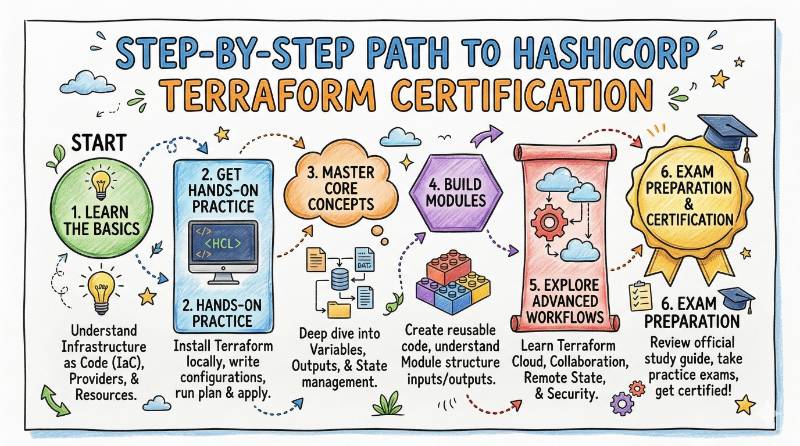
In the current landscape of digital transformation, the ability to manage infrastructure through code is no longer a “nice-to-have” skill—it is the foundation of a modern engineering career. We have moved past the era where engineers manually configured servers in a dark data center. We are now in the age of the “Cloud Engineer,” where every piece of hardware, every network rule, and every security policy is written, tested, and deployed just like software.
HashiCorp Terraform has become the primary tool for this evolution. It provides a single, unified way to talk to any cloud provider, whether you are using AWS, Azure, Google Cloud, or on-premise systems. As a mentor who has guided countless teams through the transition from manual setups to full-scale automation, I can tell you that Terraform is the bridge to your next career level.
This guide is a comprehensive resource for software engineers, DevOps practitioners, and managers across India and the global tech market. It outlines the path to becoming a certified expert and explains how these skills integrate with the wider world of Kubernetes and specialized domains like FinOps and DevSecOps.
The Necessity of Infrastructure Automation
The transition from manual configuration to automated deployment is seen as a requirement for survival in the digital age. When infrastructure is managed through code, the risk of human error is virtually eliminated. It is often noted that manual changes lead to “configuration drift,” where environments that should be identical start to differ over time. Automation prevents this by ensuring that the real-world environment always matches the desired state defined in the code.
For software engineers and leadership, automation represents a massive increase in efficiency. Deployments that previously took days or weeks can now be completed in minutes. This speed allows businesses to react faster to market changes. Furthermore, because the code acts as documentation, any team member can look at the configuration and understand exactly how the system is built. It is clear that the future of IT is defined by those who can master these automated workflows.
Advancing Careers with Observability Engineering
While building infrastructure is a critical skill, maintaining its health is equally important. The Master in Observability Engineering Certifications Program is designed to complement automation skills by teaching engineers how to gain deep insights into their systems. It is acknowledged that even the most perfectly automated infrastructure can fail. When failures occur, observability is what allows teams to find the root cause quickly.
Through this advanced certification program, expertise is gained in the three pillars of observability: metrics, logs, and traces. It is observed that as systems become more complex and distributed, traditional monitoring is no longer enough. Engineers are taught how to build systems that are “observable” by design. This combination of building with Terraform and monitoring with observability tools creates a highly sought-after professional profile in the global market.
Professional Certification Comparison
Identifying the correct starting point is vital for long-term career success. The following table outlines the primary certification path for those entering the world of infrastructure automation.
| Track | Level | Who it’s for | Prerequisites | Skills covered | Recommended order |
| Infrastructure Automation | Associate | Engineers & Managers | General Cloud Knowledge | HCL, State Management, Modules, Providers | Start Here |
Detailed Certification Insight: Hashicorp Terraform Associate
What it is
The Hashicorp Certified Terraform Associate is a professional-level credential that validates an individual’s proficiency in using the fundamental features of the tool. It is focused on the open-source version of the software. It tests the ability to manage the lifecycle of resources, understand the core workflow, and apply best practices for infrastructure management.
Who should take it
This certification is highly recommended for anyone involved in cloud operations, including DevOps engineers, site reliability engineers (SREs), and cloud architects. It is also suitable for software developers who are moving toward a full-stack or platform-focused role. Engineering managers find this certification valuable as it provides the technical context needed to lead modern engineering teams.
Skills you’ll gain
A comprehensive understanding of the tool’s internal logic is developed throughout the training process. The ability to translate business requirements into technical blueprints is mastered.
- Deep proficiency in the HashiCorp Configuration Language (HCL) is achieved.
- Advanced techniques for managing the terraform state file and ensuring its security are learned.
- The use of modules to create dry, reusable, and organized code is mastered.
- Knowledge of how to interact with various cloud APIs through providers is gained.
- Mastery of essential commands such as plan, apply, and destroy is developed.
Real-world projects you should be able to do
Upon successful completion of the training, several high-impact projects can be executed. these projects demonstrate the ability to handle production-grade infrastructure.
- A global, multi-region network architecture is deployed and managed entirely through code.
- Automated provisioning of highly available database clusters with backup policies is achieved.
- Integration of infrastructure deployments into automated CI/CD pipelines is realized.
- Implementation of policy-as-code to ensure that all infrastructure meets corporate security standards.
Preparation plan
A structured and disciplined approach to learning is recommended for achieving the best results.
- 7–14 days: This fast-track plan is utilized by professionals who have significant experience with the tool. Effort is focused on reviewing the official exam objectives and filling in specific knowledge gaps.
- 30 days: This is the standard preparation path. The first two weeks are spent on foundational reading and documentation, while the remaining time is dedicated to practical, hands-on labs.
- 60 days: This comprehensive plan is suggested for those new to infrastructure management. The first month covers general cloud and networking concepts, while the second month focuses purely on automation syntax and workflows.
Common mistakes
Identifying and avoiding common pitfalls is a key part of the preparation journey.
- Relying solely on theoretical knowledge without performing hands-on labs is a frequent reason for failure.
- Misunderstanding how the state file works can lead to catastrophic data loss in production environments.
- Using hardcoded values instead of dynamic variables makes the code difficult to maintain and share.
- Failing to read the official documentation thoroughly leads to missing important updates and new features.
Choose Your Path: 6 Specialized Career Journeys
Infrastructure automation is a foundational skill that can be applied to various specialized domains. The following six paths are recommended for career diversification:
- DevOps Path: Focus is placed on creating a seamless flow between development and operations through continuous automation.
- DevSecOps Path: Security is integrated into the heart of the automation process, ensuring that every deployment is secure by default.
- SRE Path: The primary focus is on system reliability and performance, using automation to reduce downtime and improve efficiency.
- AIOps/MLOps Path: Specialized infrastructure for supporting artificial intelligence and machine learning models is automated and managed.
- DataOps Path: The focus is on automating the complex data pipelines and storage solutions required for modern analytics.
- FinOps Path: Automation is used to track and optimize cloud spending, ensuring that resources are used in the most cost-effective manner.
Role-Based Certification Mapping
Specific certifications are suggested based on the intended professional role within an organization:
- DevOps Engineer: Terraform Associate + Kubernetes Administrator.
- SRE: Terraform Associate + Observability Specialist.
- Platform Engineer: Terraform Associate + Multi-cloud Professional.
- Cloud Engineer: Terraform Associate + Solution Architecture.
- Security Engineer: Terraform Associate + Security Automation.
- Data Engineer: Terraform Associate + Data Infrastructure.
- FinOps Practitioner: Terraform Associate + Cloud Financial Management.
- Engineering Manager: Terraform Associate + Technical Leadership.
Why Choose DevOpsSchool?
DevOpsSchool is recognized as a premier institution for technical education, particularly in the fields of automation and operations. The curriculum is designed by industry veterans who bring years of practical experience to the classroom. This ensures that the training is not just academic but is grounded in real-world scenarios.
The support provided to learners is unparalleled. Every student is given access to high-quality lab environments where they can practice without fear of making mistakes. Mentors are available to provide guidance and answer complex questions. Furthermore, the certifications provided by DevOpsSchool are respected by employers globally, providing a significant advantage in the job market. Choosing this institution is seen as a strategic investment in a long-term professional career.
Next Certifications to Consider
After achieving the primary automation certification, the following three directions are suggested for further growth:
- Same Track: Specialize further in the Hashicorp ecosystem by mastering Vault for secrets management or Consul for service networking.
- Cross-Track: Expand into container orchestration by pursuing a Kubernetes certification, which is the perfect companion to infrastructure automation.
- Leadership: Focus on certifications that emphasize architectural design and strategic planning for large-scale enterprise environments.
Top Institutions for Training and Certification
DevOpsSchool
A leader in the field of DevOps education, this institution offers a wide range of courses focused on practical application and industry readiness. Their hands-on approach is highly valued by students.
Cotocus
Known for providing specialized corporate training, this provider focuses on helping large organizations transition to modern, automated workflows through intensive workshops.
Scmgalaxy
This platform provides a massive library of resources and community support for DevOps professionals. It is a key source of information for staying updated on the latest tools and trends.
BestDevOps
Training programs here are designed for career transformation. The focus is on providing students with the skills needed to move into high-level engineering and architecture roles.
DevSecOpsSchool
This school focuses on the critical intersection of security and operations. Students are taught how to build automation that is secure, compliant, and resilient.
Sreschool
Education here is centered around the principles of site reliability. It is the ideal choice for those who want to learn how to keep large-scale systems running smoothly.
Aiopsschool
This institution prepares engineers for the future of IT operations by teaching the integration of artificial intelligence into automation workflows.
Dataopsschool
Specialized training is provided for managing the infrastructure required for big data and analytics, ensuring data integrity and speed.
Finopsschool
This provider teaches the financial side of cloud computing, helping professionals balance performance with cost efficiency.
Frequently Asked Questions (Career Focus)
- Is the Terraform Associate exam considered difficult?It is a professional-level test that requires a solid grasp of both the theory and practical application of the tool.
- What is the recommended study time for a working professional?Most individuals find that 30 to 60 days of consistent study is sufficient for a successful result.
- Are there any prerequisites for the exam?While no formal prerequisites exist, a basic understanding of cloud providers is highly recommended.
- In what order should I pursue these certifications?It is best to start with the Terraform Associate before moving on to more specialized certifications like Kubernetes or Observability.
- What is the current value of this certification in the market?It is highly valued as organizations across the globe are moving toward fully automated infrastructure models.
- What career growth can be expected after certification?Many professionals see opportunities for senior roles, lead engineering positions, and specialized architecture tasks.
- Can I pass the exam without hands-on practice?It is very difficult, as many questions test the candidate’s understanding of specific command-line behaviors.
- How long is the certification valid?The certification is typically valid for two years, after which recertification is encouraged to stay current with software updates.
- How does Terraform compare to other automation tools?Its main advantage is its ability to manage diverse resources across multiple cloud and local environments using a single language.
- Do I need to be a programmer to learn Terraform?While a programming background is helpful, the language used is designed to be accessible to everyone in the IT field.
- Why is the observability program mentioned in this guide?Because building systems and monitoring systems are the two core halves of modern system management.
- Should an engineering manager get certified?Yes, it provides the necessary technical insight to lead teams effectively and manage project expectations.
FAQs on Hashicorp Terraform Training & Certification Program
- Where can I find the registration link for the course?The details and official link can be found at DevOpsSchool Certification Page.
- What is the format of the exam questions?The exam includes a variety of multiple-choice, multiple-response, and true/false questions.
- Are practice labs provided during the training?Yes, reputable training providers like the ones listed above always include hands-on lab environments.
- Can the exam be taken in India?Yes, the exam is available globally as an online proctored test.
- What is the passing grade for the certification?Candidates are usually required to score around 70% to pass the exam and receive the credential.
- Is there a policy for retaking the exam?Yes, if the first attempt is not successful, a retake can be scheduled after a waiting period and an additional fee.
- Is this certification recognized by large tech companies?Hashicorp certifications are widely recognized and respected by top-tier technology firms globally.
- Will this training assist in technical interviews?The deep technical knowledge and practical skills gained are highly beneficial for passing technical screenings.
Testimonials
“The structured learning path provided the clarity needed to master complex automation concepts. The focus on state management was particularly useful.” – Vivek
“An exceptional training experience that combined deep theory with practical labs. It was exactly what I needed to advance my career.” – Anjali
“The guidance from the mentors made a significant difference in my preparation. I felt confident and well-prepared for the exam.” – Sandeep
Conclusion
The journey toward mastering Hashicorp Terraform is seen as a transformative step for any professional in the technology sector. It is observed that as the industry moves further away from manual configuration, the demand for automation experts continues to grow. By following a structured training program and achieving professional certification, individuals are equipped with the skills needed to build and manage the complex infrastructure of the future. This guide has provided a comprehensive overview of the path to success, emphasizing the importance of both building through automation and understanding through observability. It is encouraged that every engineer and manager continues to invest in these critical skills to remain relevant and impactful in an ever-changing digital landscape. Through dedication and practical experience, a high level of expertise can be attained, leading to a rewarding and long-term career.



Leave a Reply
You must be logged in to post a comment.