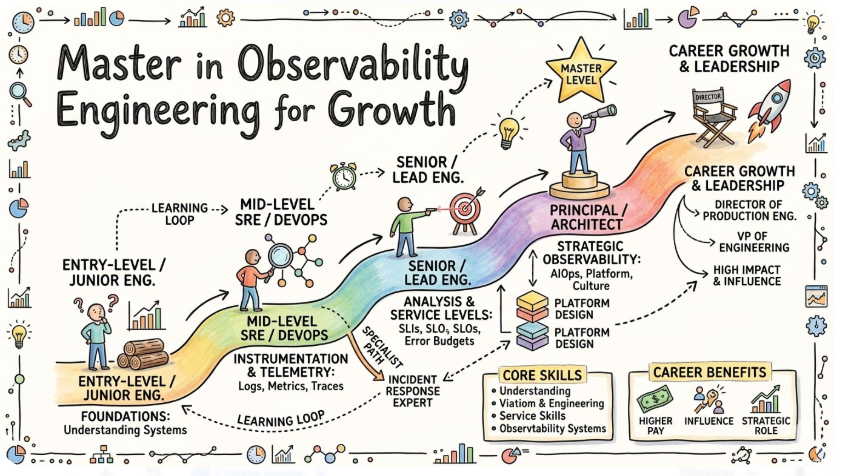
We live in a time where a single minute of downtime can cost a company millions. But there is a bigger problem than downtime: “silent failures.” These are the bugs that don’t crash the server but make the app slow, drain the database, or frustrate your users until they leave. As systems get more complex, we can no longer rely on simple “up or down” checks. We need a way to see inside.
Observability Engineering is the art of making the invisible, visible. It is the most critical skill for any engineer or manager today. If you want to move from being a “fixer” to a “strategist,” you need to master this field. This guide will show you how the Master in Observability Engineering certification can help you build systems that don’t just work, but thrive.
Why Observability Matters Now
In my years of leading technical teams, I have seen that the most successful organizations aren’t the ones with the best code, but the ones with the best visibility. When you can see exactly how a request travels through your cloud, you can fix things before they break. This isn’t just about technical metrics; it’s about business survival.
For engineers in India and across the world, this is the path to the top. Companies are looking for people who can prove that their systems are healthy and efficient. Mastering observability is your way to show that value every single day.
Master in Observability Engineering Certification Overview
The Master in Observability Engineering is the definitive program for those who want to reach the highest level of technical competence. It provides a structured way to learn the deep science of telemetry.
| Track | Level | Who it’s for | Prerequisites | Skills Covered | Recommended Order |
| Observability Mastery | Master | Engineers & Managers | Linux, Networking, Docker | OpenTelemetry, Tracing, SLOs | Core -> Master |
The Deep Dive: Master in Observability Engineering (MOE)
What it is
The Master in Observability Engineering is a high-level certification program provided by DevOpsSchool. It is designed to move you past the basics of looking at logs. It is a deep-dive into how to architect a system that is transparent. You will learn the science of the “Three Pillars”—Logs, Metrics, and Traces—and how to combine them into a single, powerful view of your entire business.
Who should take it
This course is for people who are serious about their careers.
- Software Engineers: Learn how to write code that tells you when it’s hurting.
- SREs & DevOps Engineers: Master the art of reducing “Mean Time to Recovery” (MTTR).
- Engineering Managers: Learn how to read the health of your department through data.
- Platform & Cloud Engineers: Build better, more stable foundations for your company.
Skills you’ll gain
You will stop guessing and start knowing. You will gain the ability to look at a complex cloud environment and know exactly where the bottleneck is.
- Advanced Telemetry: You will learn how to use OpenTelemetry to collect data from any application without changing the core code.
- Contextual Tracing: Learn to follow a user’s path across 50 microservices to find the exact millisecond where a delay happens.
- Reliability Metrics: Master the creation of Service Level Objectives (SLOs) that actually mean something to the business.
- Data Strategy: Learn how to store and analyze massive amounts of data without making your cloud bill skyrocket.
Real-world projects you should be able to do
After finishing this, you will have a portfolio of work that proves you are a master.
- The Self-Healing System: Build a project where the observability data triggers an automatic fix for a common error.
- The Full-Stack Map: Create a live map of every service in your company, showing how they talk to each other and where the stress points are.
- The User Experience Dashboard: Build a view that shows exactly how long real users are waiting for the app to load in different parts of the world.
Preparation Plan
- 7–14 Days (The Foundations): Learn the vocabulary. What is cardinality? What is a span? Get comfortable with the basic theory of telemetry.
- 30 Days (The Tooling): Start using Prometheus and Grafana. Learn how to instrument a simple app and see the data flow in real-time.
- 60 Days (The Expert Level): Focus on the master projects. Learn how to scale these tools for a company with thousands of servers and millions of users.
Common Mistakes
I see many smart engineers make these mistakes. Mastering this course helps you avoid them.
- Too Many Alerts: If your phone is buzzing every 5 minutes, you aren’t monitoring; you are just being annoyed. You must learn to alert only on what matters.
- Thinking Tools are the Answer: Tools change. The principles of observability do not. Don’t just learn a tool; learn the system.
- Forgetting the Business: If your technical metrics are “green” but the business is losing money, your observability is broken. Always link your data to the user experience.
Choose Your Path: 6 Specialized Learning Journeys
Observability is not a silo; it is the glue that holds everything together. Depending on your interest, you can take it in 6 different directions:
- DevOps Path: Focus on “Continuous Feedback.” Use observability to see if a new code change is causing problems as soon as it is deployed.
- DevSecOps Path: Use visibility to find hackers. If a database suddenly starts sending more data than usual, your observability tools should catch it instantly.
- SRE Path: This is about reliability. Use your data to manage “Error Budgets”—knowing exactly when you can take risks and when you need to focus on stability.
- AIOps/MLOps Path: Feed your clean observability data into AI models to find strange patterns that a human would never notice.
- DataOps Path: Ensure your data is moving correctly. If a data pipeline slows down, it can break the company’s reports. Observability keeps the data flowing.
- FinOps Path: Cloud costs are a major problem. Use observability to see which servers are being paid for but not being used.
Role → Recommended Certifications Mapping
To help you reach your career goals, here is the roadmap I recommend:
- DevOps Engineer: Master in DevOps → Master in Observability Engineering.
- SRE: SRE Certified Professional → Master in Observability.
- Platform Engineer: Kubernetes (CKA) → Master in Observability.
- Cloud Engineer: Cloud Architect → Master in Observability.
- Security Engineer: DevSecOps Professional → Master in Observability.
- Data Engineer: DataOps Professional → Master in Observability.
- FinOps Practitioner: FinOps Certified → Master in Observability.
- Engineering Manager: Certified DevOps Manager → Master in Observability.
Leading Institutions for Training & Certification
When you want to become a master, you need to learn from the best. Here are the top institutions that can help you:
This is the top choice for those who want a deep, master-level education. They focus on real-world training led by people who have actually worked in the field for years. Their labs are second to none, giving you the chance to work on production-like systems without the risk.
Cotocus
If you learn best by getting your hands dirty, Cotocus is a great option. They provide excellent lab environments where you can practice complex tasks until they become second nature. Their focus is on making sure you can actually “do” the work, not just talk about it.
Scmgalaxy
Scmgalaxy is a fantastic community-driven institution. They provide a massive amount of technical resources and support, making it a great place for engineers who want to stay connected to the latest trends in the industry.
BestDevOps
This school is perfect for those who want practical, straightforward training. They cut through the fluff and focus on the skills that will actually help you get a job or a promotion in the shortest time possible.
DevSecOpsSchool
For those who want to merge security with operations, this is the place to be. They teach you how to use visibility to protect your applications and respond to threats in real-time.
SRESchool
SRESchool focuses specifically on the culture of reliability. They teach you the mindset of a Site Reliability Engineer—how to think about uptime, error budgets, and system health from a high level.
AIOpsSchool
This is the place for the future. They show you how to use artificial intelligence to manage your systems. You will learn how to take all the data from your observability tools and let an AI help you make decisions.
DataOpsSchool
Data is the lifeblood of modern companies. This school focuses on making sure your data pipelines are healthy and visible. It is perfect for those who want to manage large-scale data systems.
FinOpsSchool
If you want to save your company money, go here. They teach you how to use technical metrics to drive financial decisions, helping you optimize your cloud spend and prove your value to the CFO.
Next Certifications to Take
Once you have mastered Observability Engineering, what is next? According to the data from Gurukul Galaxy, these are the three best paths:
- Same Track: Advanced AIOps – Moving from “seeing” the problem to letting an AI “predict” the problem.
- Cross-Track: DevSecOps Certified Professional – Using your visibility skills to become a security expert.
- Leadership: Certified DevOps Manager (CDM) – Using your technical knowledge to lead departments and set business strategy.
FAQs: Master in Observability Engineering
- Is this course too hard for a beginner? It is a “Master” program, so you should have some basic knowledge of Linux and cloud. It is designed to take you from “Intermediate” to “Expert.”
- How much time will I need to study? Most people find that spending 10 hours a week for two months is enough to really understand the material.
- What are the prerequisites? You should understand how a basic website works, how to use a terminal (Linux), and have some experience with Docker.
- Do I have to take the courses in a specific sequence? It’s best to understand basic DevOps or SRE first, but you can jump straight into Observability if you have the background.
- Is this certification worth it? Yes. Observability is one of the highest-paying skills in the market right now because so few people truly understand it.
- What career outcomes can I expect? You will be qualified for Senior SRE, Observability Architect, or Lead Platform Engineer roles.
- Is there a lot of math? Only basic statistics (like knowing what a “99th percentile” is). You don’t need to be a mathematician.
- Will this help me with remote jobs? Yes. Remote companies rely on observability because they can’t be in the same room. They need the data to talk to each other.
- What tools will I learn? You will use the standard tools used by the biggest companies: Prometheus, Grafana, OpenTelemetry, and the ELK stack.
- Do I get a certificate I can put on LinkedIn? Yes, you receive a professional certificate from DevOpsSchool that is recognized globally.
- Can I take the exam more than once? Yes, if you don’t pass the first time, you can usually retake it after a little more study.
- Is this just for large companies? No. Small startups need observability even more because they have fewer people to watch the systems.
FAQs: Master in Observability Engineering
- Does the course cover cloud-specific tools? Yes, you will learn how to use tools in AWS, Azure, and Google Cloud, but the focus is on “Open” tools that work everywhere.
- Who is the primary instructor? The courses are governed by industry veterans like Rajesh Kumar, who has decades of experience in high-scale systems.
- Are there live classes? Yes, DevOpsSchool offers live instructor-led sessions where you can ask questions in real-time.
- Do I get help with the labs? Yes, there is technical support available if you get stuck on any of the hands-on projects.
- Is there a focus on cost-saving? Yes, a large part of the “Master” curriculum is learning how to be efficient with your data and cloud costs.
- Does it cover AIOps? Yes, it includes how to feed your metrics into AI tools for better anomaly detection.
- How long does the training last? The core training is usually 30-45 days, followed by your final master projects.
- Can a manager take this course? Absolutely. Managers who understand observability make much better decisions for their teams and the business.
Conclusion
Mastering Observability Engineering is about more than just passing an exam; it is about changing how you see the digital world. In a world that is becoming more complex every day, the ability to find clarity in the chaos is the most valuable skill you can possess. By taking this step, you are moving away from the old way of “hope-based” engineering and into a new era of data-driven leadership. Whether you are an engineer looking to reach the next level or a manager trying to protect your business, the Master in Observability Engineering from DevOpsSchool is your guide. The time you spend over the next 60 days learning these skills will set you apart from the crowd for the rest of your career. Don’t just watch your systems; understand them. Don’t just fix problems; build a system that tells you how to be better. The future belongs to those who have the vision to see what others cannot.


Leave a Reply
You must be logged in to post a comment.