Introduction
In the modern software development landscape, speed is no longer the sole metric of success, as organizations must balance rapid delivery with resilience against evolving cyber threats. Traditionally treated as a final gatekeeper review, security often created massive bottlenecks and left critical vulnerabilities exposed late in the development lifecycle. The evolution from DevOps to DevSecOps solves this by embedding security into every phase of the software delivery pipeline as a shared responsibility across development, operations, and security teams. However, transitioning to this model is rarely straightforward, as many organizations stumble over cultural silos, tool overload, and a lack of automation—challenges that can be successfully navigated with structured guidance and expert training from DevOpsSchool.
What Is DevSecOps?
DevSecOps stands for development, security, and operations. It is an extension of DevOps that embeds security practices, tools, and testing directly into the continuous integration and continuous deployment pipeline.
DevOps Versus DevSecOps
While DevOps focuses on breaking down silos between developers and operations to accelerate software delivery, DevSecOps extends this collaboration to include security professionals. In a traditional DevOps model, security teams operate independently, auditing code only after development is complete. DevSecOps transforms security into an integrated, automated discipline that operates concurrently with code creation and deployment.
The Shift Left Approach
The core philosophy of DevSecOps is “Shift Left.” This means moving security testing and validation as early as possible in the software development lifecycle. Instead of finding vulnerabilities in production, developers identify and fix security flaws while writing the code on their local machines or during initial pull request reviews.
Continuous Security in CI/CD
Security in DevSecOps is not a single milestone; it is a continuous feedback loop. Automated security checks run at every stage of the pipeline—from code commits and dependency checks to container image building and infrastructure provisioning. This ensures that security vulnerabilities are caught immediately when they are cheapest and easiest to fix.
Why Teams Struggle with DevSecOps Implementation
Transitioning from a traditional security model to an integrated DevSecOps culture requires navigating significant organizational and technical hurdles.
Cultural Challenges
The deepest barrier to DevSecOps is often organizational culture. Development teams are incentivized to deliver features quickly, while security teams are incentivized to mitigate risk. Without deliberate cultural alignment, these conflicting priorities create friction and resistance.
Legacy Development Processes
Many organizations attempt to overlay modern security automation onto rigid, waterfall-style development workflows. When legacy approval gates and manual change advisory boards remain intact, automated pipelines lose their speed advantage.
Lack of Automation and Tool Complexity
Teams often struggle by attempting to automate everything at once without a coherent strategy. Adopting dozens of disconnected security scanners leads to tool sprawl, overwhelming alert fatigue, and administrative overhead that paralyzes engineering productivity.
Common DevSecOps Mistakes Teams Make
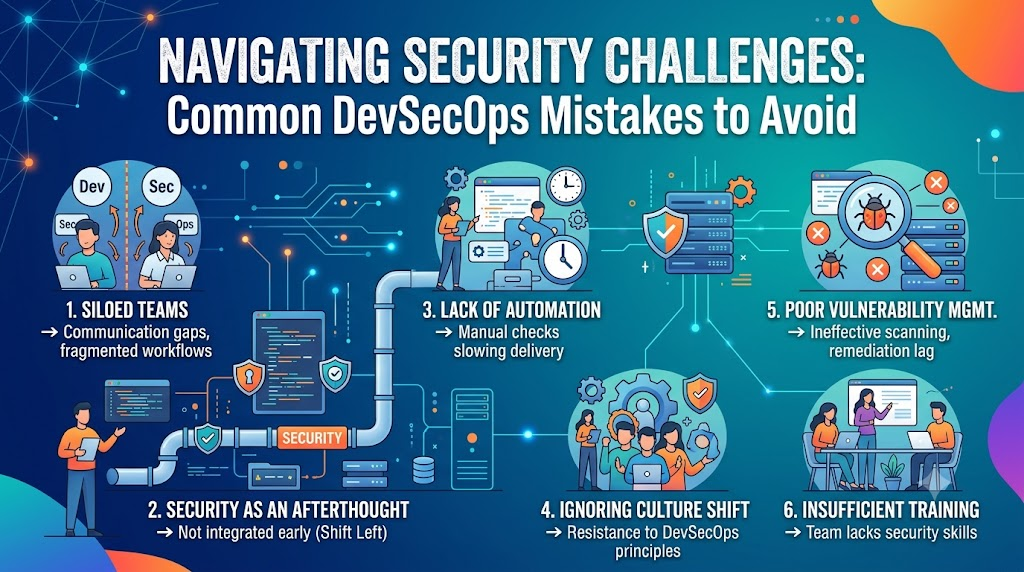
Mistake 1: Treating Security as the Final Step
The Problem
Many organizations still treat security as a gate at the end of the development pipeline. Code is written, tested for functionality, packaged, and then handed off to a security team for final penetration testing. When vulnerabilities are discovered at this stage, remediation is disruptive, expensive, and stressful.
The Best Practice
Embrace Shift Left security by integrating automated checks into early development phases. Developers should run lightweight static analysis in their integrated development environments, and automated scanners should evaluate pull requests before code merges into the primary branch.
Mistake 2: Lack of Collaboration Between Development, Operations, and Security Teams
The Problem
Operating in departmental silos is a primary reason security initiatives fail. Developers write code without understanding security requirements, operations teams deploy infrastructure without hardening guidelines, and security teams write long PDF reports that engineers find difficult to action.
The Best Practice
Establish shared responsibility models across all three functions. Create cross-functional squads, include security engineers in architectural planning sessions, and ensure that security metrics are shared across the entire engineering organization.
Mistake 3: Ignoring Security Automation
The Problem
Relying on manual security reviews and human-driven audits does not scale in modern cloud-native environments. Manual testing creates severe release bottlenecks, forcing teams to bypass security checks to meet tight delivery schedules.
The Best Practice
Automate security testing across every stage of the CI/CD pipeline. Implement automated vulnerability scanners, dependency checkers, and policy enforcement engines that run transparently without requiring manual intervention.
Mistake 4: Using Security Tools Without a Strategy
The Problem
Faced with compliance mandates, teams often purchase numerous commercial and open-source security tools without a unified strategy. This results in tool overload, conflicting scan results, and alert fatigue where critical findings are ignored amidst hundreds of false positives.
The Best Practice
Define a clear tool standardization strategy based on risk prioritization and developer workflow integration. Choose tools that provide actionable remediation advice and integrate smoothly into existing developer environments.
Mistake 5: Not Securing Infrastructure as Code (IaC)
The Problem
Modern infrastructure is defined in code using tools like Terraform, CloudFormation, or Kubernetes manifests. Teams often focus exclusively on application code security while leaving IaC files unmonitored, leading to cloud misconfigurations, open storage buckets, and overly permissive firewall rules.
The Best Practice
Integrate IaC scanning into the version control workflow. Scan infrastructure templates for security compliance and policy violations before deployment to cloud environments.
Mistake 6: Poor Secrets Management
The Problem
Hardcoding database passwords, API tokens, and cryptographic keys directly into source code repositories or environment files is a dangerous and common mistake. If a repository is compromised, these secrets are immediately exposed.
The Best Practice
Adopt centralized secrets management vaults. Retrieve secrets dynamically at runtime, enforce role-based access to credential stores, and implement automated secret rotation policies.
Mistake 7: Ignoring Container and Kubernetes Security
The Problem
Containers and Kubernetes offer incredible agility, but they introduce new attack surfaces. Teams often pull base images from public registries without verifying their integrity or deploy Kubernetes clusters with default, insecure configurations.
The Best Practice
Scan all container images for known vulnerabilities before deployment. Utilize private, trusted container registries, enforce Kubernetes Pod Security Standards, and apply strict network policies between microservices.
Mistake 8: Weak Access Control
The Problem
Using shared administrative accounts, granting overly broad permissions, and failing to revoke access when employees change roles creates severe vulnerabilities that attackers easily exploit for privilege escalation.
The Best Practice
Enforce the principle of least privilege across all systems. Implement multi-factor authentication, robust Identity and Access Management, and strict Role-Based Access Control policies.
Mistake 9: Failing to Monitor Security Continuously
The Problem
Treating security as something that ends at deployment leaves systems vulnerable to zero-day exploits and runtime anomalies. Without continuous monitoring, teams remain blind to active breaches.
The Best Practice
Deploy continuous monitoring tools, centralized log aggregation systems, and runtime application self-protection mechanisms to detect and respond to suspicious activity instantly.
Mistake 10: Neglecting Security Training
The Problem
Expecting developers to write secure code without providing adequate training is setting them up for failure. Security education is often treated as an annual compliance checkbox rather than a continuous skill-building journey.
The Best Practice
Provide regular, hands-on secure coding workshops, contextual vulnerability training, and cultivate internal security champions within development teams to guide best practices.
DevSecOps Best Practices Checklist
| Practice | Business Benefit | Implementation Priority |
| Shift Left Security | Reduces cost of fixing vulnerabilities and prevents production delays | High |
| CI/CD Security | Ensures automated compliance and secure code delivery pipelines | High |
| IaC Security | Prevents cloud misconfigurations and infrastructure drift | High |
| Container Security | Secures microservices and supply chain dependencies | Medium |
| Continuous Monitoring | Enables rapid threat detection and incident response | High |
| Secure Coding | Reduces overall application vulnerability surface | Medium |
| Compliance Automation | Streamlines audit preparation and regulatory adherence | Medium |
| Incident Response | Minimizes impact and downtime during security breaches | High |
Secure DevSecOps Pipeline Workflow
Building a robust DevSecOps pipeline requires embedding security checks at each sequential stage of software delivery:
- Planning: Security architects review user stories, threat models, and architectural designs to identify potential risks before coding begins.
- Secure Development: Developers write code locally while utilizing integrated security linters and secure coding guidelines.
- Code Review: Peer code reviews include security checks to ensure authentication, authorization, and input validation standards are met.
- Static Security Testing (SAST): Automated tools analyze source code for common vulnerability patterns without executing the program.
- Dependency Scanning (SCA): Automated scanners check third-party libraries and open-source packages for known CVEs.
- Container Scanning: Build systems inspect container images and base layers for vulnerabilities before pushing to registries.
- Infrastructure Validation: IaC templates are scanned against compliance policies and security benchmarks.
- Deployment: Automated deployment scripts push validated artifacts to staging and production environments under strict access controls.
- Runtime Monitoring: SIEM and APM tools monitor application behavior, network traffic, and system logs in real time.
- Continuous Improvement: Post-incident reviews and feedback loops refine security rules and developer training programs.
Common Security Tools Used in DevSecOps
| Category | Purpose | Example Use Case |
| SAST | Analyze source code for security vulnerabilities | Scanning Java or Python code during pull requests |
| DAST | Test running applications for exploitable flaws | Assessing web applications in staging environments |
| SCA | Identify vulnerabilities in open-source dependencies | Checking npm or Maven packages for known CVEs |
| Container Security | Scan container images and registries | Verifying Docker images before cluster deployment |
| IaC Scanning | Detect cloud infrastructure misconfigurations | Reviewing Terraform files for open S3 buckets |
| Secrets Management | Securely store and inject credentials | Managing database connection strings dynamically |
| SIEM | Centralize log collection and threat detection | Correlating security events across cloud clusters |
| Vulnerability Management | Track and prioritize discovered security flaws | Managing remediation workflows for engineering teams |
| Runtime Protection | Detect and block attacks in running applications | Stopping SQL injection attempts in production |
Real-World Example: Improving a DevSecOps Pipeline
Consider a fast-growing financial technology company experiencing recurring security incidents. Their deployment process relied on manual code handoffs, and vulnerabilities were routinely discovered by external auditors just weeks before major product launches. This reactive approach created severe stress, delayed product features, and strained relationships between developers and security personnel.
To resolve these challenges, engineering leadership initiated a comprehensive DevSecOps transformation. First, they introduced Shift Left security by embedding lightweight static analysis plugins directly into the developers’ local code editors. Next, they automated dependency scanning and container image checks within their CI/CD pipeline, ensuring that builds containing high-severity vulnerabilities failed automatically before reaching testing environments.
To address cultural silos, the organization established a security champions program, training senior developers from each product squad to act as security liaisons. These champions helped translate security requirements into everyday engineering tasks. Within six months, the team reduced vulnerability remediation time by 70 percent, eliminated deployment bottlenecks, and achieved seamless regulatory compliance without sacrificing delivery speed.
Measuring DevSecOps Success
Organizations must track specific metrics to evaluate the effectiveness of their DevSecOps initiatives and guide continuous improvement.
| Metric | Why It Matters |
| Vulnerability Detection Time | Measures how early in the lifecycle security flaws are identified |
| Mean Time to Remediate (MTTR) | Indicates how quickly discovered security issues are fixed |
| Deployment Frequency | Ensures security automation does not slow down delivery speed |
| Security Incident Rate | Reflects overall application and infrastructure resilience |
| Compliance Score | Tracks adherence to regulatory and internal security standards |
| Automation Coverage | Measures the percentage of security checks integrated into CI/CD |
Tracking these metrics allows engineering leaders to identify process bottlenecks, justify security investments, and demonstrate continuous maturity improvements to stakeholders.
Building a Security-First DevSecOps Culture
True security transformation cannot be achieved through tools alone; it requires intentional cultural cultivation.
Leadership support is paramount. Executive sponsors must champion security as a core business enabler rather than an obstacle to speed. By establishing shared ownership, organizations ensure that every engineer feels responsible for the security posture of the software they build.
Continuous learning programs keep engineering teams updated on emerging threat vectors. Appointing security champions within individual development squads fosters organic knowledge sharing and peer-to-peer mentoring. When security becomes an engaging, collaborative part of the engineering culture, teams naturally build safer, more reliable software.
How DevOpsSchool Supports DevSecOps Learning
Mastering DevSecOps requires practical, hands-on experience with modern security tools, cloud platforms, and CI/CD pipelines. DevOpsSchool provides industry-focused training programs designed to bridge the gap between theory and real-world execution.
Through structured learning paths, expert mentorship, and practical security labs, professionals gain deep proficiency in secure software development, container hardening, automated compliance, and cloud security fundamentals. Whether you are an individual engineer looking to upskill or an enterprise team undergoing digital transformation, DevOpsSchool offers the educational resources necessary to build resilient DevSecOps capabilities.
Future of DevSecOps
The DevSecOps landscape continues to evolve rapidly in response to emerging technologies and shifting threat models.
- AI-Assisted Security: Artificial intelligence and machine learning models are increasingly used to triage alerts, write secure code snippets, and predict potential vulnerability hotspots.
- Software Supply Chain Security: Protecting the entire software supply chain from source code to artifact repositories has become a critical focus area.
- Zero Trust Architecture: Organizations are shifting away from perimeter-based security toward continuous verification models across all network interactions.
- GitOps Security: Managing infrastructure and security policies declaratively through Git repositories ensures complete auditability and consistency.
- Platform Engineering Security: Integrating security guardrails directly into internal developer platforms empowers teams to build securely by default.
Frequently Asked Questions
What are the most common DevSecOps mistakes?
Common mistakes include treating security as a final review step, operating in team silos, failing to automate security testing, and neglecting infrastructure as code security.
Why do DevSecOps implementations fail?
Implementations often fail due to cultural resistance, tool overload without a clear strategy, lack of developer training, and attempting to automate legacy workflows without process redesign.
What is Shift Left Security?
Shift Left Security is the practice of moving security testing and validation to the earliest possible phases of the software development lifecycle, such as design and coding.
How does DevSecOps improve software security?
DevSecOps embeds automated security checks throughout the CI/CD pipeline, ensuring vulnerabilities are identified and remediated early when costs and risks are lowest.
Why is automation important in DevSecOps?
Automation eliminates manual release bottlenecks, reduces human error, and ensures consistent security policy enforcement across all application deployments.
How do teams secure CI/CD pipelines?
Teams secure pipelines by implementing strict access controls, scanning source code and dependencies, validating build artifacts, and protecting pipeline execution runners.
What role does Kubernetes play in DevSecOps?
Kubernetes requires specialized security measures, including container image scanning, RBAC configuration, network policies, and runtime vulnerability monitoring.
How can organizations build a DevSecOps culture?
Organizations build culture through executive support, shared ownership, security champions programs, continuous training, and collaborative cross-functional workflows.
How does secrets management prevent breaches?
Centralized secrets management prevents hardcoded credentials in source code by dynamically injecting secure tokens and passwords at runtime.
What is the role of SAST in a pipeline?
Static Application Security Testing analyzes source code for vulnerabilities early in the development process without executing the application.
How does DAST differ from SAST?
While SAST analyzes source code at rest, Dynamic Application Security Testing evaluates running applications by simulating external attacks.
Why is IaC security critical?
Infrastructure as Code security prevents cloud misconfigurations, open storage buckets, and overly permissive firewall rules before infrastructure is deployed.
How do security metrics guide improvement?
Metrics like Mean Time to Remediate and vulnerability detection time help teams measure pipeline efficiency and prioritize security investments.
What is a security champion?
A security champion is a developer or engineer trained to advocate for secure coding practices and bridge communication between development and security teams.
How does continuous monitoring help operations?
Continuous monitoring provides real-time visibility into runtime application behavior, enabling rapid threat detection and incident response.
Final Thoughts
Implementing DevSecOps is a journey of continuous cultural and technical evolution. By recognizing and avoiding common missteps—such as delayed vulnerability checks, tool overload, and organizational silos—engineering teams can transform security from a restrictive gatekeeper into an enabler of rapid innovation.
Successful DevSecOps relies on shared responsibility, robust automation, and proactive risk management. When development, operations, and security teams work in unison, organizations can deliver reliable, compliant, and highly secure software faster than ever before.






Leave a Reply
You must be logged in to post a comment.