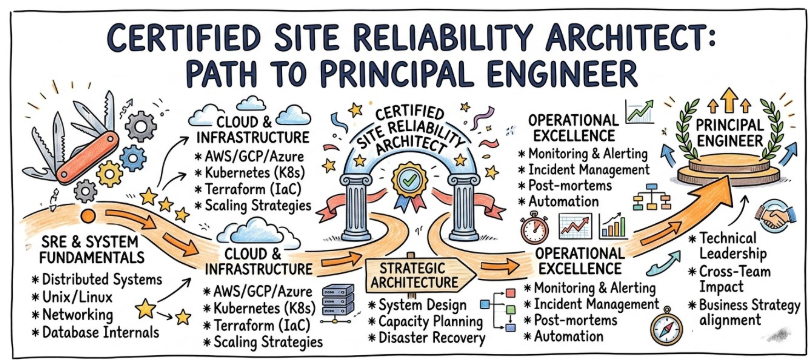
The Certified Site Reliability Architect represents the pinnacle of reliability engineering, focusing on the systemic design and governance of high-availability systems. This guide is specifically designed for senior engineers and technical leaders who aim to move beyond tactical firefighting and into the realm of strategic infrastructure design. As modern digital ecosystems grow in complexity, the need for architectural oversight within the SRE domain has never been more critical for global enterprises. Professionals looking to validate their expertise in designing resilient systems will find this certification a vital asset in their career progression. By following the insights shared here, engineers can navigate the nuances of reliability frameworks and make informed decisions about their professional development at SREschool .
What is the Certified Site Reliability Architect?
The Certified Site Reliability Architect is a professional designation that signifies a deep mastery of designing, implementing, and governing reliability at an organizational scale. Unlike entry-level certifications that focus on individual tools or basic monitoring, this architectural track emphasizes the creation of resilient systems through engineering principles. It exists to bridge the gap between high-level business requirements and the technical reality of distributed systems operating under heavy load.
The program focuses heavily on production-ready patterns, ensuring that architects can manage large-scale infrastructure while maintaining strict performance standards. It aligns with modern enterprise practices by teaching engineers how to balance the velocity of feature delivery with the absolute necessity of system stability. This is not just a theoretical framework; it is a practical methodology for building systems that can survive and thrive in unpredictable cloud environments.
Who Should Pursue Certified Site Reliability Architect?
Senior software engineers and seasoned DevOps practitioners are the primary candidates for this architectural certification. Those currently serving as Site Reliability Engineers (SREs), Platform Engineers, or Cloud Architects will find the curriculum directly applicable to their daily challenges. It is particularly beneficial for professionals who are responsible for the overall availability of critical services and need a formal framework to manage service level objectives (SLOs) across multiple teams.
Furthermore, engineering managers and technical leaders who oversee SRE teams should pursue this certification to better understand the technical debt and reliability trade-offs within their departments. While beginners might find the concepts advanced, the certification provides a clear roadmap for long-term career growth in both the Indian and global markets. Security and data professionals who interact with core infrastructure will also gain a profound understanding of how reliability impacts their respective domains.
Why Certified Site Reliability Architect is Valuable and Beyond
In an era where downtime translates directly into significant financial loss and brand damage, the demand for architects who can guarantee reliability is surging. Enterprises are moving away from reactive operations and toward “reliability by design,” making the skills taught in this program essential for long-term career longevity. This certification ensures that a professional stays relevant regardless of which specific cloud provider or automation tool is currently trending in the market.
The return on investment for this certification is realized through the ability to lead complex digital transformation projects with confidence. Organizations are actively seeking leaders who can implement error budgets and toil reduction strategies that actually work at scale. By mastering these architectural patterns, professionals position themselves as indispensable assets who can protect an organization’s most valuable digital revenue streams.
Certified Site Reliability Architect Certification Overview
The Certified Site Reliability Architect program is delivered via the official Certified Site Reliability Architect curriculum and is hosted on the SREschool.com platform. This program is structured to provide a comprehensive assessment of an individual’s ability to design systems that are not only scalable but also inherently observable and maintainable. The certification is owned and governed by industry experts who ensure the content remains aligned with the latest production-grade engineering standards.
The assessment approach is rigorous, moving beyond simple multiple-choice questions to evaluate how a candidate would handle real-world architectural dilemmas. It covers the full lifecycle of a service, from initial design and deployment to incident response and post-mortem analysis. This structure ensures that anyone holding the certification has demonstrated a practical ability to manage the complexities of modern, cloud-native enterprise environments.
Certified Site Reliability Architect Certification Tracks & Levels
The certification ecosystem is designed to support a professional from their early career stages through to senior leadership roles. The foundation level introduces the core concepts of SRE, focusing on terminology and the basic pillars of reliability engineering. As candidates progress to the professional level, the focus shifts toward the implementation of these concepts using industry-standard tools and methodologies in active production environments.
At the advanced or architect level, the curriculum expands to cover cross-team governance, financial operations, and the integration of artificial intelligence into operations. These levels are designed to align with career progression, moving from individual contributor roles to lead and architectural positions. Specialized tracks also allow professionals to focus on specific niches such as security-focused SRE or data-centric reliability, ensuring a tailored learning path for every engineer.
Complete Certified Site Reliability Architect Certification Table
| Track | Level | Who it’s for | Prerequisites | Skills Covered | Recommended Order |
| Reliability Engineering | Foundation | Junior Engineers, Students | Basic IT knowledge | SLOs, SLIs, Toil, Error Budgets | 1 |
| Reliability Architecture | Professional | SREs, DevOps Engineers | 2+ years experience | Observability, Incident Management | 2 |
| Strategic Leadership | Advanced | Architects, Managers | 5+ years experience | Governance, Multi-cloud Design | 3 |
| Specialized SRE | Expert | Security/Data Engineers | Advanced Reliability | DevSecOps, Data Reliability | 4 |
Detailed Guide for Each Certified Site Reliability Architect Certification
What it is
The Certified Site Reliability Engineer – Foundation certification validates a professional’s understanding of the core principles that govern modern reliability engineering. It serves as the essential starting point for anyone looking to transition into an SRE role by establishing a common language and conceptual framework used by elite engineering teams.
Who should take it
This certification is ideal for junior software engineers, recent graduates, or systems administrators who want to understand the SRE philosophy. It is also suitable for project managers and stakeholders who need to communicate effectively with technical reliability teams but do not require deep architectural skills yet.
Skills you’ll gain
- Defining and calculating Service Level Indicators (SLIs) and Service Level Objectives (SLOs).
- Understanding the concept of Error Budgets and how they influence release frequency.
- Identifying and eliminating “Toil” within operational workflows.
- Grasping the fundamentals of the SRE hierarchy of needs.
- Implementing basic monitoring and alerting strategies for cloud services.
Real-world projects you should be able to do
- Create a basic reliability dashboard for a web application using standard monitoring tools.
- Conduct a simulated post-mortem analysis for a minor system outage.
- Calculate the available error budget for a service based on a 99.9% availability target.
Preparation plan
- 7–14 days: Intensive study of the official SRE handbook and core terminology definitions.
- 30 days: Practical application of concepts using open-source monitoring tools in a lab environment.
- 60 days: Full immersion, including participating in community forums and taking multiple practice assessments.
Common mistakes
- Focusing too much on specific tools rather than the underlying reliability principles.
- Underestimating the importance of cultural changes required for successful SRE implementation.
- Memorizing definitions without understanding how they apply to real production incidents.
Best next certification after this
- Same-track option: Certified Site Reliability Engineer – Professional.
- Cross-track option: Certified DevOps Professional.
- Leadership option: Engineering Management Foundation.
Choose Your Learning Path
1. DevOps Path
The DevOps path focuses on the seamless integration of development and operations through automation and cultural alignment. Professionals on this path will learn how to build robust continuous integration and continuous deployment pipelines that prioritize both speed and stability. This journey is essential for those who want to master the entire software delivery lifecycle and ensure that code moves from a developer’s machine to production with minimal friction.
2. DevSecOps Path
The DevSecOps path emphasizes the “security as code” philosophy, ensuring that safety measures are baked into every stage of the development process. Candidates will explore how to automate security scanning, manage secrets effectively, and maintain compliance in highly regulated industries. This path is critical for engineers who want to protect their infrastructure from modern threats without slowing down the pace of innovation.
3. SRE Path
The SRE path is dedicated to the engineering of reliable systems, focusing heavily on the operational health of services in production. It covers the management of incidents, the design of observable systems, and the application of software engineering practices to infrastructure problems. This is the ideal route for those who want to specialize in keeping complex, distributed systems running smoothly at all times.
4. AIOps Path
The AIOps path explores the intersection of artificial intelligence and IT operations, teaching engineers how to use machine learning to automate incident detection and resolution. Professionals will learn to handle massive volumes of telemetry data and extract actionable insights that human operators might miss. This path is forward-looking and prepares engineers for the next generation of intelligent, self-healing infrastructure.
5. MLOps Path
The MLOps path focuses on the unique challenges of deploying and maintaining machine learning models in production environments. It addresses issues like data drift, model versioning, and the reliability of high-performance computing clusters used for training. This is a specialized path for engineers who want to bridge the gap between data science and production-grade reliability.
6. DataOps Path
The DataOps path applies the principles of DevOps and SRE to data pipelines and big data infrastructure. It focuses on ensuring data quality, availability, and low latency across the entire data lifecycle from ingestion to analysis. This path is essential for organizations that rely on real-time data to drive business decisions and require high reliability for their data platforms.
7. FinOps Path
The FinOps path introduces the discipline of cloud financial management, teaching engineers how to optimize cloud costs while maintaining performance. It involves understanding the economics of the cloud, implementing showback or chargeback models, and ensuring that every dollar spent on infrastructure provides maximum value. This path is vital for senior architects who must balance technical excellence with fiscal responsibility.
Role → Recommended Certified Site Reliability Architect Certifications
| Role | Recommended Certifications |
| DevOps Engineer | Certified DevOps Professional, SRE Foundation |
| SRE | SRE Professional, Certified Site Reliability Architect |
| Platform Engineer | Certified Cloud Architect, SRE Professional |
| Cloud Engineer | Certified Cloud Practitioner, SRE Foundation |
| Security Engineer | DevSecOps Expert, SRE Foundation |
| Data Engineer | DataOps Specialist, SRE Professional |
| FinOps Practitioner | FinOps Certified Associate, SRE Foundation |
| Engineering Manager | SRE Foundation, Strategic Leadership Certification |
Next Certifications to Take After Certified Site Reliability Architect
Same Track Progression
Once you have mastered the architectural level, the logical next step is to dive deeper into specialized reliability domains. This could include exploring advanced chaos engineering certifications or focusing on global-scale traffic management. Staying within the reliability track allows you to become a recognized subject matter expert who can handle the most complex stability challenges an enterprise can face.
Cross-Track Expansion
To become a more versatile leader, consider expanding into adjacent fields such as DevSecOps or DataOps. Understanding how reliability interacts with security protocols or data integrity will give you a more holistic view of the technology stack. This cross-pollination of skills makes you a more effective architect because you can design systems that are not just reliable, but also secure and data-efficient.
Leadership & Management Track
For those looking to transition away from individual technical contributions, moving into a leadership track is a natural progression. Certifications in engineering management or strategic digital transformation can help you apply your technical knowledge to organizational design. This allows you to build and lead entire departments that embody the reliability principles you have mastered throughout your career.
Training & Certification Support Providers for Certified Site Reliability Architect
DevOpsSchool
DevOpsSchool provides an extensive array of training programs designed to help professionals master the latest tools and methodologies in the DevOps and SRE ecosystem. With a focus on hands-on learning and real-world scenarios, they offer a curriculum that covers everything from basic automation to advanced architectural patterns. Their instructors are industry veterans who bring years of practical experience to the classroom, ensuring that students gain not just theoretical knowledge but also the skills needed to excel in production environments. DevOpsSchool has established itself as a leader in the Indian market, helping thousands of engineers transition into high-paying roles within elite technology organizations worldwide.
Cotocus
Cotocus is a specialized training and consulting organization that focuses on bridging the gap between academic knowledge and industry requirements. They offer tailored programs for the Certified Site Reliability Architect path, emphasizing the practical application of reliability engineering in modern cloud environments. Their approach combines rigorous technical training with mentorship, helping candidates navigate the complexities of large-scale infrastructure. Cotocus is known for its high-quality course material and its ability to prepare engineers for the rigorous demands of global enterprise environments. They provide a supportive learning atmosphere that encourages deep technical exploration and the development of critical thinking skills essential for any aspiring architect.
Scmgalaxy
Scmgalaxy is a prominent community-driven platform and training provider that has been at the forefront of the DevOps movement for over a decade. They offer a wealth of resources, including tutorials, webinars, and certification programs that cater to engineers at all stages of their careers. Their training for SRE and architectural certifications is highly regarded for its depth and technical accuracy. Scmgalaxy fosters a strong sense of community, allowing professionals to learn from their peers and share best practices across different industries. By focusing on the latest trends and tools, they ensure that their students remain competitive in an ever-changing technical landscape.
BestDevOps
BestDevOps is committed to delivering top-tier educational content that focuses on the core principles of reliability and automation. Their training programs are designed to be concise yet comprehensive, making them ideal for busy professionals who need to upgrade their skills quickly. They provide a clear roadmap for achieving certifications like the Certified Site Reliability Architect, with a strong emphasis on passing the exam through practical understanding. BestDevOps takes pride in its curated curriculum, which is constantly updated to reflect the latest industry standards and enterprise practices. Their goal is to empower engineers to take control of their career paths through high-quality, accessible education.
devsecopsschool.com
devsecopsschool.com is the leading destination for professionals who want to integrate security into their reliability and DevOps workflows. They offer specialized certifications that highlight the importance of “shifting left” and automating security checks within the delivery pipeline. Their curriculum is essential for any architect who wants to ensure that their reliable systems are also inherently secure against modern cyber threats. With a focus on practical labs and real-world case studies, devsecopsschool.com provides the tools and knowledge necessary to build resilient, compliant, and secure infrastructure at scale. They are an essential resource for engineers operating in highly regulated sectors.
sreschool.com
sreschool.com is the primary authority and hosting platform for the Certified Site Reliability Architect program and related reliability certifications. They offer a dedicated learning environment that is focused entirely on the principles and practices of Site Reliability Engineering. The platform provides access to official study guides, practice exams, and a community of reliability experts who are dedicated to advancing the field. By specializing exclusively in SRE, they offer a level of depth and expertise that is unmatched by more generalist training providers. sreschool.com is the go-to resource for anyone serious about building a long-term career in system reliability and architectural design.
aiopsschool.com
aiopsschool.com is at the cutting edge of the industry, offering training programs that teach engineers how to leverage artificial intelligence to enhance system reliability. Their courses cover the implementation of machine learning models for predictive maintenance, anomaly detection, and automated incident response. As infrastructure becomes more complex, the skills taught at aiopsschool.com are becoming increasingly vital for architects who need to manage massive scale. They provide a forward-looking curriculum that prepares professionals for a future where AI and human operators work side-by-side to maintain the world’s most critical digital services.
dataopsschool.com
dataopsschool.com focuses on the critical intersection of data engineering and operational excellence. They provide certifications and training for professionals who are responsible for the reliability of data pipelines, warehouses, and real-time processing systems. Their curriculum addresses the unique challenges of maintaining high availability for data platforms, including ensuring data consistency and managing large-scale storage clusters. For an architect, understanding the principles taught at dataopsschool.com is essential for designing holistic systems where data flows reliably and accurately. They are the premier choice for engineers who want to specialize in the burgeoning field of Data Operations.
finopsschool.com
finopsschool.com addresses the financial aspects of cloud architecture, providing engineers with the tools to manage and optimize infrastructure costs. Their training programs focus on the cultural and technical shifts required to implement successful cloud financial management within an organization. By teaching architects how to balance performance with cost-efficiency, finopsschool.com ensures that technical decisions are aligned with business objectives. This knowledge is crucial for senior leaders who must justify infrastructure spending and demonstrate the financial value of reliability initiatives. They offer a unique perspective that is often missing from traditional technical certification tracks.
Frequently Asked Questions (General)
- How difficult is it to achieve an SRE certification?
The difficulty depends on the level; foundation exams are accessible with study, while architect levels require several years of hands-on production experience. - What is the average time required to prepare for these exams?
Most professionals spend between 30 and 60 days preparing, depending on their existing experience with cloud-native technologies and reliability principles. - Are there any mandatory prerequisites for the Architect level?
While not always strictly enforced, having a professional-level SRE or DevOps certification and significant industry experience is highly recommended for success. - Will this certification help me get a job in India?
Yes, major Indian tech hubs like Bangalore, Hyderabad, and Pune have a high demand for certified SREs and architects in both product startups and global MNCs. - What is the typical ROI for a Site Reliability Architect certification?
Certified professionals often see significant salary increases and access to senior leadership roles due to the critical nature of the skills they possess. - How often do I need to renew my certification?
Most certifications in this track are valid for two to three years, after which you may need to take a recertification exam or earn continuing education credits. - Is the exam conducted online or at a testing center?
The exams are typically available through online proctored platforms, allowing candidates to take them from the comfort of their home or office. - Do I need to know how to code to become an SRE Architect?
Yes, a strong foundation in programming (such as Python or Go) is essential for automating tasks and designing reliable software systems. - Can a Project Manager benefit from these certifications?
Absolutely, the foundation level is excellent for managers who need to understand the technical constraints and reliability goals of their engineering teams. - What tools should I be familiar with before taking the exam?
Familiarity with Kubernetes, Prometheus, Grafana, and cloud platforms like AWS, Azure, or GCP is highly beneficial for the practical portions of the curriculum. - How does SRE differ from traditional DevOps?
SRE is often seen as a specific implementation of DevOps principles, with a stronger focus on engineering solutions for operational problems and reliability. - Is there a community or forum for certified professionals?
Yes, sreschool.com and other providers host communities where you can network with other architects and share insights on production challenges.
FAQs on Certified Site Reliability Architect
- What makes the Architect level different from the Professional level?
The Architect level focuses on organizational governance, multi-team SLOs, and high-level system design rather than just managing individual service reliability. - Does this certification cover cloud-specific tools?
While it mentions major cloud providers, the focus is on vendor-neutral architectural patterns that can be applied to any cloud or on-premise environment. - How much weight do employers give to the Certified Site Reliability Architect title?
It is highly respected as it demonstrates a candidate’s ability to think strategically about reliability and lead large-scale digital transformations. - Is chaos engineering part of the architect curriculum?
Yes, designing systems that are resilient to failure through proactive testing and chaos engineering is a core component of the architectural track. - Can I skip the Foundation level and go straight to Architect?
It is generally not recommended unless you have over 10 years of experience, as the Foundation level sets the critical conceptual groundwork. - Are there practical lab exams for the Architect certification?
The assessment usually includes scenario-based questions that require you to design solutions for complex, real-world reliability failures. - What is the focus on cost optimization in this program?
The program includes elements of FinOps, teaching architects how to build reliable systems that are also cost-effective for the business. - How does the certification stay updated with new technology?
The curriculum is reviewed annually by a board of industry experts to ensure it reflects the latest shifts in cloud-native and platform engineering.
Final Thoughts: Is Certified Site Reliability Architect Worth It?
As a mentor with decades of experience in the trenches of production systems, I can say with confidence that the architectural approach to reliability is the future of our industry. Moving beyond the “ops” mindset and into a design-centric role is the best way to secure your career against the fluctuations of the job market. The Certified Site Reliability Architect certification provides more than just a credential; it provides a rigorous mental model for solving the most difficult problems in modern computing. If you are willing to put in the work to master these concepts, the professional rewards and the impact you can have on your organization are immense. Focus on the principles, practice in real environments, and use this certification as a stepping stone to the highest levels of technical leadership.



Leave a Reply
You must be logged in to post a comment.