Imagine visiting an online store and finding products that match your interests without searching through hundreds of items. A streaming platform suggests a film you might enjoy. A learning website recommends the next course based on your progress.
These experiences use recommendation engines.
Recommendation engines analyze user activity, product information, and content preferences. They use this information to suggest relevant products, services, articles, videos, or other items.
Businesses use them to improve product discovery, customer engagement, content recommendations, and online shopping experiences.
However, not every recommendation engine works in the same way. Some provide ready-to-use recommendation APIs. Others focus on ecommerce product discovery, while open-source frameworks let developers build custom machine learning models.
This guide compares 10 recommendation engine tools. It explains their features, strengths, limitations, practical uses, and the factors businesses should consider before choosing one.
What Are Recommendation Engine Tools?
Recommendation engine tools are software platforms, APIs, or development frameworks that help businesses suggest relevant items to users.
They analyze information such as:
- Products a customer views.
- Items added to a shopping cart.
- Previous purchases.
- Search queries.
- Videos or articles a user watches.
- Customer ratings and reviews.
- Product descriptions and categories.
- User preferences and browsing patterns.
The system uses this information to identify useful relationships and generate recommendations.
For example, an online store may notice that customers who purchase a particular camera often purchase a memory card. It can use this relationship to recommend memory cards to other shoppers.
A recommendation engine can also suggest items based on individual interests, similar products, popular content, or current browsing activity.
How Do Recommendation Engines Work?
Most recommendation engines follow a process that includes data collection, candidate selection, ranking, and feedback.
1. Data Collection
The system collects information about users, items, and their interactions.
Common events include product views, clicks, purchases, ratings, searches, and content views.
The system may also receive item details such as product category, brand, price, genre, and description.
2. User Behavior Analysis
The engine examines interaction patterns to understand what users may like.
For example, customers who watch similar videos may have related interests. The system can use those patterns to suggest additional content.
3. Candidate Generation
The engine creates a list of possible recommendations.
It may use product similarities, user interests, purchase relationships, or popular items.
4. Recommendation Ranking
The system ranks possible items based on relevance.
It may consider user preferences, item information, current context, and business rules.
5. Recommendation Delivery
The application displays the selected items.
Common placements include homepage suggestions, related products, shopping cart recommendations, video feeds, and personalized content sections.
6. Feedback and Improvement
The engine records how users respond to recommendations.
Clicks, purchases, views, and other interactions can help improve future suggestions.
Main Types of Recommendation Engines
Before comparing products, it helps to understand the main recommendation methods.
1. Collaborative Filtering
Collaborative filtering analyzes relationships between users and items.
If several customers who purchased one product also purchased another, the engine may recommend the second product to similar shoppers.
Best For: Ecommerce stores, streaming services, music platforms, and applications with useful interaction histories.
Limitation: New users and new products may lack enough interaction data.
2. Content-Based Filtering
Content-based filtering recommends items that share characteristics with something a user already likes.
For example, a movie platform may recommend films with similar genres, actors, or themes.
Best For: Product catalogs, articles, videos, educational content, and applications with detailed item descriptions.
Limitation: Recommendations can become repetitive if the system focuses too heavily on existing interests.
3. Hybrid Recommendation Systems
Hybrid systems combine multiple recommendation methods.
They may use user behavior, product attributes, purchase patterns, and contextual information together.
Best For: Large ecommerce stores, marketplaces, streaming platforms, and applications with different data sources.
Limitation: Combining models can increase development and maintenance work.
4. Knowledge-Based Recommendations
Knowledge-based systems use predefined rules and information about customer requirements.
For example, a travel platform may recommend hotels based on budget, location, and travel preferences.
Best For: Travel, expensive products, financial services, and purchases that happen infrequently.
Limitation: Teams must maintain accurate rules and product information.
5. Context-Aware Recommendations
Context-aware systems consider the situation in which a user requests a recommendation.
They may use device type, current session, location, or time-related context where permitted.
Best For: Travel websites, mobile applications, retail, and food delivery services.
Limitation: Contextual information must be accurate and handled responsibly.
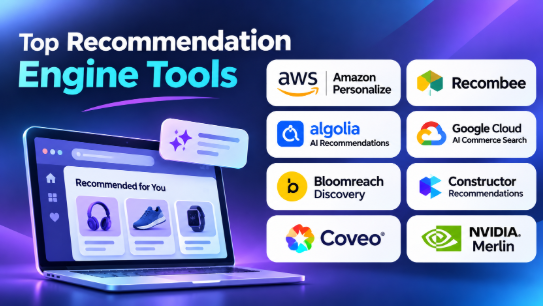
Top 10 Recommendation Engine Tools
1. Amazon Personalize
Best for managed machine learning recommendations
Amazon Personalize
Managed recommendation models for websites, applications, and digital services.
Amazon Personalize is a managed machine learning service from Amazon Web Services. It helps developers create personalized recommendations without building the entire machine learning infrastructure themselves.
Businesses provide information about users, items, and interactions. The service uses this data to train models and return recommendations through APIs.
It supports several use cases, including personalized item suggestions, similar items, personalized ranking, user segmentation, and next-best-action recommendations.
Its managed approach is useful for teams that want recommendation capabilities without operating every part of the underlying model infrastructure.
Key Features:
- User Personalization: Recommends items based on available user interaction history.
- Similar Items: Finds products or content related to a selected item.
- Personalized Ranking: Reorders a list based on an individual user’s preferences.
- Trending Items: Identifies items gaining popularity.
- Next-Best-Action: Recommends suitable actions based on user behavior.
- Real-Time Events: Uses recent interactions to support changing recommendations.
- Batch Recommendations: Generates recommendations for larger workflows.
- Business Filters: Applies rules to control which items can appear.
Benefits:
- Reduces the need to manage recommendation model infrastructure.
- Supports different recommendation use cases.
- Provides API-based integration.
- Fits applications already running on AWS.
- Supports real-time and batch workflows.
Pros:
- Managed machine learning service.
- Multiple recommendation use cases.
- API-based application integration.
- Supports personalized ranking.
- Useful for custom application development.
- Integrates with the AWS ecosystem.
Cons:
- Requires suitable training and interaction data.
- AWS knowledge helps with implementation.
- Usage and provisioned capacity affect costs.
- Does not provide a complete visual marketing platform.
- Teams must monitor model quality and recommendation performance.
Use Cases:
- Ecommerce product recommendations.
- Video and content discovery.
- Personalized application feeds.
- Product ranking.
- Customer segmentation.
- Next-best-action suggestions.
Best For: Developers, ecommerce companies, and businesses that want managed machine learning recommendations without building the complete recommendation infrastructure themselves.
2. Recombee
Best for flexible recommendation APIs
Recombee
Recommendation APIs for products, content, and digital applications.
Recombee provides recommendation-as-a-service through APIs and SDKs.
It is designed for businesses that want to add recommendation functionality to their own applications. Developers send user and item information to the service and request recommendations when needed.
One useful feature is its support for separate recommendation scenarios. A business can create different recommendation strategies for a homepage, product page, shopping cart, or email campaign.
This gives developers flexibility without requiring them to build every recommendation model themselves.
Key Features:
- Personalized Recommendations: Suggests items based on user interactions.
- Item Recommendations: Finds items related to a selected product or content item.
- Scenario Management: Separates different recommendation use cases.
- User Segmentation: Supports recommendations for user groups.
- Filtering: Applies conditions to returned recommendations.
- REST API: Connects recommendation functionality with custom applications.
- SDK Support: Provides developer integration options.
- Anonymous User Support: Can use session identifiers for visitors without registered accounts.
Benefits:
- Supports different industries and content types.
- Provides an API-first approach.
- Allows separate recommendation scenarios.
- Reduces the need to operate custom recommendation infrastructure.
- Supports websites and mobile applications.
Pros:
- Flexible recommendation API.
- Supports multiple recommendation scenarios.
- Useful for ecommerce and content platforms.
- Developer-friendly integration.
- Supports anonymous users.
- Suitable for different business models.
Cons:
- Requires application development.
- Recommendation quality depends on event and catalog data.
- Teams must design suitable recommendation scenarios.
- Does not replace a complete ecommerce platform.
- Advanced usage needs careful configuration.
Use Cases:
- Ecommerce product suggestions.
- Media recommendations.
- Travel discovery.
- Online learning platforms.
- Personalized application content.
- Related content recommendations.
Best For: Developers, SaaS businesses, and digital platforms that need recommendation APIs without building and maintaining their own recommendation service.
3. Algolia AI Recommendations
Best for search and product discovery
Algolia AI Recommendations
Recommendation models connected to search and discovery experiences.
Algolia AI Recommendations helps businesses display relevant products and content through recommendation APIs.
It uses catalog information and behavioral events to generate suggestions. Depending on the selected model, it can recommend related products, complementary items, frequently purchased products, or trending items.
Its connection with Algolia’s search platform is an important distinction. Businesses can use search and recommendations together to create a more connected discovery experience.
For example, a shopper searching for a camera can discover related accessories without manually exploring the entire catalog.
Key Features:
- Related Products: Suggests items connected to a selected product.
- Frequently Bought Together: Identifies products commonly purchased together.
- Trending Items: Helps surface popular products.
- Visual Similarity: Supports discovery of visually related items.
- Personalized Recommendations: Uses available user behavior and context.
- Recommendation APIs: Returns suggestions for custom interfaces.
- Search Integration: Connects recommendations with discovery workflows.
- Merchandising Controls: Supports business-oriented discovery management.
Benefits:
- Connects recommendations with search.
- Provides several recommendation models.
- Supports custom website and application interfaces.
- Helps retailers improve product discovery.
- Uses behavioral events and catalog information.
Pros:
- Developer-friendly API approach.
- Useful recommendation models.
- Connects with Algolia search.
- Supports product discovery workflows.
- Suitable for ecommerce and content platforms.
Cons:
- Requires suitable catalog indexing and event tracking.
- Recommendation quality depends on interaction data.
- Does not replace a complete marketing automation platform.
- Usage limits and costs need review.
- Requires technical integration.
Use Cases:
- Ecommerce product recommendations.
- Related articles and content.
- Product discovery.
- Cross-selling suggestions.
- Personalized search experiences.
- Frequently bought together sections.
Best For: Ecommerce and content businesses that already use Algolia or want to connect recommendation features with search.
4. Google Cloud AI Commerce Search
Best for large retail catalogs
Vertex AI Search for Commerce
Retail product discovery, search, and personalized recommendations.
Google Cloud provides AI-powered commerce search and recommendation capabilities for retailers through its retail discovery offerings.
Its recommendation models use product information and customer interaction events to suggest relevant products.
Different models serve different shopping situations. A homepage may use personalized recommendations, while a product page may show similar items or complementary products.
This context-based approach matters because customers have different needs at different stages of a shopping journey.
The platform also depends on product catalog quality and event tracking. A recommendation model needs useful product information and relevant interaction data to produce meaningful results.
Key Features:
- Recommended for You: Suggests products based on available shopper signals.
- Others You May Like: Recommends products related to the current shopping context.
- Frequently Bought Together: Identifies products commonly purchased together.
- Similar Items: Helps shoppers discover alternatives.
- Buy It Again: Supports repeat-purchase recommendations.
- Product Catalog Integration: Uses structured product information.
- Retail Event Tracking: Uses browsing and purchase interactions.
- API Integration: Connects recommendations with retail applications.
Benefits:
- Designed for retail product discovery.
- Supports different recommendation placements.
- Connects recommendations with commerce search.
- Uses managed cloud infrastructure.
- Provides models for common shopping scenarios.
Pros:
- Strong retail focus.
- Supports multiple recommendation strategies.
- Connects product data with customer interactions.
- Useful for large catalogs.
- Supports managed cloud workflows.
Cons:
- Requires suitable product catalog data.
- Event tracking needs careful implementation.
- Cloud usage and configuration affect costs.
- Focuses on retail rather than every recommendation use case.
- Integration requires technical planning.
Use Cases:
- Large ecommerce catalogs.
- Product detail page recommendations.
- Shopping cart suggestions.
- Personalized homepages.
- Retail search.
- Repeat-purchase recommendations.
Best For: Retailers with substantial product catalogs that want managed product search and recommendation capabilities through Google Cloud.
5. Bloomreach Discovery
Best for ecommerce merchandising and recommendations
Bloomreach Discovery
Product discovery, search, merchandising, and commerce recommendations.
Bloomreach Discovery focuses on helping shoppers find relevant products through search, browsing, merchandising, and recommendations.
Its recommendation capabilities use customer interactions and product information to suggest relevant items.
The platform is particularly useful for retailers because recommendations connect with merchandising decisions. Businesses can combine automated product discovery with commercial priorities.
For example, a retailer may want to recommend products that match shopper interests while considering product availability and merchandising requirements.
Bloomreach also offers broader commerce and customer engagement products. Buyers should distinguish the capabilities included in Discovery from those offered elsewhere in its product ecosystem.
Key Features:
- Product Recommendations: Suggests relevant products to shoppers.
- Personalized Search: Supports relevant product search experiences.
- Product Merchandising: Provides controls for product ranking and presentation.
- Product Discovery: Connects search, browsing, and recommendation workflows.
- Customer Signals: Uses available behavioral information.
- Catalog Integration: Works with structured product information.
- Commerce Analytics: Helps teams understand product discovery activity.
Benefits:
- Strong focus on ecommerce workflows.
- Connects search and recommendations.
- Provides merchandising controls.
- Helps retailers manage large product catalogs.
- Supports product discovery across shopping journeys.
Pros:
- Ecommerce-focused functionality.
- Combines search and recommendations.
- Supports product merchandising.
- Useful for large retail catalogs.
- Connects discovery with customer engagement.
Cons:
- Its strongest fit is commerce.
- Product and event data need careful preparation.
- Different capabilities may belong to different packages.
- Implementation can require ecommerce expertise.
- May be more than a small store needs.
Use Cases:
- Ecommerce product recommendations.
- Personalized category pages.
- Product search.
- Product merchandising.
- Cross-selling.
- Retail customer discovery.
Best For: Retail businesses that want recommendations connected with search, browsing, and merchandising.
6. Constructor Recommendations
Best for behavior-driven ecommerce recommendations
Constructor Recommendations
Personalized product suggestions connected with ecommerce search and discovery.
Constructor provides recommendation capabilities designed for ecommerce product discovery.
Its system uses search, browsing, and purchase behavior to generate product suggestions. It also connects recommendation strategies with its broader search and discovery platform.
A useful distinction is its range of recommendation strategies.
Retailers can create recommendations for different shopping situations, such as recently viewed products, complementary products, alternative products, and products a shopper may want to purchase again.
This helps businesses place relevant suggestions at different stages of the shopping journey.
Key Features:
- Personalized Recommendations: Uses information about individual shoppers.
- Complementary Products: Suggests items that work well with the selected product.
- Alternative Items: Helps shoppers find substitutes.
- Recently Viewed: Displays products a visitor has explored.
- Buy It Again: Supports repeat purchasing.
- Visually Similar Items: Suggests products with similar visual characteristics.
- Bestsellers: Displays popular products.
- Recommendation Pods: Places recommendation strategies across website pages.
Benefits:
- Designed for ecommerce workflows.
- Connects search and recommendation signals.
- Provides multiple recommendation strategies.
- Supports merchandising and page-level placement.
- Helps retailers personalize product discovery.
Pros:
- Commerce-focused functionality.
- Supports different recommendation placements.
- Connects search with product discovery.
- Useful for product merchandising.
- Supports behavior-driven recommendations.
Cons:
- Primarily designed for ecommerce.
- Requires accurate product and interaction data.
- Advanced configuration may require vendor support.
- Its broader product suite may exceed smaller stores’ needs.
Use Cases:
- Product detail page recommendations.
- Homepage recommendations.
- Shopping cart suggestions.
- Alternative products.
- Complementary product suggestions.
- Repeat-purchase recommendations.
Best For: Retailers that want recommendation strategies connected with search, browsing, and product discovery.
7. Coveo Machine Learning Recommendations
Best for enterprise search and content discovery
Coveo
Machine learning recommendations for commerce and content experiences.
Coveo provides machine learning capabilities for product and content recommendations.
Its commerce recommendation models use customer interactions to suggest products that match visitor behavior and shopping context.
The platform also supports content recommendations. This is useful for organizations that want to suggest knowledge articles, documentation, or other information based on visitor activity.
Coveo connects recommendations with its search and query pipeline architecture. This allows teams to manage recommendation requests and apply relevant business rules.
Key Features:
- Product Recommendations: Suggests products based on customer activity.
- Content Recommendations: Suggests relevant information and articles.
- User History Strategies: Uses browsing and purchase history.
- Seeded Recommendations: Uses a selected product as the starting point.
- Unseeded Recommendations: Suggests popular products using broader activity.
- Search Integration: Connects recommendations with search workflows.
- Analytics Events: Uses tracked interactions to support model learning.
- Query Pipelines: Provides controls for recommendation requests and business rules.
Benefits:
- Supports product and content recommendations.
- Connects recommendations with search.
- Provides different recommendation strategies.
- Fits enterprise discovery environments.
- Supports business rules and query management.
Pros:
- Strong search specialization.
- Supports product and content discovery.
- Offers machine learning recommendation capabilities.
- Useful for large information collections.
- Supports enterprise search experiences.
Cons:
- Requires suitable analytics events and catalog configuration.
- Some models need sufficient interaction data.
- Implementation requires familiarity with Coveo architecture.
- Search personalization is not a complete marketing platform.
Use Cases:
- Ecommerce recommendations.
- Enterprise content discovery.
- Knowledge portals.
- Product suggestions.
- Personalized search experiences.
- Customer service content recommendations.
Best For: Enterprises that want recommendations connected with search, product discovery, and content retrieval.
8. NVIDIA Merlin
Best for building custom recommendation systems
NVIDIA Merlin
Open-source tools for developing and deploying large-scale recommendation pipelines.
NVIDIA Merlin is different from managed recommendation services. It is an open-source framework for building recommendation systems.
It provides tools for data preparation, feature engineering, model training, inference, and deployment.
This gives data scientists and machine learning engineers more control over how recommendation systems work.
Merlin includes components such as Merlin Models, NVTabular, and Transformers4Rec. These components support different parts of a recommendation workflow.
For example, a team can prepare large datasets, train recommendation models, and build a pipeline for serving predictions.
Key Features:
- Merlin Models: Provides model implementations for recommendation tasks.
- NVTabular: Supports feature engineering and data preprocessing.
- Transformers4Rec: Supports session-based recommendation workflows.
- GPU Acceleration: Supports GPU-based data and model workloads.
- Interoperability: Works with other machine learning components.
- Custom Models: Allows teams to develop their own recommendation approaches.
- Production Pipelines: Supports workflows from training to inference.
- Large-Scale Processing: Provides components designed for substantial recommendation datasets.
Benefits:
- Open-source framework.
- Greater control over recommendation architecture.
- Supports large-scale data preparation.
- Provides tools for training and inference.
- Useful for specialized machine learning teams.
Pros:
- Open-source availability.
- Flexible architecture.
- Supports custom recommendation models.
- Provides GPU-oriented components.
- Useful for large-scale recommendation pipelines.
Cons:
- Requires strong machine learning expertise.
- Teams must build and operate the complete system.
- GPU infrastructure can increase costs.
- It is not a ready-made recommendation service.
- Maintenance requires technical ownership.
Use Cases:
- Large-scale ecommerce recommendations.
- Media discovery.
- Custom recommendation systems.
- Session-based recommendations.
- Machine learning research.
- High-volume recommendation pipelines.
Best For: Data scientists, machine learning engineers, and organizations that want to build and operate custom recommendation systems.
9. TensorFlow Recommenders
Best for custom TensorFlow recommendation models
TensorFlow Recommenders
A flexible development library for building and evaluating recommendation models.
TensorFlow Recommenders is an open-source library built on TensorFlow. It helps developers and researchers build recommendation models using a flexible machine learning workflow.
Unlike a managed recommendation service, it does not provide a complete hosted recommendation platform. Teams use it to develop, train, evaluate, and integrate their own models.
It supports important recommendation tasks such as retrieval and ranking.
Retrieval narrows a large catalog to a smaller set of possible items. Ranking then orders those items based on their relevance to a user.
This separation is useful when an application needs to recommend items from a large catalog.
Key Features:
- Recommendation Modeling: Provides tools for building custom recommendation models.
- Retrieval Models: Finds candidate items from a larger collection.
- Ranking Models: Scores and orders candidate recommendations.
- Feature Integration: Uses user and item features.
- Model Training: Supports custom TensorFlow training workflows.
- Model Evaluation: Provides tools for assessing recommendation models.
- Extensibility: Allows teams to adapt models to specific applications.
- TensorFlow Integration: Works within TensorFlow-based development environments.
Benefits:
- Open-source library.
- Provides model development flexibility.
- Supports retrieval and ranking workflows.
- Useful for machine learning education and research.
- Integrates with TensorFlow tools.
Pros:
- Flexible recommendation architecture.
- Supports custom model development.
- Useful for advanced data science teams.
- Open-source availability.
- Supports retrieval and ranking.
Cons:
- Requires TensorFlow knowledge.
- Does not provide a hosted recommendation dashboard.
- Teams must manage data pipelines and deployment.
- Production monitoring requires additional tools.
- Model quality depends on data and evaluation practices.
Use Cases:
- Custom ecommerce recommenders.
- Video and media recommendations.
- Personalized content feeds.
- Machine learning research.
- User-item ranking.
- Large-catalog retrieval systems.
Best For: Machine learning engineers, data scientists, and research teams that want full control over recommendation models using TensorFlow.
10. Gorse
Best for self-hosted recommendation services
Gorse
A self-hosted recommendation server with APIs for application integration.
Gorse is an open-source recommendation system written in Go. It is designed to help developers build recommendation services without creating every component from scratch.
Unlike libraries that focus mainly on model development, Gorse provides a recommendation server and API-oriented workflow.
It can use user interactions and item information to generate recommendations. Its architecture supports different recommendation approaches, including collaborative filtering and item-based methods.
Gorse is useful for developers who want to host recommendation functionality within their own infrastructure.
Key Features:
- Recommendation Server: Provides a service for generating recommendations.
- REST API: Allows applications to request recommendations.
- Collaborative Filtering: Uses user-item interaction patterns.
- Item-Based Recommendations: Suggests items related to other items.
- Data Import: Supports loading user and item information.
- Feedback Collection: Uses user interactions to improve suggestions.
- Self-Hosting: Gives teams control over deployment.
- Open-Source Development: Allows technical teams to inspect and adapt the project.
Benefits:
- Open-source availability.
- Provides a recommendation server.
- Supports API-based integration.
- Gives teams infrastructure control.
- Reduces the need to build a recommendation service from zero.
Pros:
- Self-hosted deployment.
- API-oriented architecture.
- Open-source project.
- Useful for custom applications.
- Supports interaction-based recommendations.
Cons:
- Requires deployment and maintenance skills.
- Teams must manage infrastructure and monitoring.
- Advanced customization may require development work.
- Does not provide a complete enterprise marketing suite.
- Buyers should evaluate project maintenance and compatibility before production use.
Use Cases:
- Self-hosted ecommerce recommendations.
- Personalized content feeds.
- Application recommendations.
- Product discovery.
- Internal recommendation services.
- Developer-led machine learning projects.
Best For: Developers, startups, and engineering teams that want an open-source recommendation server they can host and manage themselves.
Comparison Table: Top 10 Recommendation Engine Tools
| Tool | Best For | Main Strength | Deployment Approach |
|---|---|---|---|
| Amazon Personalize | Managed machine learning recommendations | Personalized models and APIs | Managed AWS service |
| Recombee | Flexible recommendations | Recommendation APIs and scenarios | Managed service |
| Algolia AI Recommendations | Search and product discovery | Recommendations connected with search | Managed platform |
| Google Cloud AI Commerce Search | Retail catalogs | Product search and recommendations | Managed cloud service |
| Bloomreach Discovery | Ecommerce merchandising | Search, recommendations, and discovery | Commerce platform |
| Constructor Recommendations | Retail product suggestions | Behavior-driven product discovery | Commerce platform |
| Coveo | Enterprise search and discovery | Product and content recommendations | Managed platform |
| NVIDIA Merlin | Custom recommendation systems | Open-source GPU-oriented framework | Self-managed |
| TensorFlow Recommenders | Custom TensorFlow models | Model development and evaluation | Open-source library |
| Gorse | Self-hosted recommendation services | Recommendation server and APIs | Self-hosted |
Features, licensing, usage limits, and deployment options can vary by product and plan. Check current vendor documentation before purchasing or deploying.
Which Recommendation Engine Tool Is Right for You?
Choosing the right tool depends on your application, available data, technical resources, and business goals.
For Beginners and Small Development Teams: Recombee
Recombee is worth considering when a team wants recommendation APIs without building its own model infrastructure.
It provides a service that developers can connect to their applications. This can reduce the initial engineering effort compared with creating a custom recommendation pipeline.
For AWS-Based Applications: Amazon Personalize
Amazon Personalize is a suitable option for teams already using AWS.
It provides managed recommendation models and APIs. It is useful when developers want to add recommendations without operating the full machine learning infrastructure.
For Ecommerce Search and Discovery: Algolia AI Recommendations
Algolia is relevant when search and recommendations need to work together.
It can help retailers display related products, complementary items, and other suggestions within a search-driven shopping experience.
For Large Retail Catalogs: Google Cloud AI Commerce Search
Google Cloud’s commerce discovery offerings are worth evaluating for retailers with large product catalogs.
They provide managed search and recommendation capabilities that can support different shopping contexts.
For Ecommerce Merchandising: Bloomreach and Constructor
Bloomreach is useful when businesses want to connect recommendations with search and merchandising.
Constructor is worth considering for retailers that need behavior-driven recommendations across different shopping pages.
For Enterprise Search and Content: Coveo
Coveo is relevant when recommendations need to work alongside enterprise search and content discovery.
It can support product suggestions as well as recommendations for knowledge content.
For Custom Machine Learning Models: NVIDIA Merlin and TensorFlow Recommenders
NVIDIA Merlin is suitable for teams that need specialized recommendation pipelines and large-scale processing.
TensorFlow Recommenders provides a flexible library for developing retrieval and ranking models.
Both require machine learning and engineering expertise.
For Self-Hosted Recommendation Services: Gorse
Gorse is a practical option for teams that want an open-source recommendation server.
It gives developers more control over infrastructure, configuration, and application integration.
Important Factors to Check Before Buying
A recommendation engine should fit your data and application architecture. Review these areas before making a decision.
1. Data Requirements
Check what information the system needs to generate useful recommendations.
Some platforms rely heavily on user-item interactions. Others can use product attributes and contextual information.
Understand how much historical data you need and how the system handles new users or products.
2. Recommendation Algorithms
Review the recommendation methods supported by the platform.
Check whether it supports collaborative filtering, content-based recommendations, hybrid models, or other relevant approaches.
Do not assume that every platform provides every algorithm.
3. API and SDK Support
Developers need reliable ways to send







Leave a Reply
You must be logged in to post a comment.