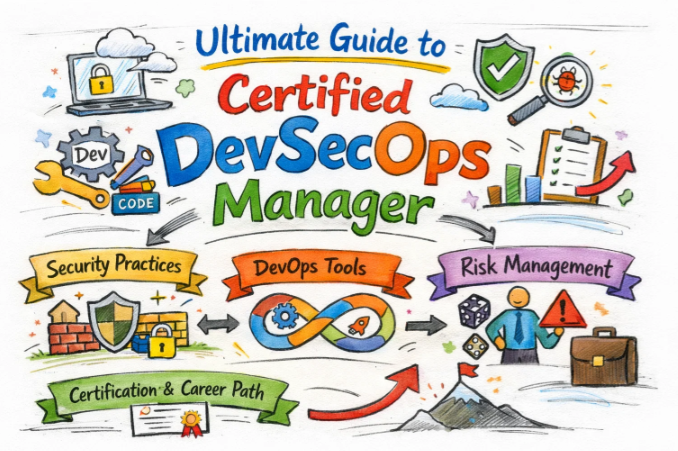
In the current landscape of rapid software evolution, the divide between speed and safety is narrowing. As someone who has spent two decades watching the industry shift from manual deployments to automated, cloud-native ecosystems, I’ve seen that the most successful leaders aren’t just technical—they are strategic. This guide is designed to help you transition into a high-level leadership role by mastering the Certified DevSecOps Manager path.
Effective management today requires a “birds-eye view” of your entire infrastructure. This is why integrated learning programs, such as the Master in Observability Engineering Certifications Program, are becoming essential. When you can see every metric and trace, you can lead with confidence.
Global Certification Roadmap
This table outlines the progression for engineers and managers looking to dominate the operational space. It serves as a strategic checklist for your career growth.
| Track | Level | Who it’s for | Prerequisites | Key Skills | Recommended Order |
| DevOps | Associate | Aspiring Talent | Foundational IT | CI/CD, Scripting | 1 |
| DevOps | Expert | Senior Engineers | 2+ Years Exp. | Scalability, IaC | 2 |
| DevSecOps | Master | Managers & Leads | 3+ Years Exp. | Governance, Strategy | 3 |
| SRE | Specialist | Reliability Pros | Coding / Systems | SLOs, Incident Mgmt | 2 |
| AIOps | Specialist | ML/Data Leads | Python, AI basics | Model Lifecycle | 3 |
| DataOps | Specialist | Data Architects | SQL, Big Data | Data Pipelines | 3 |
| FinOps | Specialist | Cloud Managers | Financial basics | Cost Optimization | 2 |
| Observability | Master | Architects / SREs | Telemetry Depth | Tracing, Analytics | 4 |
Deep Dive: Certified DevSecOps Manager (CDOM)
The Certified DevSecOps Manager credential represents a shift from executing tasks to orchestrating a secure culture.
What it is
The CDOM is a pinnacle certification that focuses on the executive and managerial aspects of security within the DevOps lifecycle. It is designed for those who need to oversee “Shift-Left” initiatives across multiple teams. Rather than just focusing on tool configuration, it emphasizes risk management, compliance automation, and strategic leadership. Just as the Master in Observability Engineering Certifications Program provides visibility into performance, the CDOM provides a clear lens through which to manage organizational security and trust.
Who should take it
This program is crafted for professionals ready to own the security roadmap:
- Engineering Managers overseeing diverse technical squads.
- Lead DevOps Engineers moving into administrative or leadership roles.
- Security Directors aiming to integrate more closely with agile development.
- CTOs building out long-term secure delivery standards.
- Compliance Architects focused on automating regulatory requirements (SOC2, HIPAA).
Skills you’ll gain
You will evolve from a technical expert into a strategic decision-maker who understands the business impact of technology.
- Organizational Transformation: Leading the cultural change required to make security a shared responsibility.
- Automated Governance: Building “Guardrails, not Gates” to ensure compliance without slowing down the developers.
- Threat Modeling at Scale: Identifying risks early in the design phase across complex, distributed systems.
- Financial Oversight (FinOps): Managing the budget for security tooling and cloud-native security services.
- Visibility Strategy: Implementing advanced monitoring to track the health and security posture of every release.
Real-world projects you should be able to do after it
Completing this program empowers you to deliver high-level executive results that protect the company’s bottom line.
- Designing a Global DevSecOps Framework: Creating a unified security standard that works across different business units and geographies.
- Implementing Compliance-as-Code: Building a system where audits are performed automatically in real-time, rather than manually every quarter.
- Orchestrating Vulnerability Response: Establishing a mature process for handling security flaws, from discovery to automated patching.
- Managing Toolchain ROI: Evaluating and consolidating the security tool stack to ensure maximum protection with minimum overhead.
Preparation Plan
- 7–14 Days (The Fast-Track): Ideal for seasoned leads. Spend this time taking practice exams and focusing purely on the management and compliance frameworks you may not use daily.
- 30 Days (The Professional Pace): The most effective approach. Weeks 1-2 should focus on the technical integration of security tools. Weeks 3-4 should be dedicated to the “Manager” modules: leadership, culture, and compliance.
- 60 Days (The Deep Dive): Recommended for those moving from a non-security background. Spend the first month mastering the technical basics and the second month perfecting your strategic leadership skills.
Common Mistakes
Avoid these frequent pitfalls to ensure your success in the role:
- Over-focusing on Technicality: Managers often spend too much time on “how” a tool works and not enough time on “how” to lead the people using it.
- Ignoring Developer Friction: If your security measures make a developer’s job harder, they will bypass them. Focus on making security easy.
- Working in a Vacuum: You must align your security goals with the company’s product goals. If they clash, the business suffers.
- Neglecting Data: Without proper observability, you are managing by guesswork. This is why many successful managers also pursue the Master in Observability Engineering.
Best Next Certification After This
Once you have mastered secure management, consider these paths to round out your executive profile:
- Same Track: Advanced Security Leadership or CISO preparation.
- Cross-Track: FinOps Practitioner to master the economics of the cloud.
- Leadership: Master in Observability Engineering to gain total system visibility.
Choose Your Path
Every career is unique. Identify your ultimate goal and follow the logic that gets you there.
- DevOps Path: Focuses on the speed of delivery. It is about CI/CD, automation, and removing silos between teams.
- DevSecOps Path: Prioritizes security within the delivery flow. It is for those who want to specialize in cyber defense and automated compliance.
- SRE Path: Focuses on system reliability and scalability. This is a highly technical path involving deep coding and system internals.
- AIOps/MLOps Path: Uses artificial intelligence to manage operations. It involves building models that can predict and fix system issues automatically.
- DataOps Path: Streamlines the delivery of data and analytics. It ensures that data pipelines are reliable and secure.
- FinOps Path: Manages the cost of cloud infrastructure. It is a mix of finance, engineering, and business strategy to optimize cloud spending.
Role → Recommended Certifications
| Current Role | Target Goal | Recommended Steps |
| DevOps Engineer | Senior / Lead | DevOps (E) $\rightarrow$ SRE (A) $\rightarrow$ CKA |
| SRE | Systems Architect | SRE (M) $\rightarrow$ Observability (M) |
| Platform Engineer | Manager | CDO Manager $\rightarrow$ FinOps (A) |
| Security Engineer | Security Lead | CDO Manager $\rightarrow$ SRE (A) |
| Data Engineer | Data Architect | DataOps $\rightarrow$ MLOps |
| Engineering Manager | Executive Leader | CDO Manager $\rightarrow$ Observability (M) |
Industry Leaders in Training & Certification
These institutions are the primary resources for professionals aiming to clear the Certified DevSecOps Manager exam.
- DevOpsSchool: A premier global training body. They are known for their practical, hands-on labs that mimic real-world production environments.
- Cotocus: Specializes in delivering high-impact corporate training sessions that help entire departments shift toward DevSecOps.
- Scmgalaxy: A technical community leader providing deep documentation and workshops on complex automation and CI/CD mechanics.
- BestDevOps: Focuses on a personalized approach to mentorship, ensuring that individuals not only get certified but also advance their careers.
- DevSecOpsSchool: The official source for the CDOM program, offering a curriculum that is always in sync with the latest exam requirements.
- SRESchool: The dedicated home for those wanting to master the art of reliability, incident response, and error budgets.
- AIOpsSchool: Provides the cutting-edge training needed to manage the next generation of AI-driven operational systems.
- DataOpsSchool: The authority on operationalizing data pipelines and maintaining data integrity at scale.
- FinOpsSchool: The essential resource for learning how to bridge the gap between engineering and finance in the cloud.
General Career FAQs
- How do I start? Focus on one core area (like DevOps) before branching into management or security.
- Is experience or certification more important? They are two sides of the same coin. Experience gives you the “how,” while certification gives you the “strategy” and the global recognition.
- How do I handle “Manager Burnout”? By automating as much as possible. A manager’s job is to build a system that runs itself.
- Is it better to be a generalist or a specialist? In your early career, specialize. As you move into management (CDOM level), you must become a “Specialized Generalist” who understands how all parts connect.
- How long do these certs take to complete? Most can be achieved within 30 to 60 days of focused study.
- Will this help my salary? Absolutely. Professionals with master-level management certifications often command the highest brackets in the market.
- Is remote learning effective? Yes, especially with providers like DevOpsSchool that use cloud-based labs for hands-on practice.
- What is the next big trend? AI-driven operations (AIOps) and full-stack visibility (Observability).
- What is the value of the “Policy-as-Code” skills taught in this course? As a manager, you will learn how to replace manual sign-offs with automated guardrails. This skill is vital because it allows your team to move at high speed without the risk of deploying non-compliant or insecure code.
- Is there a focus on cost management (FinOps) within the curriculum? While the primary focus is security, the program touches on the efficiency of tool selection. For a deeper dive into cost, it is often paired with a FinOps Practitioner certification to ensure your secure pipeline is also cost-effective.
- Does the certification help in transitioning from an Engineer to a Manager? Absolutely. It is specifically designed to bridge that gap. It provides the “management vocabulary”—risk assessment, ROI of security tools, and team leadership—that engineers need to step into a Lead or Manager role.
- Do I need to be a coding expert? You need to be “code-literate”—you must be able to understand script logic even if you aren’t writing code every day.
Certified DevSecOps Manager (CDOM) FAQs
- What is the exam format? It typically involves a mix of scenario-based questions and practical assessments to prove you can lead in real-time.
- Are there prerequisites? A few years of experience in development, security, or operations is highly recommended.
- Does it cover different cloud providers? Yes, the principles are vendor-neutral and apply to AWS, GCP, and Azure.
- Is the training mandatory? While not strictly mandatory, it is highly recommended given the complexity of the “Manager” modules.
- How does this help my team? It gives you the blueprint to reduce security bottlenecks, making your team faster and happier.
- Can I transition from QA to CDOM? Yes, if you have experience with automated testing, the transition to DevSecOps is a very natural path.
- How often is the content updated? Every year, to ensure it covers the latest threats and compliance regulations.
- Why choose devsecopsschool.com for this? Because they are the specialists who designed the curriculum to meet the specific needs of modern engineering managers.
Conclusion
Stepping into the role of a Certified DevSecOps Manager is a defining moment in a technical career. It marks the transition from being an individual contributor to a visionary leader who secures the future of the organization. By integrating speed, security, and financial responsibility, you become the glue that holds high-performing teams together. This roadmap has provided you with the necessary steps—from choosing the right training partner like DevOpsSchool to mastering the critical pillars of SRE, FinOps, and AIOps. Remember, the most effective managers are those who can see the invisible; this is why programs like the Master in Observability Engineering Certifications Program are the ultimate career multiplier. The world of software is moving fast—take the lead and ensure your organization stays safe, reliable, and ahead of the curve.



Leave a Reply
You must be logged in to post a comment.