Files often move between people, devices, and teams. A designer sends a large project folder. A client uploads signed documents. A remote team edits shared files from different locations.
Without a clear system, teams can lose track of file versions. They may also share private documents with the wrong people.
File sync and share tools help prevent these problems. They keep selected files updated across devices and let users share content with others. Many also offer access controls, file history, and team collaboration.
But each platform serves a different need. Some focus on everyday teamwork. Others support secure client exchange, business governance, or self-hosted file sharing.
This guide compares ten established tools. It explains their features, advantages, limitations, and best uses.
What Are File Sync and Share Tools?
File Sync and Share (FSS) tools let users store, synchronize, access, and share files across devices and locations.
Synchronization keeps selected files updated. When a user changes a synced file, the service sends that change to connected devices.
Sharing gives other people access to files or folders. The owner can often control who can view, edit, download, or upload content.
Common uses include:
- Sharing files with clients and partners
- Keeping work files updated across devices
- Managing team folders and project documents
- Sending large files without email attachments
- Working with remote teams
- Controlling access to sensitive documents
- Restoring earlier file versions
File Sync, File Sharing, and Backup Are Different
These terms often appear together, but they describe different tasks.
- File sync keeps selected files updated across devices.
- File sharing gives other people access to selected content.
- File backup creates separate copies for recovery after data loss.
A sync service may also offer file history and deleted-file recovery. However, synchronization alone is not a complete backup plan. Accidental changes or deletions may spread across connected devices.
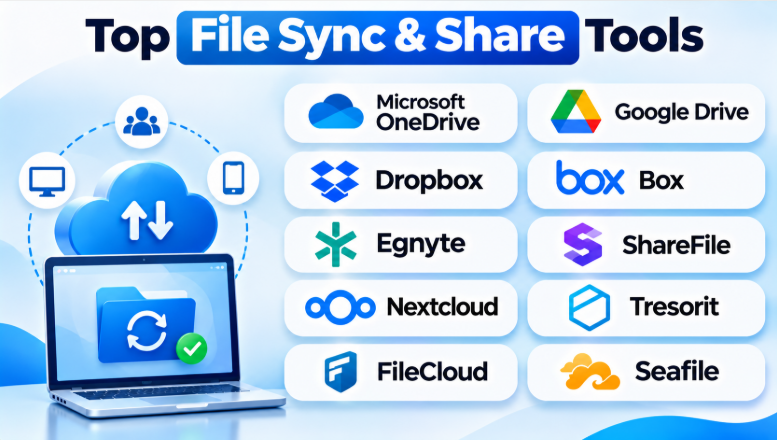
Top 10 File Sync and Share Tools
The following tools cover everyday file sharing, business collaboration, secure client exchange, and self-hosted file services. They are not a strict ranking. Each one solves a different file management problem.
1. Microsoft OneDrive
Microsoft OneDrive is a cloud file synchronization and sharing service. It works closely with Windows and Microsoft 365 applications.
Users can store personal work files, sync folders, and share documents. Teams can also access shared files through connected SharePoint libraries.
One important distinction is ownership. OneDrive suits individual work files. SharePoint is usually better for documents that a team owns and manages together. Microsoft Learn+1
Key features
- File synchronization across supported devices
- Files On-Demand to reduce local storage use
- File sharing and permission controls
- Version history and file recovery
- Integration with Word, Excel, PowerPoint, and Teams
- Shared access through SharePoint libraries
- Administrative and security controls on supported plans
Pros
- Fits naturally into Microsoft 365 workflows.
- Works well with Windows File Explorer.
- Supports document collaboration.
- Provides useful file recovery and sharing controls.
- Connects personal work files with team libraries.
Cons
- Advanced controls depend on the Microsoft 365 plan.
- Teams need clear rules for OneDrive and SharePoint.
- Sync conflicts can affect complex file workflows.
- It may be less convenient for organizations outside the Microsoft ecosystem.
Best use: Businesses, schools, and professionals who already use Microsoft 365.
2. Google Drive
Google Drive combines cloud file storage, synchronization, sharing, and document collaboration. It works closely with Google Docs, Sheets, and Slides.
Its strongest use case is collaborative work. Team members can edit supported documents together and share files through controlled permissions.
Google Shared Drives also help organizations keep files under team ownership instead of tying them to one employee’s account.
Key features
- Cloud file storage and synchronization
- Shared folders and Shared Drives
- Viewer, commenter, and editor permissions
- Real-time collaboration in Google Workspace apps
- File search and organization
- Desktop and mobile access
- Administrative controls through Google Workspace
Pros
- Makes document collaboration straightforward.
- Works closely with Google Workspace.
- Supports team-owned Shared Drives.
- Offers browser, desktop, and mobile access.
- Fits schools and distributed teams.
Cons
- Advanced administration depends on the Workspace plan.
- Complex folder permissions need careful management.
- Some business workflows may need extra tools.
- Teams using Microsoft Office heavily may prefer a Microsoft-centered setup.
Best use: Google Workspace teams, schools, freelancers, and organizations that collaborate on documents.
3. Dropbox
Dropbox focuses on file synchronization and sharing across devices. Its desktop folder provides a familiar way to work with files from different applications.
Users can share files through links or folders. Business plans add team administration and collaboration controls.
Dropbox is useful when teams work with many file types. It does not require every file to belong to an online office suite.
Key features
- Desktop file synchronization
- File and folder sharing
- Shared team folders
- File history and recovery options
- Web and mobile access
- Selective synchronization
- Business administration features on supported plans
Pros
- Offers a straightforward sync workflow.
- Works with many common file types.
- Supports external file sharing.
- Fits creative and remote teams.
- Provides desktop access through a familiar folder.
Cons
- Storage and recovery limits depend on the plan.
- Advanced business controls may cost more.
- Teams must manage shared links carefully.
- It may duplicate features already included in an existing office suite.
Best use: Creative teams, freelancers, and businesses that need simple cross-device file synchronization.
4. Box
Box is a business content management and file-sharing platform. It focuses on collaboration, access control, and managing business documents.
Teams can use Box to share files with colleagues and external partners. Its wider content tools support workflows that go beyond basic file synchronization.
Box can be useful when an organization needs consistent control over documents across departments.
Key features
- Cloud file storage and sharing
- Team collaboration
- External sharing controls
- Metadata and content organization
- Workflow and approval capabilities
- Electronic signature features
- Administrative and governance tools
Pros
- Supports business-focused content workflows.
- Offers controls for external sharing.
- Helps organize large document collections.
- Supports integrations with business applications.
- Suits organizations with formal document processes.
Cons
- Advanced governance features may require extra services or plans.
- It can be more than small teams need.
- Administrators must plan access and retention policies.
- Costs can rise as teams add users and capabilities.
Best use: Enterprises that need controlled document sharing and content governance.
5. Egnyte
Egnyte focuses on business file collaboration and content governance. It is especially relevant to organizations that manage large project files or need access across cloud and existing storage environments.
Its approach can help teams work with shared business content without forcing every workflow into a basic cloud drive. Organizations should check the exact deployment and storage options available for their plan.
Key features
- Cloud file sharing and synchronization
- Hybrid file access options
- External collaboration controls
- File locking for supported workflows
- Desktop and mobile access
- Content governance features
- Integrations with business applications
Pros
- Supports complex business file workflows.
- Can suit teams with large project files.
- Offers controls for external collaboration.
- Helps organizations manage shared content.
- Relevant to construction and engineering workflows.
Cons
- May be more complex than basic file sharing services.
- Costs can be high for small teams.
- Deployment options vary by offering.
- Teams should test large-file and remote-access workflows.
Best use: Businesses with large project files, distributed teams, and hybrid storage needs.
6. Citrix ShareFile
Citrix ShareFile, now part of the Progress ShareFile product family, focuses on secure document exchange and client-facing workflows.
It is useful for professional services firms that collect documents from customers. For example, an accounting firm may need clients to upload financial records through a controlled process.
ShareFile provides web, desktop, and mobile access. Its enterprise offering also includes options for organizations that want to manage parts of their own storage environment. docs.sharefile.com+1
Key features
- Secure file sharing and document exchange
- Client-facing upload workflows
- Web, desktop, and mobile access
- Integration with email applications
- User and permission management
- Enterprise storage management options
- Document collaboration features
Pros
- Fits client document collection workflows.
- Helps professional firms exchange sensitive files.
- Offers several access methods.
- Supports enterprise storage options.
- Can reduce reliance on email attachments.
Cons
- May be unnecessary for basic team synchronization.
- Some enterprise capabilities need additional setup.
- Organizations should review storage and deployment choices.
- Client workflows need careful permission design.
Best use: Accounting firms, legal practices, financial services, and businesses that exchange documents with clients.
7. Nextcloud
Nextcloud Files is an open-source file sync and sharing platform. Organizations can host it on their own infrastructure or use a hosting provider.
This gives teams more control over where files live. It also allows administrators to connect external storage and add collaboration features.
Nextcloud can support file sharing, desktop and mobile sync, file versioning, and office integrations. Its self-hosted model also means the organization must manage updates, server security, and backups. Nextcloud
Key features
- Self-hosted file synchronization
- File and folder sharing
- Desktop and mobile clients
- File version history
- External storage connections
- Office collaboration integrations
- Access rules and sharing controls
- File locking for supported workflows
Pros
- Offers control over hosting and data location.
- Provides an open-source option.
- Supports different storage backends.
- Can connect with office and collaboration tools.
- Gives administrators flexibility.
Cons
- Self-hosting requires technical skills.
- Teams must maintain servers and updates.
- Performance depends on infrastructure design.
- Some advanced features need extra configuration or services.
Best use: Organizations that want control over their file sharing infrastructure.
8. Tresorit
Tresorit focuses on secure file synchronization and sharing. It uses end-to-end encryption for supported content and workflows.
This makes it relevant to teams that handle confidential documents. Users can share files while applying controls to access and collaboration.
Its security approach can also affect how teams use search, previews, and integrations. Buyers should test those workflows before moving large amounts of content.
Key features
- Encrypted file storage and synchronization
- Secure file and folder sharing
- Access permissions
- Desktop and mobile applications
- Version history and recovery options
- External collaboration controls
- Business administration features
Pros
- Focuses on protecting confidential files.
- Offers secure sharing workflows.
- Supports access across devices.
- Fits teams with strict privacy needs.
- Provides business-focused controls.
Cons
- Security-focused workflows may limit some convenience features.
- Advanced business controls depend on the plan.
- It may cost more than basic file storage services.
- Teams should check compatibility with existing collaboration tools.
Best use: Legal, financial, healthcare, and other teams that exchange sensitive documents.
9. FileCloud
FileCloud provides enterprise file sharing, synchronization, and content management. It offers cloud, self-hosted, and hybrid deployment options.
This flexibility can matter to organizations with specific data location or infrastructure needs. FileCloud also supports custom metadata, access controls, and file classification features.
Its sharing options include controls such as passwords, expiry dates, and download permissions. Buyers should compare the Enterprise Server and Enterprise Online offerings because their feature sets can differ. FileCloud+1
Key features
- File synchronization and sharing
- Cloud and self-hosted deployment options
- Team folders and shared workspaces
- File access and permission controls
- Custom metadata and content classification
- Desktop and mobile applications
- Audit reporting and administration
- Large-file upload and sharing support
Pros
- Offers flexible deployment choices.
- Supports business content management.
- Provides detailed sharing controls.
- Can fit organizations with data location needs.
- Supports metadata-based file organization.
Cons
- Setup may require IT involvement.
- Advanced features depend on the edition.
- Self-hosting adds maintenance work.
- Buyers need to compare server and online capabilities carefully.
Best use: IT teams and businesses that need enterprise file sharing with cloud, on-premises, or hybrid options.
10. Seafile
Seafile is a file synchronization and sharing platform with open-source and commercial editions. It uses libraries to organize files and supports synchronization across connected devices.
Its virtual drive approach can help users access files without downloading every folder in full. This can be useful when teams manage large collections of documents.
Seafile is worth considering for technical teams that want a focused sync platform. Buyers should compare the Community and Professional editions before choosing, since some administration and enterprise features differ.
Key features
- File synchronization through libraries
- File and folder sharing
- Desktop and mobile clients
- Virtual drive access through SeaDrive
- File versioning and snapshots
- File locking
- Encrypted libraries
- Professional administration features
Pros
- Offers an open-source option.
- Focuses on file synchronization.
- Supports virtual drive access.
- Can suit self-hosted environments.
- Provides library-based organization.
Cons
- Requires server management when self-hosted.
- Some enterprise features depend on the edition.
- Teams may need separate tools for wider collaboration.
- Administrators must plan storage and recovery.
Best use: Technical teams and organizations that want focused, self-hosted file synchronization.
File Sync and Share Tools Comparison
| Tool | Main Strength | Deployment | Best Use |
|---|---|---|---|
| Microsoft OneDrive | Microsoft 365 integration | Cloud | Microsoft users |
| Google Drive | Online collaboration | Cloud | Google Workspace teams |
| Dropbox | Simple file synchronization | Cloud | Creative teams |
| Box | Content governance | Cloud | Enterprises |
| Egnyte | Hybrid file access | Cloud and hybrid options | Large businesses |
| Citrix ShareFile | Client document exchange | Cloud and supported hybrid options | Professional services |
| Nextcloud | Self-hosted collaboration | Self-hosted or hosted | Organizations seeking data control |
| Tresorit | Encrypted file sharing | Cloud | Sensitive documents |
| FileCloud | Enterprise file management | Cloud, on-premises, and hybrid | IT teams |
| Seafile | Focused file synchronization | Self-hosted or hosted | Technical teams |
This comparison is a starting point. Actual features, storage limits, and administrative controls depend on the selected plan and deployment. SRESchool+2
How to Choose the Right File Sync and Share Tool
The best choice depends on how your team works. Start with your existing applications, file types, and sharing needs.
For Microsoft 365 Teams
Microsoft OneDrive is a natural starting point. It works with Office apps and connects with SharePoint team libraries.
Use OneDrive for individual work files. Use SharePoint when a team needs a shared document space.
For Google Workspace Teams
Google Drive fits teams that create and edit documents with Google apps. Shared Drives help keep business files under team ownership.
It is a practical option for schools, agencies, and remote teams.
For Creative and Remote Teams
Dropbox can suit teams that work across many file types and applications. Its desktop sync workflow can make file access familiar.
Test large files, shared folders, and offline access before moving active projects.
For Enterprise Content Governance
Box and Egnyte deserve attention when document control matters. They offer business-focused sharing and content management features.
Compare their permission models, external sharing policies, and governance options against your actual requirements.
For Client Document Exchange
ShareFile can fit firms that collect documents from clients. Tresorit may suit teams that place stronger emphasis on encrypted file sharing.
The right choice depends on the client experience and the security controls your workflow requires.
For Self-Hosted File Sharing
Nextcloud, FileCloud, and Seafile offer self-hosted options. They can give organizations more control over storage and infrastructure.
But self-hosting creates ongoing work. Your team must manage updates, monitoring, backups, access, and server security.
Important Features to Check Before Choosing
1. Sync Reliability
Check how the tool handles offline edits and conflicting changes. Test folders with many files and large files.
Also review selective sync and online-only file options. These can help users save local disk space.
2. Sharing Permissions
Look for clear controls over who can view, edit, download, or upload files.
For external sharing, check password protection, link expiry, and guest access policies.
3. Version History and Recovery
Version history helps users restore earlier file copies. Deleted-file recovery can help after accidental removal.
Check retention periods and recovery limits. Do not assume these features replace a separate backup.
4. Encryption and Privacy
Review encryption during transfer and while files are stored. If end-to-end encryption matters, confirm which content and features it covers.
Also consider account recovery. Some encryption models can make recovery harder if users lose access to their keys.
5. Device and Platform Support
Check support for Windows, macOS, Linux, Android, and iOS. Make sure every user can access files on their work device.
Also test browser access and offline workflows.
6. Administration and Reporting
Businesses may need user management, activity logs, audit reports, and access reviews.
Check which features come with your selected plan. Advanced controls may require a business or enterprise edition.
7. Data Location and Compliance
Some organizations need files stored in a particular country or region. Check the provider’s data location options and contract terms.
Do not assume a product meets every legal or industry requirement. Verify the exact plan and configuration.
Common Mistakes When Using File Sync and Share Tools
Using Sync as the Only Backup
Sync keeps files updated across devices. It can also copy unwanted changes or deletions.
Keep a separate backup copy of important files. Test recovery before you need it.
Sharing Files Through Public Links
Public links can expose documents to people outside your intended audience.
Use specific-user sharing for sensitive files. Set link expiry and passwords when available.
Ignoring File Ownership
Files stored in an employee’s personal account may become difficult to manage after they leave.
Use team-owned folders and shared workspaces for business documents. Set clear ownership rules.
Choosing Based Only on Storage Space
Storage capacity does not tell you how well a service handles sharing or synchronization.
Check file size limits, version history, recovery, and access controls. Test the workflows your team uses every day.
Forgetting the Cost of Self-Hosting
Open-source tools can reduce software licensing costs. However, servers, storage, maintenance, and support still cost money.
Calculate the full operating cost before choosing a self-hosted platform.
Frequently Asked Questions
What is the difference between file sync and file sharing?
File sync keeps selected files updated across devices. File sharing gives other people access to files or folders.
Many platforms offer both features in one service.
Which file sync and share tool is best for businesses?
The right choice depends on the existing work environment. OneDrive suits Microsoft 365 teams. Google Drive suits Google Workspace users. Box and Egnyte offer business content controls. ShareFile supports client document exchange.
Are file sync and share tools secure?
They can protect files through encryption, access controls, and account security features. However, users must configure sharing permissions correctly.
Review each provider’s security model and the features included in your plan.
Can I use file sync tools without an internet connection?
Many desktop clients support offline files. Users can open and edit downloaded files without internet access.
The service usually syncs changes after the device reconnects. Online-only files may not be available offline.
Are open-source file sync and share tools available?
Yes. Nextcloud and Seafile are two examples. FileCloud also offers deployment options for organizations that need more control.
Self-hosted services require technical staff to manage updates, security, storage, and backups.
Does file synchronization replace cloud backup?
No. Synchronization keeps files consistent across devices. It may also spread accidental changes or deletions.
A separate backup system provides another recovery copy. Businesses should test that recovery process.
Choose a Platform That Fits the Way Your Team Shares Files
The right file sync and share tool should make collaboration easier without weakening control over business documents.
OneDrive and Google Drive fit teams already using their office ecosystems. Dropbox offers a familiar synchronization workflow. Box and Egnyte focus on business content needs. ShareFile supports client document exchange, while Tresorit emphasizes encrypted sharing. Nextcloud, FileCloud, and Seafile offer options for organizations that want more control over deployment.
Before choosing, test a real team workflow. Share a folder, edit files offline, restore an earlier version, and remove a user’s access. These simple checks reveal whether a platform fits your daily work, security needs, and IT resources.


Leave a Reply
You must be logged in to post a comment.