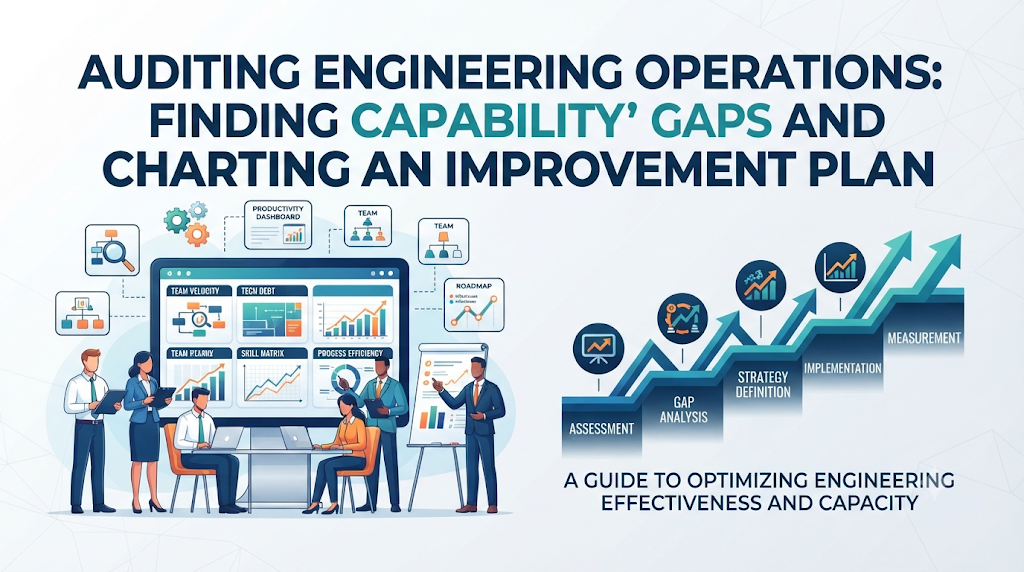
Think about a scaling software organization that checks every modern infrastructure box on paper. Services run on managed Kubernetes, cloud resources live inside Terraform modules, automated pipelines ship updates daily, and monitoring tools display dozens of live graphs. Yet inside the engineering department, deployments still feel risky. Weekend pages wake up on-call engineers over recurring alerts, image vulnerabilities sit unresolved for weeks, rollbacks depend on manual console steps, and cloud expenses climb faster than customer adoption.
This gap between modern tooling and fragile execution is surprisingly common. Adopting managed cloud platforms and hiring strong engineers are essential, yet software tools alone cannot create operational resilience. Dependable operations come from how team habits, architectural standards, service ownership, and automation reinforce each other when production systems come under stress. When organizations adopt new tools piecemeal without checking how their underlying workflows connect, critical blind spots stay hidden beneath a polished stack.
A deliberate engineering operations evaluation brings those hidden weaknesses into focus before they trigger major outages, security breaches, or chronic engineer fatigue.
What a Complete Engineering Operations Audit Examines
Auditing engineering operations means examining how an organization designs, ships, secures, observes, and supports production software end to end. Instead of merely inventorying which tools teams have purchased, a useful audit tests whether operational practices are repeatable, measurable, fault-tolerant, and aligned with business needs.
A well-rounded review evaluates both technical controls and team workflows across eight core pillars:
- Deployment and release engineering: How changes move from pull request to production, covering automated verification, progressive rollouts, release approvals, and rollback speed.
- Infrastructure as code and automation: Whether environments are created and updated deterministically through version control rather than manual portal adjustments.
- Production resilience and continuity: How workloads absorb traffic spikes, upstream outages, resource saturation, and availability zone disruptions.
- Continuous security integration: Whether vulnerability scanning, secrets management, least-privilege IAM, and policy guardrails run automatically across the delivery pipeline.
- Incident detection and response: How teams spot degradation, organize triage roles, communicate status updates, and turn post-mortems into lasting fixes.
- Observability and system diagnostics: Whether engineers have correlated telemetry that makes unfamiliar production issues fast to isolate.
- Cloud cost governance: How teams track resource efficiency, right-size compute, manage storage lifecycles, and tie infrastructure spend to product value.
- Internal platform capabilities: Whether reusable templates, paved roads, and self-service workflows reduce cognitive load for product engineers.
Looking across all eight areas together exposes how weaknesses compound. Brittle infrastructure automation slows down emergency recovery; noisy alerts dull on-call urgency; vague service ownership stalls debugging when releases misbehave.
Diagnose Production Risk Before Buying Another Tool
When operational friction becomes painful, the natural instinct in many organizations is to shop for a new platform. Teams dealing with outages look for a different monitoring vendor; teams frustrated by slow releases trial another CI/CD tool. While better tooling occasionally helps, adding software before diagnosing operational risk usually increases complexity without eliminating the root cause.
Effective engineering organizations start with a production readiness assessment before investing in new tools. Examining production readiness forces teams to verify whether critical services can withstand real-world failure conditions:
- Explicit service ownership: Does every production component have a clearly assigned team accountable for its reliability, scaling, and lifecycle maintenance?
- Predictable rollback mechanics: Can on-call engineers revert a faulty deployment in minutes without corrupting state or breaking downstream consumers?
- Tested disaster recovery: Are backup restorations rehearsed regularly against defined recovery time and recovery point objectives?
- Capacity and limit modeling: Do teams understand how services behave near resource ceilings and what happens when cloud quotas or connection pools saturate?
- Least-privilege access controls: Are production permissions tightly scoped, audited regularly, and protected against accidental human modifications?
- Service dependency mapping: Have teams documented hard and soft dependencies so a non-critical service failure cannot cascade across the platform?
- Actionable alerting and escalation: Are core user journeys covered by meaningful alerts backed by clear escalation paths?
Starting with production risk directs engineering time toward closing high-consequence gaps rather than expanding an already fragmented toolchain.
Measuring Current Operational Capabilities Against Engineering Goals
Once leaders commit to evaluating their operations, they need an objective way to compare current practices against target standards. A DevOps maturity assessment gives engineering managers and practitioners a structured baseline across core delivery and operational capabilities.
Comprehensive evaluations look across deployment automation, cross-team collaboration, environment parity, infrastructure lifecycle management, developer feedback loops, security controls, and service reliability. Rather than relying on vague self-descriptions—like claiming deployments are “mostly automated”—reliable frameworks anchor each maturity tier to observable criteria.
For example, there is a major operational difference between running automated build jobs that still rely on manual production cutovers and operating fully automated pipelines protected by automated canary rollbacks. Tying maturity scores to concrete evidence—such as runbook coverage, automated policy checks, or change failure rates—prevents inflated self-ratings and reveals an honest baseline.
Leaders must also keep clear boundaries around what internal evaluations represent. Self-reported assessments provide strong diagnostic clarity for engineering roadmaps, but they do not replace independent security audits, formal penetration tests, or regulatory compliance certifications. Nor does a high maturity score guarantee zero outages. Instead, consistent scoring provides a repeatable measurement system that supports better engineering trade-offs.
Turning Assessment Findings Into Ranked Engineering Priorities
A thorough operational audit frequently uncovers dozens of gaps simultaneously. Trying to fix everything at once scatters engineering focus and slows product delivery. Converting raw findings into a practical execution plan requires ranking work across five practical dimensions:
- Business impact: What happens to customers, revenue, or contractual obligations if this gap fails under load?
- Technical severity: Could this weakness cause data loss, extended downtime, or cascading system failures?
- Implementation effort: How much engineering time, architectural refactoring, or cross-team coordination does the fix demand?
- Foundational dependencies: Must core capabilities—such as centralized logging or standardized identity controls—be built before higher-level improvements can succeed?
- Near-term urgency: Are upcoming product launches, traffic peaks, or cloud migrations amplifying short-term risk?
Consider an organization whose evaluation surfaces two issues: product teams lack self-service preview environments, and the core checkout service runs inside a single availability zone with untested database backups. Self-service previews would improve developer convenience, but the single-zone checkout service creates immediate business exposure. Structured prioritization keeps execution disciplined—resolving critical production risks first while scheduling developer workflow improvements in realistic waves.
Inspecting Production Readiness Through a Kubernetes Workload
Walking through a concrete infrastructure stack demonstrates how structured reviews catch real technical gaps. Even experienced teams operating on Kubernetes frequently miss important safeguards as clusters grow organically. Applying a Kubernetes production readiness checklist during an assessment highlights specific weaknesses across seven operational layers:
Cluster Configuration and Identity Governance
Reviews check whether role-based access control (RBAC) tightly restricts administrative privileges, whether control-plane endpoints are locked down, and whether cluster upgrades follow a repeatable promotion path across environments.
Resource Requests and Limits
Without calibrated CPU and memory requests and limits, noisy containers can starve neighboring workloads of compute capacity, triggering severe throttling or node-level out-of-memory evictions during traffic spikes.
Health Probes and Workload Resilience
Liveness, readiness, and startup probes need to verify genuine application health rather than superficial port responses. Paired with pod disruption budgets and multi-zone pod topology spreads, proper probes ensure traffic reaches only healthy instances during rollouts or node maintenance.
Secrets Management and Network Segmentation
Storing sensitive tokens in plain ConfigMaps or permitting unrestricted pod-to-pod traffic widens the blast radius of a compromised workload. Readiness reviews verify external secrets integration and default-deny network policies.
Stateful Storage and Backup Drills
Stateful services require appropriate storage classes, scheduled volume snapshots, and documented restoration drills proving data can actually be recovered under pressure.
Cluster Telemetry and Alert Design
Production clusters need centralized log shipping, control-plane and workload metrics, and alerts tied to customer-facing symptoms rather than transient pod restarts.
Deployment Rollouts and Recovery Paths
Tuned rolling update parameters, canary verification, and tested GitOps or Helm rollback workflows determine whether a defective release is contained rapidly or disrupts all users.
How Routine Troubleshooting Exposes Deeper Operational Gaps
Daily production incidents serve as live stress tests of an organization’s operational maturity. Walking through Kubernetes CrashLoopBackOff troubleshooting illustrates how a local container failure often points to broader systemic weaknesses.
When a pod repeatedly crashes into CrashLoopBackOff, an experienced engineer follows a structured diagnostic sequence:
- Inspect pod status and cluster events: Run
kubectl describe podto review scheduler warnings, restart counts, and container exit codes—such as exit code 137 for out-of-memory termination or exit code 1 for application exceptions. - Review container logs: Pull current and previous container logs (
kubectl logs --previous) to inspect stack traces, missing configuration values, or startup errors prior to exit. - Validate ConfigMaps and Secrets: Confirm that mounted configuration files, secrets, and environment variables exist in the target namespace and match application expectations.
- Check resource headroom: Compare observed memory and CPU usage against container limits to identify premature resource kills.
- Audit health probe timing: Verify that aggressive liveness or startup probes are not terminating slow-initializing services before startup completes.
- Test downstream dependencies: Check DNS resolution, network policies, database credentials, and upstream service reachability from inside the cluster network.
Restoring the pod resolves the immediate outage, yet operational maturity shows in what follows. If the engineer lost twenty minutes jumping across disconnected log tools, struggled to identify the service owner, or edited a live manifest manually without updating Git, the incident exposed underlying operational friction. Mature teams feed those troubleshooting lessons directly into their improvement backlog.
Building Lasting Reliability Beyond Fast Incident Heroics
Many engineering cultures equate reliability with emergency heroics—celebrating engineers who jump online at midnight to wrestle broken services back to life. While rapid triage matters, durable reliability comes from building engineering guardrails that prevent recurring instability in the first place.
Following an SRE adoption roadmap enables organizations to introduce site reliability practices incrementally without stalling product delivery:
- Service-level indicators (SLIs) and objectives (SLOs): Defining measurable, user-centered targets for availability, latency, and correctness so engineering and product teams share an objective standard of reliability.
- Error budgets: Using acceptable unreliability margins to balance release velocity—shipping features rapidly when error budgets are healthy and prioritizing stability work when budgets shrink.
- Blameless incident analyses: Examining systemic contributors behind outages rather than faulting individuals, resulting in tracked preventive actions.
- Toil reduction: Identifying repetitive manual operational tasks—such as manual certificate renewals or routine capacity adjustments—and systematically automating them.
- Shared reliability ownership: Making capacity planning and failure resilience part of everyday architectural design rather than an afterthought at launch.
Connecting reliability targets directly to user experience helps organizations sustain both rapid feature delivery and long-term system stability.
Maturing Incident Response From Firefighting to Continuous Learning
Every complex system eventually fails, making structured incident handling essential. Using an incident management maturity model helps organizations evaluate how effectively they detect, triage, communicate, resolve, and learn from service disruptions.
Teams typically advance through five recognizable stages of incident management capability:
- Ad-hoc firefighting: Users discover outages first, response roles are improvised during the crisis, updates scatter across chat channels, and lessons fade once service returns.
- Defined response procedures: Severity levels are documented, structured on-call rotations exist, and basic runbooks guide initial triage for common failures.
- Coordinated incident command: Clear incident commander, communications lead, and technical resolver roles keep major outages organized alongside predictable internal and customer updates.
- Automated detection and remediation: High-signal alerts trigger automated diagnostics, runbook workflows, or self-healing actions to shorten detection and recovery times.
- Continuous organizational learning: Post-incident reviews consistently generate prioritized engineering improvements, highlight recurring failure patterns, and drive regular game-day simulations.
Benchmarking incident response maturity reveals whether on-call rotations merely survive outages or actively convert every disruption into stronger resilience.
Making Telemetry Actionable During Live Investigations
Ingesting large volumes of telemetry is easy; turning that data into fast, confident engineering decisions is much harder. Many teams collect terabytes of logs and metrics yet still spend hours guessing why latency jumped after a release. An observability maturity model evaluates whether instrumentation actually supports system understanding and rapid root-cause isolation.
Strong observability assessments look beyond tool adoption to examine four core capabilities:
- Correlated telemetry signals: Whether metrics, logs, and distributed traces share consistent service, version, and request context so engineers can pivot seamlessly during triage.
- Critical path coverage: Whether key user journeys, asynchronous workers, and external dependencies emit consistent instrumentation across services.
- Decision-focused dashboards: Whether dashboards answer clear operational questions—around saturation, error rates, and dependency health—rather than displaying visual clutter.
- Actionable alert design: Whether alerts trigger on user-impacting symptoms paired with runbook guidance rather than noisy threshold breaches that cause alert fatigue.
Evaluating observability through a diagnostic lens often lets teams reduce telemetry storage costs while dramatically accelerating incident resolution.
Embedding Security Into Everyday Engineering Workflows
When security sits outside daily development—appearing only as pre-release gates or annual compliance reviews—it slows delivery and leaves production exposed between checkpoints. A DevSecOps implementation roadmap integrates security verification directly into the software delivery lifecycle.
Evaluating security maturity across engineering operations covers five connected practices:
- Secure coding habits: Equipping developers with clear security guidelines, lightweight threat modeling, and automated feedback inside pull requests.
- Automated code and dependency scanning: Detecting vulnerable third-party libraries and insecure code patterns early in CI builds before artifacts reach staging.
- Container and supply-chain security: Building minimal container images, scanning artifacts continuously, signing builds, and enforcing runtime admission policies.
- Secrets management and policy as code: Eliminating hardcoded secrets through automated rotation while validating Terraform and Kubernetes manifests against policy-as-code guardrails.
- Risk-based vulnerability management: Prioritizing remediation using runtime exposure context and maintaining continuous audit trails automatically.
Integrating security verification into automated pipelines removes late-stage bottlenecks while making security posture visible across every release.
Designing Internal Platforms That Reduce Developer Cognitive Load
As engineering organizations scale, expecting every product team to master Kubernetes networking, cloud IAM policies, CI/CD security gates, and observability instrumentation creates heavy cognitive drag. A platform engineering adoption roadmap provides a structured path to building internal capabilities that speed up delivery without compromising governance.
Effective platform initiatives focus on measurable engineering outcomes:
- Self-service internal developer platforms (IDPs): Offering unified portals or CLI workflows where developers can provision environments, deploy services, and inspect operational health without filing infrastructure tickets.
- Golden paths and reusable templates: Providing curated, production-ready service templates pre-configured with logging, security scanning, health checks, and deployment pipelines.
- Built-in governance: Embedding tagging, compliance rules, and access guardrails directly into platform templates so the easiest path for developers is automatically compliant.
- Product-minded platform teams: Treating internal developers as customers—gathering feedback, tracking onboarding and deployment lead times, and preserving flexibility for specialized workloads.
Assessing platform maturity ensures organizations invest in self-service tools that remove real delivery bottlenecks rather than building rigid abstractions teams try to bypass.
Managing Cloud Infrastructure Spend Without Hurting Reliability
Unexpected cloud spending spikes are usually a symptom of operational blind spots rather than unavoidable growth costs. A cloud cost optimization roadmap helps engineering and finance teams align infrastructure spending with workload demand and business value.
Instead of imposing blunt budget freezes that risk performance degradation or downtime, mature cloud financial management relies on engineering visibility and architectural discipline:
- Idle resource cleanup: Identifying unattached storage volumes, oversized compute instances, forgotten staging environments, and underutilized cluster nodes.
- Workload sizing and autoscaling: Matching CPU and memory requests to actual utilization profiles and configuring responsive horizontal and vertical autoscalers.
- Storage and telemetry lifecycle rules: Applying retention policies, tiering infrequently accessed logs and backups, and controlling high-cardinality metrics ingestion.
- Granular cost attribution: Enforcing consistent tagging standards so product teams see the real infrastructure cost of the services they own.
- Cross-functional FinOps collaboration: Bringing engineering, product, and finance leaders together to evaluate cost trade-offs alongside latency, availability, and delivery speed.
When cost visibility is woven into regular operational reviews, teams manage cloud efficiency as a routine part of engineering stewardship.
Synthesizing Domain Findings Into a Coordinated Roadmap
Evaluating reliability, security, observability, platform workflows, and cloud costs in isolation creates competing wish lists. Lasting operational progress happens when organizations bring findings across all domains together into a single, coordinated execution plan.
Building an organization-wide operational roadmap follows six practical steps:
- Establish a baseline maturity score: Run structured evaluations across engineering teams to benchmark current capabilities and capture supporting evidence.
- Identify high-impact operational gaps: Filter weaknesses by production risk, customer impact, and operational friction rather than personal preference.
- Map cross-domain dependencies: Sequence foundational work—such as standardized service ownership, tagging, and core telemetry—ahead of advanced automation or platform layers.
- Assign clear ownership and timelines: Give specific teams accountability for each initiative and protect dedicated capacity alongside feature delivery.
- Define measurable success metrics: Track concrete operational indicators—such as change failure rate, mean time to recovery, alert noise reduction, or unallocated cloud spend—to verify real progress.
- Reassess maturity on a regular cadence: Repeat evaluations periodically to measure improvement, account for architectural growth, and recalibrate priorities.
This link between structured diagnosis and practical execution is what OpsRoadmaps is built to support. As an engineering operations assessment and improvement planning platform, OpsRoadmaps helps engineering teams, DevOps professionals, SREs, platform engineers, cloud architects, security practitioners, and technology leaders turn complex operational reviews into clear action plans. Spanning 42 engineering operations disciplines across nine core domains, the platform connects structured self-assessments and explainable maturity scores with prioritized findings, technical guidance, and actionable roadmaps aligned to an organization’s current stage.
Making Operational Assessment an Ongoing Engineering Habit
Engineering operations never reaches a permanent steady state. Every new service, cloud migration, traffic milestone, or team expansion introduces fresh failure modes and raises operational expectations. Treating an engineering operations assessment as a one-time audit leaves most of its value unrealized.
Organizations that sustain reliable, secure, and cost-effective software delivery treat operational evaluation as a continuous practice. They use transparent, criteria-based scoring to guide honest technical conversations, prioritize high-risk production gaps over shiny new tools, and verify whether every change measurably reduces friction and risk. With structured frameworks and platforms like OpsRoadmaps supporting ongoing evaluation and roadmap planning, engineering teams can steadily strengthen their operational foundation while staying focused on delivering value.










Leave a Reply
You must be logged in to post a comment.