Introduction to DevSecOps
Modern software development is changing rapidly. Businesses are building applications, launching digital services, and updating software more frequently than ever before. Cloud computing, microservices, containers, APIs, and automated deployment pipelines have made software delivery faster and more flexible. However, these technologies have also increased security risks. Applications can contain vulnerable code, exposed credentials, insecure dependencies, misconfigured cloud resources, and weaknesses that attackers may exploit. Traditionally, security testing was often performed near the end of the software development process. Developers focused on building features, operations teams concentrated on deployment and reliability, and security specialists reviewed the application before its release. This approach frequently created delays because vulnerabilities were discovered after significant development work had already been completed.
DevSecOps addresses this challenge by integrating security into every stage of the software development lifecycle. The term DevSecOps combines three important areas: Development, Security, and Operations. It extends DevOps practices by making security a shared responsibility among developers, security professionals, quality engineers, and operations teams. Instead of treating security as a final checkpoint, DevSecOps encourages teams to identify and fix security problems from the beginning. Automated security testing, secure coding practices, dependency analysis, infrastructure scanning, access management, and continuous monitoring become part of the regular software delivery process. The primary objective is to help organizations develop, test, deploy, and maintain secure applications without unnecessarily slowing down software delivery. According to AWS, DevSecOps integrates security testing throughout software development and encourages collaboration between development, security, and operations teams.
What Is DevSecOps?
DevSecOps is a software engineering approach that integrates security practices, automated security testing, and continuous risk management into the complete software development and delivery lifecycle. The traditional DevOps model focuses on improving collaboration between development and operations teams, automating repetitive tasks, and delivering software quickly and reliably. DevSecOps builds on these principles by introducing security controls throughout the same workflow. In a DevSecOps environment, security is considered during application planning, architecture design, coding, building, testing, deployment, and production monitoring. Teams use automated tools to identify vulnerabilities early and establish consistent security standards across applications and infrastructure.
For example, when a developer submits new code to a Git repository, an automated pipeline can scan the code for security weaknesses, check third-party dependencies for known vulnerabilities, and detect accidentally exposed passwords or API keys. If a serious security issue is identified, the pipeline can notify the development team or prevent the affected build from progressing until the problem is addressed. This approach helps organizations reduce security risks while maintaining the speed and flexibility of modern software development.
What Does DevSecOps Stand For?
DevSecOps consists of three interconnected components:
1. Development (Dev)
Development involves designing, writing, testing, and maintaining application code. Developers are responsible for implementing secure coding practices, using trusted libraries, validating user inputs, and avoiding common programming vulnerabilities.
2. Security (Sec)
Security focuses on identifying, preventing, and managing risks throughout the software lifecycle. It includes vulnerability assessment, secure code analysis, penetration testing, secrets management, identity management, compliance checks, and security monitoring.
3. Operations (Ops)
Operations focuses on deploying, managing, monitoring, and maintaining applications and infrastructure. Operations teams help protect production environments through secure configurations, access controls, logging, monitoring, patch management, and incident response.
When these three areas work together, organizations can build applications that are more reliable, secure, and easier to maintain.
Why Did DevSecOps Become Important?
The growing importance of DevSecOps is closely connected to the evolution of software development and infrastructure management. Organizations increasingly rely on cloud platforms, distributed applications, automated pipelines, and third-party software components.
These technologies provide significant advantages, but they also introduce additional security challenges.
1. Faster Software Release Cycles
Agile development and CI/CD pipelines allow organizations to release software updates frequently. Manual security reviews cannot always keep pace with continuous deployment.
DevSecOps introduces automated security checks into the delivery pipeline, allowing teams to evaluate changes more consistently without depending entirely on separate manual reviews.
2. Increasing Cybersecurity Threats
Organizations face threats such as ransomware, credential theft, malicious dependencies, application attacks, and unauthorized access.
DevSecOps helps identify weaknesses earlier through continuous testing, vulnerability scanning, and monitoring.
3. Growing Cloud Infrastructure
Modern applications often operate across public cloud environments, containers, Kubernetes clusters, and distributed services. Incorrect permissions, exposed storage, insecure networking, and configuration mistakes can create serious risks.
DevSecOps incorporates cloud security and infrastructure validation into the deployment process.
4. Third-Party Dependency Risks
Applications frequently use open-source libraries, frameworks, packages, and external services. Vulnerabilities in these components can affect the security of the entire application.
Software Composition Analysis (SCA) tools help teams identify vulnerable dependencies and evaluate software supply chain risks.
5. Compliance and Data Protection Requirements
Organizations handling personal, financial, healthcare, or business-critical information must follow relevant security and regulatory requirements.
DevSecOps supports continuous compliance by automating policy checks, maintaining security records, and applying consistent controls throughout development and deployment.
Why Is DevSecOps Important for Modern Software Development?
DevSecOps is important because modern software must be delivered quickly without ignoring security. A successful development process should protect application data, infrastructure, users, and business operations while supporting continuous improvement.
The following benefits explain why organizations are adopting DevSecOps practices.
1. Identifies Security Vulnerabilities Earlier
One of the most important advantages of DevSecOps is early vulnerability detection. When security testing is introduced during coding and development, teams can identify weaknesses before they become part of a production release.
For example, a developer may accidentally introduce an insecure database query. A Static Application Security Testing tool can analyze the source code and highlight the potential issue during the development process.
Finding the problem early makes it easier to understand the affected code and apply a suitable correction.
2. Reduces Security Remediation Costs
Security problems discovered after deployment can require emergency fixes, additional testing, application downtime, and incident response activities.
DevSecOps helps reduce these expenses by identifying and prioritizing vulnerabilities earlier. Developers can address problems while they are already working on the affected features.
3. Improves Collaboration Between Teams
In traditional environments, developers, security professionals, and operations engineers may work independently. This separation can create communication gaps and delays.
DevSecOps encourages shared responsibility. Security specialists help developers understand risks, developers follow secure coding practices, and operations teams maintain secure production environments.
4. Strengthens CI/CD Pipeline Security
CI/CD pipelines automate application building, testing, and deployment. However, an insecure pipeline can become a target for attackers.
DevSecOps protects these pipelines through repository permissions, secrets management, dependency scanning, artifact verification, access controls, and automated security policies.
5. Supports Faster and Safer Releases
Security testing does not have to become a separate process that delays every release. Automated checks can run alongside existing build and test activities.
This allows organizations to maintain development speed while receiving continuous feedback about security risks.
6. Protects Sensitive Business Data
Applications frequently process customer details, payment information, employee records, and confidential business data.
DevSecOps helps protect this information through encryption, secure authentication, access management, secure storage, and continuous monitoring.
7. Improves Cloud and Container Security
Cloud-native applications often use containers, Kubernetes, serverless functions, and infrastructure as code.
DevSecOps introduces security checks for container images, deployment manifests, infrastructure templates, cloud permissions, and runtime environments.
8. Strengthens Software Supply Chain Security
Modern applications depend on external libraries, build systems, container images, plugins, and deployment tools.
DevSecOps helps organizations evaluate these components, identify known vulnerabilities, verify software artifacts, and control access to critical development resources.
9. Supports Continuous Compliance
Instead of checking compliance only before an audit, organizations can automate selected security policies throughout the software lifecycle.
This helps teams maintain better visibility into security controls, configuration changes, access permissions, and audit evidence.
10. Builds Customer Trust
Customers expect applications to protect their information and remain available. Strong security practices reduce the likelihood of preventable incidents and help organizations demonstrate their commitment to protecting users.
DevSecOps vs. DevOps: Understanding the Difference
DevOps and DevSecOps share many principles, including automation, collaboration, continuous integration, continuous delivery, and continuous improvement. The main difference is how security is incorporated into the development process.
DevOps primarily emphasizes collaboration between development and operations teams to improve software delivery and operational reliability. DevSecOps extends this approach by integrating security responsibilities and controls throughout the lifecycle.
| Area | DevOps | DevSecOps |
|---|---|---|
| Primary focus | Development and operations collaboration | Development, security, and operations collaboration |
| Security approach | May be handled through separate security activities | Integrated throughout the lifecycle |
| Testing | Functional, integration, and performance testing | Includes automated security testing |
| CI/CD pipeline | Automates build, test, and deployment | Adds security validation and policy checks |
| Vulnerability detection | May happen through separate security reviews | Begins during development and continues in production |
| Team responsibility | Shared development and operations ownership | Shared responsibility for security as well |
| Main objective | Faster and more reliable delivery | Faster delivery with continuous security |
Both approaches are valuable. DevSecOps does not replace DevOps; it strengthens the DevOps model by making security an essential part of everyday engineering activities.
Understanding the DevSecOps Lifecycle
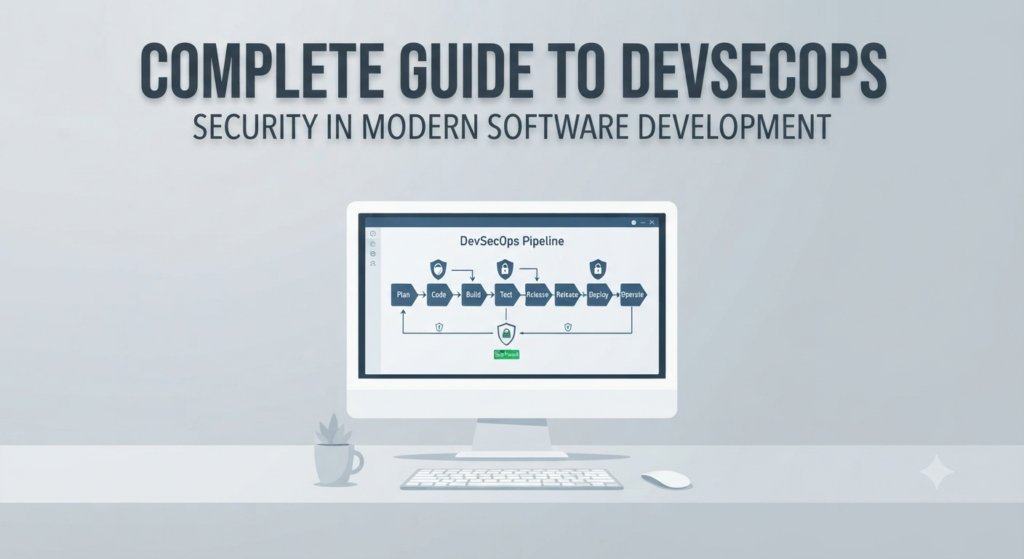
The DevSecOps lifecycle integrates security activities into the different stages of software development. Security is not limited to a single testing phase. It is continuously evaluated as the application moves from planning to production.
1. Plan
Security requirements should be identified before development begins. Teams evaluate application risks, business requirements, data sensitivity, compliance obligations, and potential attack scenarios.
Activities include:
- Defining application security requirements.
- Identifying sensitive data and critical assets.
- Performing initial threat modeling.
- Establishing security policies.
- Identifying authentication and authorization requirements.
2. Develop
Developers write application code while following secure coding standards. Security tools can be integrated into development environments and repositories to provide early feedback.
Activities include:
- Following secure coding guidelines.
- Validating user inputs.
- Avoiding hardcoded passwords and API keys.
- Using approved libraries and frameworks.
- Reviewing code changes before merging.
3. Build
The build stage converts application source code into executable software packages or artifacts. Security checks help ensure that the build process does not introduce unnecessary risks.
Activities include:
- Static Application Security Testing (SAST).
- Software Composition Analysis (SCA).
- Secrets detection.
- Build environment security checks.
- Software artifact verification.
4. Test
The testing stage evaluates application functionality and security. Automated security tests can identify weaknesses that may not be detected through ordinary functional testing.
Activities include:
- Dynamic Application Security Testing (DAST).
- API security testing.
- Vulnerability scanning.
- Container image scanning.
- Security regression testing.
5. Release
Before a release is approved, teams evaluate whether required security checks have been completed and whether identified risks are acceptable.
Activities include:
- Reviewing security findings.
- Validating release approvals.
- Checking security policies.
- Verifying software artifacts.
- Documenting unresolved risks.
6. Deploy
Applications are deployed into staging or production environments. Infrastructure and deployment configurations should be validated to prevent insecure settings.
Activities include:
- Infrastructure as Code (IaC) scanning.
- Cloud configuration validation.
- Secure container deployment.
- Access permission checks.
- Environment configuration verification.
7. Operate
After deployment, operations teams maintain the application and its supporting infrastructure. Security remains important throughout daily operations.
Activities include:
- Managing user permissions.
- Applying security patches.
- Maintaining secure configurations.
- Managing secrets and credentials.
- Protecting production infrastructure.
8. Monitor
Continuous monitoring helps organizations identify suspicious activities, unexpected configuration changes, vulnerabilities, and potential attacks.
Activities include:
- Collecting application and infrastructure logs.
- Monitoring security alerts.
- Detecting unusual access patterns.
- Tracking vulnerabilities.
- Investigating potential incidents.
The lifecycle is continuous. Findings from production monitoring should influence future planning, coding, testing, and deployment decisions.
Key DevSecOps Practices Every Organization Should Follow
Successful DevSecOps adoption requires more than installing security tools. Organizations need consistent processes, clear responsibilities, and a culture in which security is considered during everyday engineering work.
1. Shift-Left Security
Shift-left security means introducing security activities as early as possible in the development lifecycle.
Rather than waiting until an application is ready for release, teams perform security reviews during planning, coding, and building.
For example, a developer can run a code security scan before submitting a pull request. This helps identify potential vulnerabilities while the code is still being developed.
2. Secure Coding Standards
Developers should follow secure programming practices to reduce common application weaknesses.
Important practices include:
- Input validation and output encoding.
- Secure authentication and session management.
- Proper authorization checks.
- Safe database query handling.
- Secure error handling.
- Avoiding hardcoded credentials.
- Using maintained and trusted dependencies.
3. Automated Security Testing
Automation makes it possible to perform security checks consistently across development environments and CI/CD pipelines.
Organizations should select appropriate security tests based on application architecture, programming languages, infrastructure, and risk.
4. Secrets Management
Passwords, API keys, access tokens, and certificates should not be stored directly in source code or exposed through build logs.
Organizations should use dedicated secrets management systems, restrict access, rotate credentials when necessary, and monitor suspicious usage.
5. Infrastructure as Code Security
Infrastructure as Code tools allow teams to define cloud resources and infrastructure through configuration files.
These templates should be scanned for insecure permissions, public exposure, weak encryption settings, and other configuration problems before deployment.
6. Container and Kubernetes Security
Containers and Kubernetes introduce additional security considerations.
Organizations should scan container images, use trusted base images, restrict container privileges, secure cluster access, and regularly review deployment configurations.
7. Continuous Monitoring
Security does not stop after an application is deployed. Teams should monitor production systems for vulnerabilities, suspicious behavior, configuration changes, and unusual access attempts.
8. Security Awareness and Training
Developers, operations engineers, and security professionals should understand the security risks associated with their responsibilities.
Regular training, code reviews, incident exercises, and secure development guidelines help build a stronger security culture.
Important DevSecOps Tools and Technologies
DevSecOps tools help organizations automate security testing, improve visibility, and enforce consistent controls throughout the software delivery process. The correct toolset depends on the organization’s technology stack, security requirements, and existing CI/CD environment.
1. Git and GitHub
Git is a version control system used to track code changes and support collaboration. GitHub provides repository hosting, pull requests, code reviews, and automation features.
In DevSecOps, repository protections, branch rules, code reviews, and secret scanning help reduce risks before code is merged.
2. Jenkins
Jenkins is an automation server commonly used to build CI/CD pipelines.
It can integrate security tools into pipeline stages so that code analysis, dependency checks, and other validations run automatically during application builds.
3. SonarQube
SonarQube analyzes source code to identify code quality problems and security-related weaknesses.
It supports static analysis and helps development teams identify issues before applications are deployed.
4. OWASP ZAP
OWASP Zed Attack Proxy (ZAP) is an open-source web application security testing tool.
It can help identify vulnerabilities in web applications through automated and manual security testing. It is particularly useful for learning and testing authorized applications.
5. Snyk
Snyk provides security capabilities for application dependencies, source code, container images, and infrastructure configurations.
It helps development teams identify known vulnerabilities and receive guidance on remediation.
6. Trivy
Trivy is an open-source security scanner used to identify vulnerabilities and misconfigurations in container images, repositories, and infrastructure-related files.
It is frequently used in cloud-native development workflows.
7. HashiCorp Vault
HashiCorp Vault helps organizations securely store and manage sensitive information such as passwords, API keys, certificates, and application credentials.
It supports controlled access to secrets and helps reduce the risk of exposing sensitive values in code or configuration files.
8. Docker
Docker provides containerization capabilities that help developers package applications and their dependencies into portable containers.
DevSecOps teams use image scanning, trusted base images, and secure container configurations to reduce container-related risks.
9. Kubernetes
Kubernetes manages containerized applications across clusters.
Its security capabilities and related ecosystem tools help teams manage workload isolation, access permissions, network policies, and deployment security.
10. Terraform
Terraform is an Infrastructure as Code tool used to provision and manage infrastructure.
DevSecOps teams can scan Terraform configuration files for insecure settings before applying infrastructure changes.
How to Implement DevSecOps in an Organization
Adopting DevSecOps should be a gradual and measurable process. Organizations should understand their existing development workflow, identify important security risks, and introduce controls that support their engineering objectives.
Step 1: Evaluate the Existing Development Process
Start by reviewing the current software development lifecycle, repositories, build systems, deployment pipelines, cloud environments, and security practices.
Identify where security reviews currently happen and where vulnerabilities are most likely to enter the application.
Step 2: Establish Shared Security Responsibilities
Define the responsibilities of developers, security specialists, testers, and operations engineers.
Security should be a shared responsibility, but teams should also have clear ownership for reviewing findings, approving exceptions, and fixing vulnerabilities.
Step 3: Introduce Secure Coding Practices
Create secure coding guidelines for the programming languages and frameworks used by the organization.
Provide developers with practical training on authentication, authorization, input validation, dependency management, and common application vulnerabilities.
Step 4: Integrate Security Tools into CI/CD
Begin with a small number of relevant automated checks.
For example, a pipeline can include:
- Source code security analysis.
- Dependency vulnerability scanning.
- Secret detection.
- Container image scanning.
- Infrastructure configuration checks.
Avoid introducing too many tools at once. Each security check should have a clear purpose and a defined process for handling its findings.
Step 5: Define Security Policies and Quality Gates
Organizations should establish rules for determining which security findings must be fixed before a release.
Critical vulnerabilities may require immediate remediation, while lower-risk findings can be prioritized according to business impact and organizational policy.
Security gates should be risk-based rather than designed to block every build for every warning.
Step 6: Secure Cloud and Infrastructure Environments
Review cloud permissions, network configurations, storage access, container security, and infrastructure templates.
Apply least-privilege access so that users and automated services receive only the permissions necessary for their responsibilities.
Step 7: Implement Continuous Monitoring
Monitor applications, infrastructure, repositories, and deployment systems for security-related events.
Define how alerts will be investigated, how incidents will be escalated, and how vulnerabilities will be tracked until resolution.
Step 8: Measure and Improve
Review security metrics regularly and identify areas where the process can be improved.
Useful measurements include vulnerability remediation time, security issues discovered before production, unresolved critical findings, dependency risk, and security policy compliance.
Real-World DevSecOps Use Cases
DevSecOps practices can be applied across industries because nearly every modern organization depends on software, cloud infrastructure, and digital services.
1. Banking and Financial Services
Financial institutions process sensitive customer information, payment transactions, and account credentials.
DevSecOps helps these organizations integrate secure code analysis, access controls, dependency scanning, encryption checks, and continuous monitoring into application delivery.
2. Healthcare Applications
Healthcare platforms manage patient records, appointment systems, diagnostic information, and other sensitive data.
DevSecOps can help protect these applications through secure authentication, controlled access, vulnerability management, encryption, and compliance-oriented monitoring.
3. E-Commerce Platforms
E-commerce applications process customer accounts, product information, orders, and payment-related workflows.
Security testing helps identify weaknesses in APIs, authentication systems, payment integrations, and third-party dependencies.
4. Cloud-Based SaaS Applications
Software-as-a-Service providers frequently release updates to applications used by many customers.
DevSecOps enables automated security validation, infrastructure scanning, container security, and continuous monitoring across cloud environments.
5. Government and Enterprise Applications
Government and enterprise systems may process confidential information and operate under strict security requirements.
DevSecOps supports controlled software delivery through automated testing, documented security policies, access governance, and continuous risk management.
Common Challenges in DevSecOps Adoption
Although DevSecOps provides many benefits, implementing it successfully can be challenging. Organizations must address technical, operational, and cultural issues.
1. Lack of Security Knowledge
Some developers may not have sufficient experience with secure coding, application vulnerabilities, or security testing.
Solution: Provide practical security training, secure coding guidelines, code review support, and accessible documentation.
2. Too Many Security Tools
Using several disconnected security tools can create complicated workflows, duplicated alerts, and unnecessary maintenance.
Solution: Select tools based on actual risks and integrate them into a manageable security workflow.
3. False Positives and Alert Fatigue
Automated scanners sometimes report issues that are not exploitable or relevant to the application.
Solution: Prioritize findings according to severity and context, tune scanning rules, and establish a clear review process.
4. Resistance to Organizational Change
Teams accustomed to separate development, security, and operations processes may initially resist shared responsibilities.
Solution: Introduce DevSecOps gradually, demonstrate practical benefits, and encourage collaboration between teams.
5. Pipeline Performance Issues
Running too many security checks during every build can increase pipeline execution time.
Solution: Optimize scanning frequency, use incremental analysis where appropriate, and run deeper assessments at suitable stages.
6. Legacy Application Complexity
Older applications may contain outdated libraries, unsupported frameworks, and architectural limitations.
Solution: Identify high-risk components first and create a realistic modernization and remediation plan.
7. Cloud Security Complexity
Multi-cloud environments and distributed infrastructure can make access management and configuration monitoring difficult.
Solution: Establish standard security policies, automate infrastructure validation, and maintain clear visibility across environments.
Best Practices for Building a Successful DevSecOps Culture
Technology alone cannot create an effective DevSecOps environment. Organizations must combine the right tools with strong engineering practices and a culture of continuous improvement.
Important recommendations include:
- Make Security a Shared Responsibility: Developers, security specialists, and operations teams should collaborate instead of treating security as the responsibility of one department.
- Start with High-Risk Areas: Identify the most important applications, data, and infrastructure components before expanding security automation across the organization.
- Automate Repetitive Security Tasks: Use automated scanning and policy checks to improve consistency and reduce unnecessary manual work.
- Use Least-Privilege Access: Restrict access to repositories, cloud resources, deployment systems, and production environments.
- Protect Secrets and Credentials: Use secure secrets management systems and avoid exposing sensitive information in source code, configuration files, and logs.
- Maintain Secure Dependencies: Regularly review third-party libraries and update vulnerable or unsupported components.
- Secure the Software Supply Chain: Protect build environments, repositories, artifacts, and deployment credentials against unauthorized modification.
- Monitor Production Continuously: Maintain logs, security alerts, and incident response procedures to identify and investigate suspicious activities.
- Measure Security Performance: Track remediation time, vulnerability trends, and the effectiveness of security controls.
- Keep Improving: Review security practices regularly as applications, infrastructure, business requirements, and threats evolve.
Skills Required to Become a DevSecOps Engineer
A DevSecOps engineer combines knowledge of software development, infrastructure automation, cloud technologies, and cybersecurity. The role requires both technical skills and the ability to collaborate with different engineering teams.
1. Linux and Operating System Fundamentals
Linux knowledge is important because many application servers, containers, and cloud environments use Linux-based systems.
Important topics include:
- Linux commands and shell scripting.
- File permissions and ownership.
- Process and service management.
- System logs.
- Networking fundamentals.
2. Programming and Scripting
A DevSecOps engineer should understand at least one programming or scripting language.
Common choices include Python, Bash, Java, and Go. These languages are useful for automation, security checks, integration tasks, and development workflows.
3. Version Control
Knowledge of Git and platforms such as GitHub or GitLab is important for managing code, reviewing changes, and securing repositories.
4. CI/CD Pipeline Management
Understanding Jenkins, GitHub Actions, GitLab CI/CD, or Azure DevOps helps engineers integrate automated security checks into software delivery pipelines.
5. Cloud Computing
Knowledge of AWS, Microsoft Azure, or Google Cloud is useful for securing cloud applications and infrastructure.
Engineers should understand cloud identity management, network security, storage permissions, logging, and configuration management.
6. Container and Kubernetes Security
Docker and Kubernetes knowledge is increasingly important for organizations running cloud-native applications.
Engineers should understand image scanning, container isolation, cluster permissions, secrets, and secure workload configurations.
7. Application Security
Important application security concepts include:
- OWASP Top 10.
- Authentication and authorization.
- SQL injection.
- Cross-Site Scripting (XSS).
- Secure API development.
- Vulnerability assessment.
- Security testing methodologies.
8. Infrastructure as Code
Knowledge of Terraform, Ansible, and configuration management helps engineers automate infrastructure while applying consistent security policies.
9. Security Tools
Practical experience with tools such as SonarQube, OWASP ZAP, Trivy, Snyk, and HashiCorp Vault helps engineers implement security automation.
10. Communication and Problem-Solving
DevSecOps engineers work with developers, security teams, architects, and operations professionals. Clear communication and practical problem-solving are essential for identifying risks and implementing appropriate solutions.
DevSecOps Career Opportunities
As organizations increasingly integrate security into software delivery, professionals with combined DevOps and security knowledge can pursue several career paths.
Common roles include:
- DevSecOps Engineer: Integrates security automation and controls into CI/CD pipelines.
- Application Security Engineer: Identifies and helps resolve vulnerabilities in application code and architecture.
- Cloud Security Engineer: Protects cloud infrastructure, identities, workloads, and configurations.
- Security Automation Engineer: Develops automated security testing and response workflows.
- DevOps Security Specialist: Strengthens the security of development and deployment environments.
- Platform Security Engineer: Builds secure internal platforms and reusable engineering controls.
- Product Security Engineer: Works with product teams to improve application security throughout development.
The exact responsibilities and required experience vary across organizations. Practical knowledge, hands-on projects, and a strong understanding of both development and security are important for career growth.
Future of DevSecOps in Modern Software Development
DevSecOps will continue evolving as software architectures, development technologies, and cyber threats change. Organizations are moving toward more automated, cloud-native, and continuously monitored security practices.
1. AI-Assisted Security Automation
Artificial intelligence can help analyze security findings, identify patterns, summarize vulnerabilities, and support remediation workflows.
However, AI-generated code and automated development tools also introduce risks. Organizations will need to validate generated code, protect sensitive data, and maintain appropriate human review.
2. Software Supply Chain Security
Organizations are paying greater attention to the security of dependencies, build systems, container images, and software artifacts.
Software bills of materials (SBOMs), artifact verification, and dependency risk management are becoming important parts of secure software delivery.
3. Cloud-Native Security
As organizations adopt containers, Kubernetes, serverless computing, and microservices, DevSecOps will increasingly focus on securing distributed environments and automated infrastructure.
4. Policy as Code
Policy as Code allows organizations to define security and compliance requirements in machine-readable formats.
These policies can be evaluated automatically during infrastructure provisioning and software deployment.
5. Continuous Compliance
Organizations will increasingly automate evidence collection, policy validation, and configuration monitoring to maintain visibility into compliance requirements.
6. Zero Trust Security
Zero Trust principles emphasize continuous verification, least-privilege access, and reducing unnecessary trust between users, devices, services, and workloads.
These principles are especially relevant to distributed cloud environments and automated software delivery systems.
Top 10 Frequently Asked Questions About DevSecOps
1. What is DevSecOps in simple terms?
DevSecOps is an approach that combines development, security, and operations to build and deliver secure software. It integrates security testing and risk management into every stage of the software development lifecycle instead of performing security checks only before deployment. Developers, security professionals, and operations engineers share responsibility for protecting applications and infrastructure.
2. What does DevSecOps stand for?
DevSecOps stands for Development, Security, and Operations. Development focuses on building applications, security focuses on identifying and managing risks, and operations focuses on deploying and maintaining software environments. The approach combines these responsibilities through collaboration, automation, and continuous security practices.
3. Why is DevSecOps important in modern software development?
DevSecOps is important because modern applications are updated frequently and depend on complex cloud infrastructure, APIs, containers, and third-party libraries. Integrating security into development helps identify vulnerabilities earlier, protect sensitive information, reduce remediation effort, and maintain safer software delivery pipelines.
4. What is the difference between DevOps and DevSecOps?
DevOps focuses on collaboration between development and operations teams to improve software delivery and reliability. DevSecOps extends this approach by integrating security into the same processes. It adds automated security testing, vulnerability management, secure coding, and continuous monitoring to the software delivery lifecycle.
5. What are the main stages of the DevSecOps lifecycle?
The DevSecOps lifecycle commonly includes planning, development, building, testing, releasing, deployment, operation, and monitoring. Security activities are integrated into each stage through practices such as threat modeling, secure coding, code scanning, dependency analysis, infrastructure validation, access management, and continuous monitoring.
6. Which tools are commonly used in DevSecOps?
Common DevSecOps tools include Git and GitHub for version control, Jenkins for CI/CD automation, SonarQube for source code analysis, OWASP ZAP for web application security testing, Snyk for vulnerability detection, Trivy for container scanning, HashiCorp Vault for secrets management, Docker for containerization, Kubernetes for orchestration, and Terraform for infrastructure automation.
7. What is Shift-Left Security in DevSecOps?
Shift-Left Security means introducing security activities early in the software development process. Instead of waiting until an application is ready for production, developers perform security checks during planning, coding, and building. This helps teams identify and resolve vulnerabilities before they become more difficult and expensive to fix.
8. Is DevSecOps suitable for beginners?
Yes, beginners can learn DevSecOps by first developing a foundation in Linux, networking, programming, Git, and basic software development. They can then learn CI/CD pipelines, cloud computing, containers, application security, and automated scanning tools. Building small practical projects is a useful way to understand how these technologies work together.
9. What skills are required to become a DevSecOps engineer?
A DevSecOps engineer should understand Linux, programming or scripting, Git, CI/CD automation, cloud platforms, Docker, Kubernetes, Infrastructure as Code, and application security. Knowledge of vulnerability scanning, secrets management, access control, security monitoring, and secure coding practices is also valuable.
10. What is the future scope of DevSecOps?
The future of DevSecOps is connected to cloud-native development, AI-assisted security, software supply chain protection, automated compliance, policy as code, and continuous security monitoring. As organizations continue adopting automated software delivery, professionals who understand both development and cybersecurity will be valuable contributors to modern engineering teams.
The article follows the DevSecOps School subject area and covers both beginner concepts and practical engineering practices. The technical explanations are informed by guidance from AWS, the OWASP DevSecOps Guideline, and Microsoft Security.
Conclusion
DevSecOps has become an important approach to modern software development because organizations need to deliver applications quickly while managing growing cybersecurity risks. By integrating security into planning, coding, building, testing, deployment, and monitoring, DevSecOps helps teams identify vulnerabilities earlier and maintain stronger control over their applications and infrastructure.
It is not simply a collection of security tools. It represents a change in engineering culture where developers, security professionals, and operations teams work together to protect software throughout its lifecycle.
Organizations adopting DevSecOps can improve security visibility, strengthen CI/CD pipelines, protect sensitive information, manage software supply chain risks, and support more reliable software releases.
For professionals interested in software engineering, DevOps, cloud computing, or cybersecurity, learning DevSecOps provides valuable knowledge for working with modern development environments. Building practical experience with Linux, Git, CI/CD, cloud platforms, containers, application security, and automation tools is a strong foundation for developing DevSecOps skills.
DevSecOps is not about slowing down development to add security. It is about making security a continuous part of building, delivering, and operating modern software.



Leave a Reply
You must be logged in to post a comment.