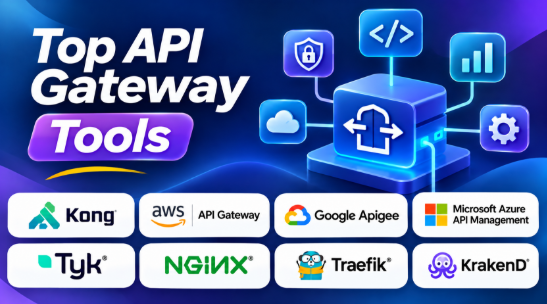
APIs connect applications, websites, mobile apps, cloud services, and business systems. As these connections grow, managing API traffic becomes more difficult. Teams must protect endpoints, control traffic, handle authentication, and monitor requests.
An API Gateway helps solve these problems. It acts as a central entry point for API requests. It can route traffic, apply security rules, manage rate limits, and connect clients with backend services.
Choosing the right gateway depends on your architecture. Some teams need a managed cloud service. Others want an open-source gateway that runs on Kubernetes. Enterprise organizations may need advanced analytics, API governance, and developer portals.
This guide explores ten popular API gateway tools. It explains their features, strengths, limitations, and best use cases.
What Is an API Gateway?
An API Gateway is a service that sits between API clients and backend services. It receives incoming requests and sends them to the correct service.
Instead of allowing clients to communicate directly with every backend service, an API gateway provides one controlled entry point.
For example, an application may need to access:
- User authentication services
- Payment services
- Product databases
- Order management systems
- Notification services
The gateway can manage these requests and apply rules before traffic reaches backend systems.
How an API Gateway Works
A typical API gateway workflow looks like this:
- A client sends an API request.
- The gateway receives the request.
- It checks authentication and access rules.
- It applies rate limits and other policies.
- It routes the request to the correct backend service.
- The backend processes the request.
- The gateway returns the response to the client.
This approach makes API management easier because teams can control many services through one entry point.
Why API Gateways Matter
API gateways help organizations manage growing API environments.
Better API Security
Gateways can enforce authentication, authorization, TLS, and other security policies. They help prevent unauthorized access to backend services.
Traffic Management
They can control request rates, protect backend services, and distribute traffic across different destinations.
Centralized Monitoring
API gateways provide useful information about traffic, errors, response times, and API usage.
Simplified Architecture
Applications do not need to manage separate connections to every backend service.
Better Developer Experience
Some API gateways include developer portals, API documentation, access management, and tools for publishing APIs.
Top 10 API Gateway Tools
1. Kong Gateway
Short Description
Kong Gateway is a popular API gateway built for modern cloud-native environments. It supports self-hosted deployments and managed API infrastructure through Kong’s commercial platform.
Kong is especially useful for organizations using containers, Kubernetes, microservices, and distributed applications.
Key Features
- API routing and traffic management
- Authentication and authorization plugins
- Rate limiting
- Load balancing
- Request and response transformation
- Observability integrations
- Plugin-based architecture
- Kubernetes integration
Benefits
Kong provides flexibility for teams that need to customize gateway behavior. Its plugin architecture allows organizations to add capabilities without building everything from scratch.
Teams can use the open-source gateway or explore commercial management features.
Pros
- Strong plugin ecosystem
- Suitable for cloud-native architecture
- Flexible deployment options
- Kubernetes-friendly
- Open-source core available
- Supports advanced API policies
Cons
- Advanced enterprise capabilities may require paid plans
- Plugin configuration can become complex
- Self-hosted deployments require operational management
Use Cases
- Kubernetes environments
- Microservices architecture
- Enterprise API infrastructure
- Hybrid cloud deployments
- API security and traffic control
Best For
Organizations that need a flexible API gateway with extensive customization options.
2. Amazon API Gateway
Short Description
Amazon API Gateway is a managed service from AWS. It helps developers create, publish, secure, monitor, and manage APIs without operating gateway infrastructure.
It is particularly useful for serverless applications that use AWS Lambda.
Key Features
- REST API support
- HTTP API support
- WebSocket APIs
- AWS Lambda integration
- Authentication and authorization
- Request throttling
- API monitoring
- AWS IAM integration
- CloudWatch integration
Benefits
AWS manages much of the infrastructure. Developers can focus on application logic instead of maintaining gateway servers.
It also works closely with other AWS services.
Pros
- Fully managed service
- Strong AWS integration
- Good serverless support
- Multiple API types
- Built-in monitoring options
- Flexible usage-based pricing
Cons
- AWS dependency
- Costs can grow with traffic
- Advanced configuration may be complex
- Less suitable for teams outside the AWS ecosystem
Use Cases
- Serverless applications
- AWS Lambda projects
- Mobile application backends
- Event-driven applications
- REST and WebSocket APIs
Best For
Developers and organizations building applications on AWS.
3. Google Apigee
Short Description
Apigee is Google’s enterprise API management platform. It supports API security, analytics, traffic management, API publishing, and monetization.
It is designed for organizations that manage large API programs and need governance across multiple teams.
Key Features
- API proxy management
- Advanced traffic policies
- API analytics
- Developer portal capabilities
- Authentication and security policies
- API monetization features
- Hybrid deployment options
- Enterprise governance
Benefits
Apigee offers a comprehensive API management environment. Organizations can manage API traffic while also monitoring API performance and usage.
Its analytics capabilities can help businesses understand how customers and partners use APIs.
Pros
- Enterprise API management
- Strong analytics capabilities
- API monetization support
- Governance features
- Suitable for large API ecosystems
- Google Cloud integration
Cons
- Can be expensive for smaller teams
- Enterprise configuration may require expertise
- Platform complexity can increase implementation time
Use Cases
- Enterprise API programs
- Partner APIs
- API monetization
- Large-scale digital platforms
- Multi-team API governance
Best For
Large organizations that need advanced API management, analytics, and governance.
4. Azure API Management
Short Description
Azure API Management is Microsoft’s API management service. It helps organizations publish, secure, monitor, and manage APIs across different environments.
It is particularly suitable for organizations already using Azure infrastructure and Microsoft services.
Key Features
- API gateway
- API policies
- Authentication and authorization
- Rate limiting
- Developer portal
- API analytics
- Azure integration
- Hybrid gateway options
Benefits
Azure API Management helps organizations centralize API access and management.
It can also help teams create consistent API policies across different backend services.
Pros
- Strong Azure ecosystem integration
- Built-in developer portal
- Flexible API policies
- Enterprise security features
- Hybrid deployment options
- Monitoring and analytics
Cons
- Pricing depends on service tier
- Some capabilities require higher tiers
- Configuration can be complex for beginners
Use Cases
- Microsoft Azure applications
- Enterprise API publishing
- Hybrid cloud architecture
- Internal business APIs
- Partner API management
Best For
Organizations using Microsoft Azure that need a managed API management platform.
5. Tyk API Gateway
Short Description
Tyk is an API gateway and API management platform that supports cloud, self-hosted, and hybrid environments.
It offers an open-source gateway and additional management capabilities for organizations that need more than basic traffic routing.
Key Features
- API routing
- Authentication
- Rate limiting
- API analytics
- GraphQL support
- API policies
- Developer portal options
- Cloud and self-hosted deployment
Benefits
Tyk provides flexibility for teams that want control over their gateway infrastructure.
Its API management capabilities can support organizations that need to publish and govern APIs across multiple environments.
Pros
- Open-source gateway option
- Flexible deployment models
- GraphQL capabilities
- API management features
- Suitable for hybrid architecture
- Custom policy support
Cons
- Full management capabilities may require commercial plans
- Self-hosted deployment needs maintenance
- Advanced configuration may require technical experience
Use Cases
- Hybrid cloud
- API management
- GraphQL APIs
- Microservices
- Enterprise API infrastructure
Best For
Teams that want an open-source gateway with a path toward full API management.
6. Gravitee API Management
Short Description
Gravitee is an API management platform that supports traditional APIs and event-driven communication.
It can help organizations manage APIs, secure traffic, and work with asynchronous systems.
Key Features
- API gateway
- API security policies
- API lifecycle management
- Developer portal
- Analytics
- Event API management
- Kafka integration
- Cloud and self-hosted options
Benefits
Gravitee is useful when an organization manages both traditional APIs and event-driven systems.
It provides capabilities for API management and asynchronous communication in one platform.
Pros
- API and event management
- Flexible deployment options
- Security policies
- Developer portal
- Open-source components
- Useful for event-driven architectures
Cons
- Platform may be more complex than a basic gateway
- Advanced features may require commercial plans
- Operational requirements vary by deployment
Use Cases
- Event-driven systems
- Kafka environments
- API lifecycle management
- Hybrid architecture
- Enterprise API security
Best For
Organizations that manage REST APIs and event-based communication.
7. Apache APISIX
Short Description
Apache APISIX is an open-source API gateway designed for high-performance and dynamic API traffic management.
It supports modern cloud-native environments and provides a flexible plugin system.
Key Features
- Dynamic routing
- Load balancing
- Authentication
- Rate limiting
- Plugin architecture
- Service discovery
- Kubernetes integration
- Observability support
Benefits
APISIX provides a flexible gateway for teams that want an open-source solution.
Its dynamic configuration capabilities can help teams manage changing infrastructure without rebuilding the gateway for every update.
Pros
- Open-source
- Flexible plugin system
- Cloud-native architecture
- Kubernetes support
- Dynamic configuration
- Suitable for high-traffic environments
Cons
- Requires infrastructure management
- Operational knowledge is important
- Configuration may be challenging for beginners
Use Cases
- Kubernetes
- Microservices
- High-traffic APIs
- Cloud-native infrastructure
- Custom API policies
Best For
Technical teams that want a powerful open-source API gateway.
8. NGINX
Short Description
NGINX is widely used as a web server, reverse proxy, and traffic management tool. It can also serve as an API gateway when configured to route and control API traffic.
NGINX is a strong option for teams that want a lightweight and highly configurable traffic layer.
Key Features
- Reverse proxy
- Load balancing
- HTTP traffic routing
- TLS termination
- Rate limiting
- Caching
- Request filtering
- Configuration-based control
Benefits
NGINX can handle many traffic management tasks without requiring a full API management platform.
It is useful when teams want a simple gateway layer with direct configuration control.
Pros
- Lightweight architecture
- Widely used
- Strong reverse-proxy capabilities
- Flexible configuration
- Open-source version available
- Useful for traffic management
Cons
- API management features may require additional tools
- Configuration can be difficult for beginners
- Developer portals and lifecycle management are not its main focus
Use Cases
- Reverse proxy architecture
- API traffic routing
- Load balancing
- Web application infrastructure
- Lightweight gateway deployments
Best For
Teams that need a flexible reverse proxy and traffic management layer.
9. Traefik Proxy
Short Description
Traefik is a modern reverse proxy and traffic routing solution designed for containers and cloud-native environments.
It automatically discovers services in supported environments and simplifies routing configuration.
Key Features
- Dynamic service discovery
- HTTP and HTTPS routing
- Load balancing
- Kubernetes integration
- Docker integration
- Middleware
- TLS management
- Dashboard
Benefits
Traefik can simplify traffic management in container environments.
Its dynamic configuration approach makes it useful for teams that frequently deploy and remove services.
Pros
- Strong container support
- Automatic service discovery
- Kubernetes-friendly
- Dynamic routing
- Easy integration with Docker
- Flexible middleware
Cons
- Full API management capabilities are limited
- Advanced enterprise features may require commercial offerings
- Configuration depends on the deployment environment
Use Cases
- Docker environments
- Kubernetes clusters
- Microservices
- Containerized applications
- Dynamic infrastructure
Best For
Teams running container-based applications that need automatic routing and traffic management.
10. KrakenD
Short Description
KrakenD is an API gateway focused on performance, request aggregation, and stateless architecture.
It helps developers create a single API endpoint that can combine data from multiple backend services.
Key Features
- API aggregation
- Request routing
- Backend service integration
- Stateless architecture
- Rate limiting
- Authentication
- Request and response transformation
- Performance-focused design
Benefits
KrakenD can reduce the number of backend requests required by clients.
It is useful when applications need to combine information from several services into one API response.
Pros
- Stateless design
- API aggregation
- Performance-focused architecture
- Configuration-based management
- Suitable for microservices
- Lightweight gateway approach
Cons
- Configuration-based approach may require technical knowledge
- Some enterprise features require commercial offerings
- Not designed as a complete API lifecycle platform
Use Cases
- Microservices
- API aggregation
- Backend-for-frontend architecture
- High-traffic API environments
- Request transformation
Best For
Teams that need efficient API aggregation and a lightweight gateway.
API Gateway Comparison Table
| API Gateway | Best For | Deployment | Open Source | Key Strength |
|---|---|---|---|---|
| Kong Gateway | Cloud-native applications | Self-hosted, cloud, hybrid | Yes | Plugin ecosystem |
| Amazon API Gateway | AWS applications | Managed cloud | No | Serverless integration |
| Google Apigee | Enterprise API management | Cloud and hybrid | No | Analytics and governance |
| Azure API Management | Microsoft environments | Cloud and hybrid | No | Azure integration |
| Tyk | Flexible API management | Cloud, self-hosted, hybrid | Gateway available | API management flexibility |
| Gravitee | API and event management | Cloud and self-hosted | Yes | Event-driven APIs |
| Apache APISIX | Cloud-native traffic | Self-hosted | Yes | Dynamic configuration |
| NGINX | Reverse proxy and traffic management | Self-hosted | Yes | Lightweight architecture |
| Traefik | Containers and Kubernetes | Self-hosted and commercial | Core available | Automatic service discovery |
| KrakenD | API aggregation | Self-hosted and commercial | Community edition | Stateless gateway design |
Which API Gateway Is Right for You?
The best API gateway depends on your infrastructure, technical skills, and business requirements.
Best for AWS Applications
Amazon API Gateway is a strong choice if your application already uses AWS services. It integrates with Lambda and other AWS services without requiring you to manage gateway infrastructure.
Best for Enterprise API Management
Google Apigee is suitable for organizations that need advanced API analytics, governance, monetization, and enterprise management capabilities.
Best for Kubernetes
Kong Gateway and Apache APISIX are strong options for Kubernetes and cloud-native environments.
Kong is attractive when teams need a large plugin ecosystem. APISIX is useful for organizations that want an open-source gateway with dynamic configuration.
Best for Microsoft Azure
Azure API Management is a natural option for organizations that already use Azure infrastructure and Microsoft identity services.
Best for Open-Source API Management
Tyk, Apache APISIX, and Kong Gateway provide open-source options.
Your choice should depend on how much management functionality you need and whether your team wants to operate the gateway itself.
Best for Event-Driven APIs
Gravitee is worth considering when your architecture includes traditional APIs and event-driven communication.
Best for Lightweight Traffic Management
NGINX and Traefik are useful when your main requirements are routing, reverse proxying, load balancing, and traffic control.
Best for API Aggregation
KrakenD can be a good option when one client request needs to collect information from multiple backend services.
Best API Gateway Tools for Different Users
| User Type | Recommended Tool | Why |
|---|---|---|
| AWS Developers | Amazon API Gateway | Strong AWS and Lambda integration |
| Azure Developers | Azure API Management | Native Azure ecosystem |
| Google Cloud Enterprises | Apigee | Enterprise analytics and governance |
| Kubernetes Teams | Kong Gateway | Flexible plugins and cloud-native support |
| Open-Source Teams | Apache APISIX | Dynamic, open-source gateway |
| API Management Teams | Tyk | Gateway plus management capabilities |
| Event-Driven Teams | Gravitee | API and event management |
| Infrastructure Teams | NGINX | Flexible reverse proxy and traffic control |
| Container Teams | Traefik | Dynamic service discovery |
| Microservices Teams | KrakenD | Request aggregation and stateless architecture |
How to Choose the Right API Gateway
Before selecting a tool, consider the following factors.
1. Deployment Requirements
Decide whether you want a managed service or a self-hosted gateway.
A managed gateway reduces infrastructure work. A self-hosted gateway provides more control over deployment, configuration, and infrastructure.
2. Cloud Environment
Your existing cloud platform may influence your choice.
- AWS users may prefer Amazon API Gateway.
- Azure users may prefer Azure API Management.
- Google Cloud users may consider Apigee.
- Kubernetes teams may consider Kong or APISIX.
3. Security Requirements
Check whether the gateway supports your required security features.
Important capabilities include:
- Authentication
- Authorization
- Rate limiting
- TLS
- API key management
- JWT validation
- OAuth support
- IP filtering
- Request validation
Do not assume every feature is available in every edition or deployment model.
4. Performance Requirements
Consider the expected API traffic.
You should evaluate:
- Request volume
- Response latency
- Traffic spikes
- Backend capacity
- Caching requirements
- Geographic traffic distribution
A gateway that works well for a small application may require different configuration for a high-traffic enterprise environment.
5. Operational Complexity
Self-hosted gateways require ongoing management.
Your team may need to manage:
- Infrastructure
- Gateway upgrades
- Configuration
- Monitoring
- Scaling
- Security patches
- High availability
Managed services reduce some of these responsibilities.
6. API Management Requirements
Some organizations need only routing and traffic control.
Others require a complete API management platform with:
- Developer portals
- API documentation
- Analytics
- API lifecycle management
- API versioning
- Monetization
- Governance
A simple gateway may be sufficient for the first group. A full API management platform may be better for the second.
API Gateway vs API Management Platform
These terms are related, but they are not exactly the same.
| Feature | API Gateway | API Management Platform |
|---|---|---|
| API routing | Yes | Yes |
| Traffic management | Yes | Yes |
| Authentication | Usually | Usually |
| Rate limiting | Usually | Usually |
| API analytics | Basic or advanced | Often advanced |
| Developer portal | Optional | Often included |
| API lifecycle management | Limited | Usually included |
| API monetization | Limited | Often available |
| API governance | Limited | More comprehensive |
An API gateway focuses mainly on API traffic. An API management platform usually provides additional tools for designing, publishing, monitoring, and governing APIs.
Organizations should choose based on their actual requirements instead of purchasing a larger platform automatically.
Common API Gateway Mistakes
Choosing a Tool Only Because It Is Popular
A popular gateway may not fit your architecture. Review deployment requirements, integrations, operational complexity, and costs.
Ignoring Operational Costs
Open-source software may have no license cost. However, infrastructure, maintenance, monitoring, and engineering time still cost money.
Using Too Many Gateway Policies
Complex policies can make API behavior difficult to understand. Start with essential security and traffic rules.
Forgetting Monitoring
An API gateway should provide visibility into traffic, errors, latency, and service health.
Not Testing Traffic Limits
Test rate limits, authentication rules, and backend capacity before production deployment.
Choosing a Full Platform for a Simple Requirement
A small application may not need advanced API lifecycle management. A lightweight gateway may be enough.
Frequently Asked Questions
What is the main purpose of an API Gateway?
An API gateway provides a central entry point for API requests. It can route traffic, enforce security, manage rate limits, and monitor API activity.
Is an API Gateway required for microservices?
No. Microservices can communicate directly. However, an API gateway can simplify external access, security, routing, and traffic management.
Which API Gateway is best for beginners?
Amazon API Gateway can be a good starting point for developers already using AWS. Traefik can also be useful for container-based environments.
The best option depends on the infrastructure you already understand.
Which API Gateway is open source?
Kong Gateway, Apache APISIX, Tyk Gateway, Gravitee, NGINX, and Traefik offer open-source components or editions.
The available features can differ between community and commercial versions.
What is the difference between an API Gateway and a Load Balancer?
A load balancer distributes traffic across servers or services.
An API gateway can do this too, but it also commonly handles authentication, rate limiting, API policies, request transformation, and API-specific routing.
Can API Gateways improve API security?
Yes. API gateways can enforce authentication, authorization, rate limits, TLS, and other policies.
However, they do not replace secure backend code, network controls, monitoring, or a complete security strategy.
Are API Gateways free?
Some API gateways have free or open-source editions. Managed services may charge based on API requests, infrastructure, features, or subscription tiers.
Always calculate the total cost of ownership, including infrastructure and operations.
Final Thoughts
API gateways help organizations manage the growing number of APIs used by modern applications. They provide a central place for routing, security, traffic control, and monitoring.
The right choice depends on your architecture.
Kong Gateway is worth considering for flexible cloud-native infrastructure. Amazon API Gateway fits AWS applications. Apigee supports enterprise API management. Azure API Management is useful for Microsoft environments. Apache APISIX offers an open-source option for dynamic traffic management.
Meanwhile, Tyk and Gravitee provide broader API management capabilities. NGINX and Traefik are practical choices for traffic routing and reverse proxy needs. KrakenD is useful when API aggregation is an important requirement.
Before making a final decision, test your chosen gateway with realistic traffic, security rules, backend services, and deployment requirements. A small proof of concept can reveal configuration complexity, performance limits, and operational costs before you commit to production.
The best API gateway is not necessarily the most feature-rich platform. It is the one that meets your requirements without adding unnecessary complexity.


Leave a Reply
You must be logged in to post a comment.